
MDR-1 mutation and drug transport
Read the draft explanation
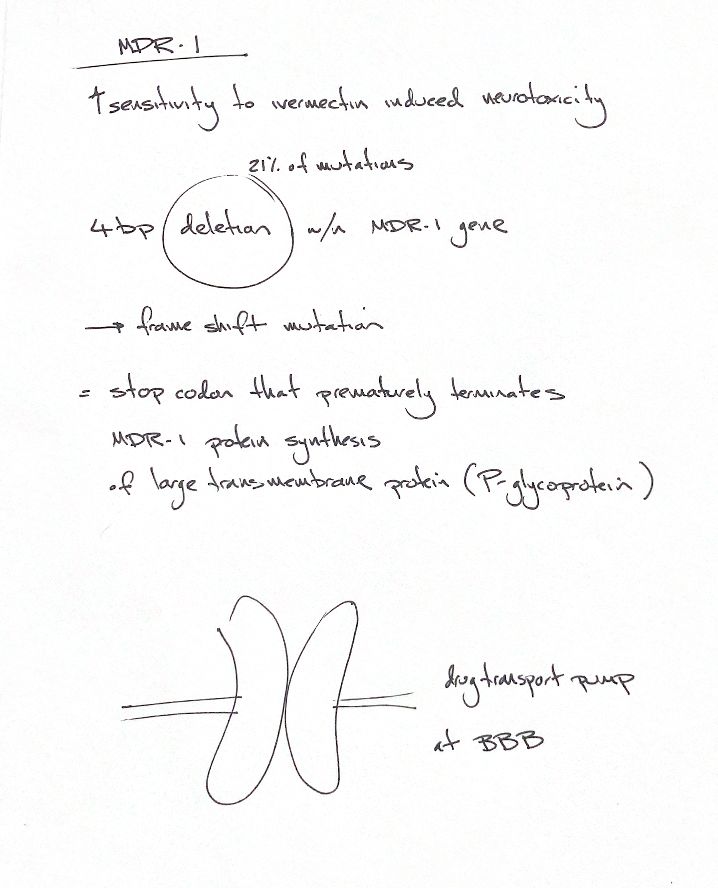
A subpopulation of Collies carries a four-base-pair deletion in ABCB1, the gene also called MDR1. Four missing bases shift the reading frame. A premature stop codon then cuts protein synthesis short. The result is a truncated, nonfunctional P-glycoprotein, or P-gp.
P-gp is a large membrane transport protein. At the blood–brain barrier, it pumps drug substrates out of endothelial cells and back towards the blood. This helps limit their entry into the brain. Loss of this efflux protection can increase brain exposure and ivermectin-induced neurotoxicity. The drawing shows a drug pump, not a tear in the barrier.
The classic ivermectin-sensitive phenotype was linked to two copies of the deletion. One copy can still affect responses to some drugs. For example, a canine vincristine study found greater haematologic toxicity in both heterozygous and homozygous dogs. Loperamide is another canine P-gp substrate. These examples do not have identical effects. Drug, formulation, exposure and genotype all matter, and breed alone does not establish an individual dog's genotype.
The “21%” beside deletion is a broad textbook mutation-class cue. It describes deletions among mutations linked to disease phenotypes, rather than the percentage of Collies with MDR1. The exact dataset behind that historical figure remains unclear. It should not be used as a canine prevalence estimate.
References
Johnston/Tobias, 2nd ed., Chs. 2 and 29; Mealey et al. 2001, 2008; UC Davis VGL; WSU.