
Surgical-site infection: location, procedure class and risk
Read the draft explanation
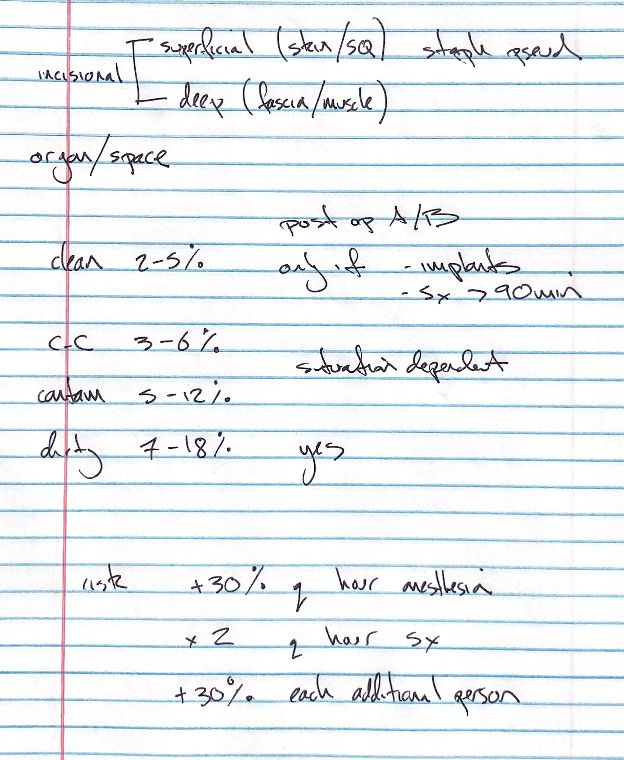
First locate the infection. Superficial incisional SSI affects skin and subcutaneous tissue. Deep SSI affects fascia or muscle. Organ/space SSI involves a site beyond the incision that was opened or manipulated during surgery. Inflammation alone does not establish SSI. A positive culture needs clinical and sampling context. My S. aureus cue needs context: the book identifies S. pseudintermedius as the main SSI pathogen in dogs.
My original class ranges are clean 2–5%, clean-contaminated 3–6%, contaminated 5–12% and dirty 7–18%. Their exact combined source is unverified. Different studies use different procedures and outcomes. These are recall ranges, not pooled estimates or a patient’s predicted risk.
The original risk cues are +30% per hour of anaesthesia, ×2 per hour of surgery and +30% per extra person. Longer time is associated with SSI, but these are not universal causal multipliers. The exact anaesthesia estimate remains unverified. Eugster’s adjusted personnel odds ratio was 1.30 (95% CI 1.03–1.64). Odds are not absolute risk or percentage points.
My “post-op A/B” column says implants or surgery >90 minutes for clean cases, situation dependent for clean-contaminated cases and yes for dirty cases. The contaminated cell is blank. Do not read this as an automatic postoperative course. Perioperative cover and intraoperative redosing are separate decisions. ENOVAT defines postoperative prophylaxis as continuing beyond 24 hours. Its guidance recommends against postoperative prophylaxis for clean implant orthopaedics; TPLO has a conditional recommendation against it. Contaminated or infected wounds need individual assessment.
References
Johnston/Tobias, 2nd ed., Ch 10; Beal 2000; Eugster 2004; ENOVAT 2025 guidelines (2026 issue). Figures retain the original source limits.