
Trazodone
Read the draft explanation
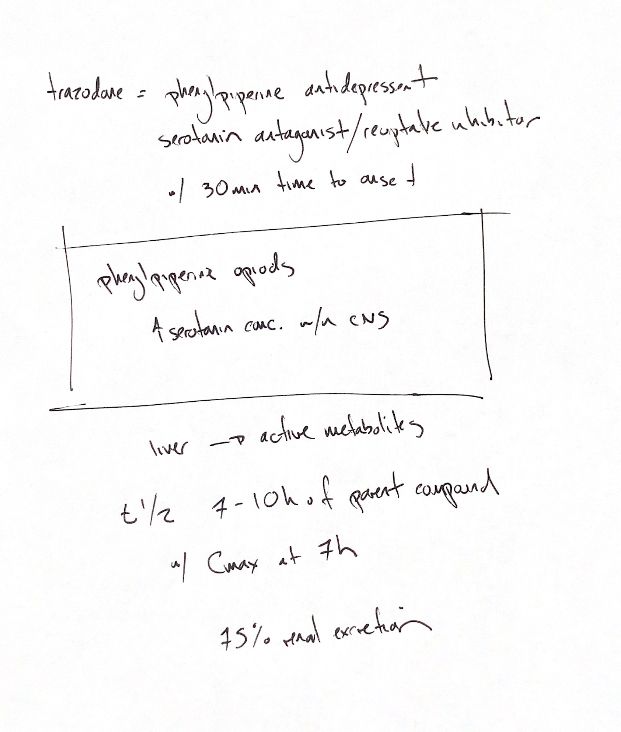
Trazodone is a phenylpiperazine antidepressant. The opioid label in my original box is incorrect. In dogs, trazodone is used for anxiolysis and can cause sedation.
It is a serotonin antagonist and reuptake inhibitor, or SARI. It blocks 5-HT2A receptors and slows neuronal serotonin reuptake. This leaves more serotonin available at synapses. These actions do not fully explain every clinical effect.
The original onset cue is about 30 minutes. Thirty-six dogs completed an open-label study after orthopaedic surgery. In the final owner survey, median onset was 31–45 minutes and median duration was at least four hours. The doses and schedule changed during recovery, so these are study observations, not fixed times for every dog.
Keep onset separate from peak plasma concentration, Cmax. Tmax means the time to that peak. In six adult Beagles given one oral 8 mg/kg study dose, mean Tmax was 445 ± 271 minutes, about 7.4 hours. This supports the book's seven-hour cue, with wide variation.
The original parent-drug half-life of 4–10 hours has no species label. It is not a verified canine rule. In the same Beagle study, oral elimination half-life was 166 ± 47 minutes, about 2.8 hours. Half-life and duration of calming are different measures.
The liver forms metabolites. Human liver studies identify the active metabolite mCPP and CYP3A4 involvement; this does not establish the same enzyme contribution in dogs.
The original 75% renal-excretion cue also needs context. A human tracer study recovered 70–75% of radioactivity in urine within 72 hours, mainly as metabolites. The human label reports less than 1% unchanged trazodone in urine. This is not 75% unchanged-drug renal clearance in dogs.
References
Johnston/Tobias, 2nd ed., Chapter 21; Jay et al. 2013; Gruen et al. 2014; Jauch et al. 1976; human product labels.