TPLO, lateral suture, or both?
This page compares TPLO with a standalone lateral suture and explains why I may recommend TPLO plus lateral extracapsular support for a selected knee. The recommendation reflects the dog's anatomy, instability, activity, other orthopedic problems, and recovery needs.
TPLO is my usual recommendation for canine cruciate disease
For cats or selected small dogs, I may recommend extracapsular stabilization, such as a lateral suture or brace, when TPLO is not appropriate or after an individual discussion with the owner.
Lateral extracapsular support can also be added to a TPLO when repeated examination identifies important rotational instability. It is not a routine addition to every TPLO.
What each operation physically changes
Both approaches require careful patient selection and controlled recovery. TPLO involves a planned bone cut that must heal. A lateral suture stabilizes the knee without changing the slope of the tibial plateau.
TPLO
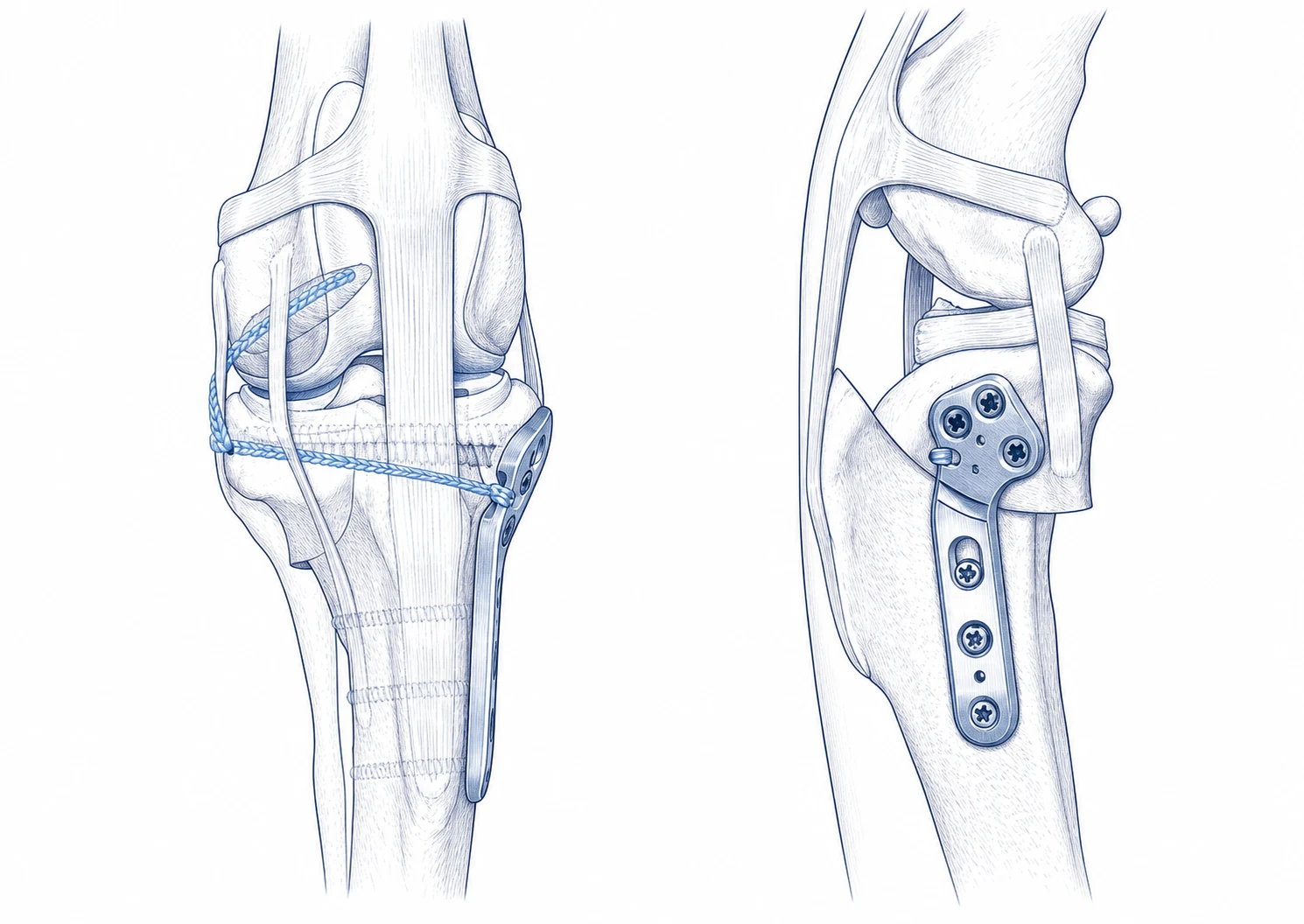
A curved cut is made in the upper tibia. The tibial plateau is rotated and held with a plate and screws to reduce the forward sliding force that occurs when the dog bears weight.
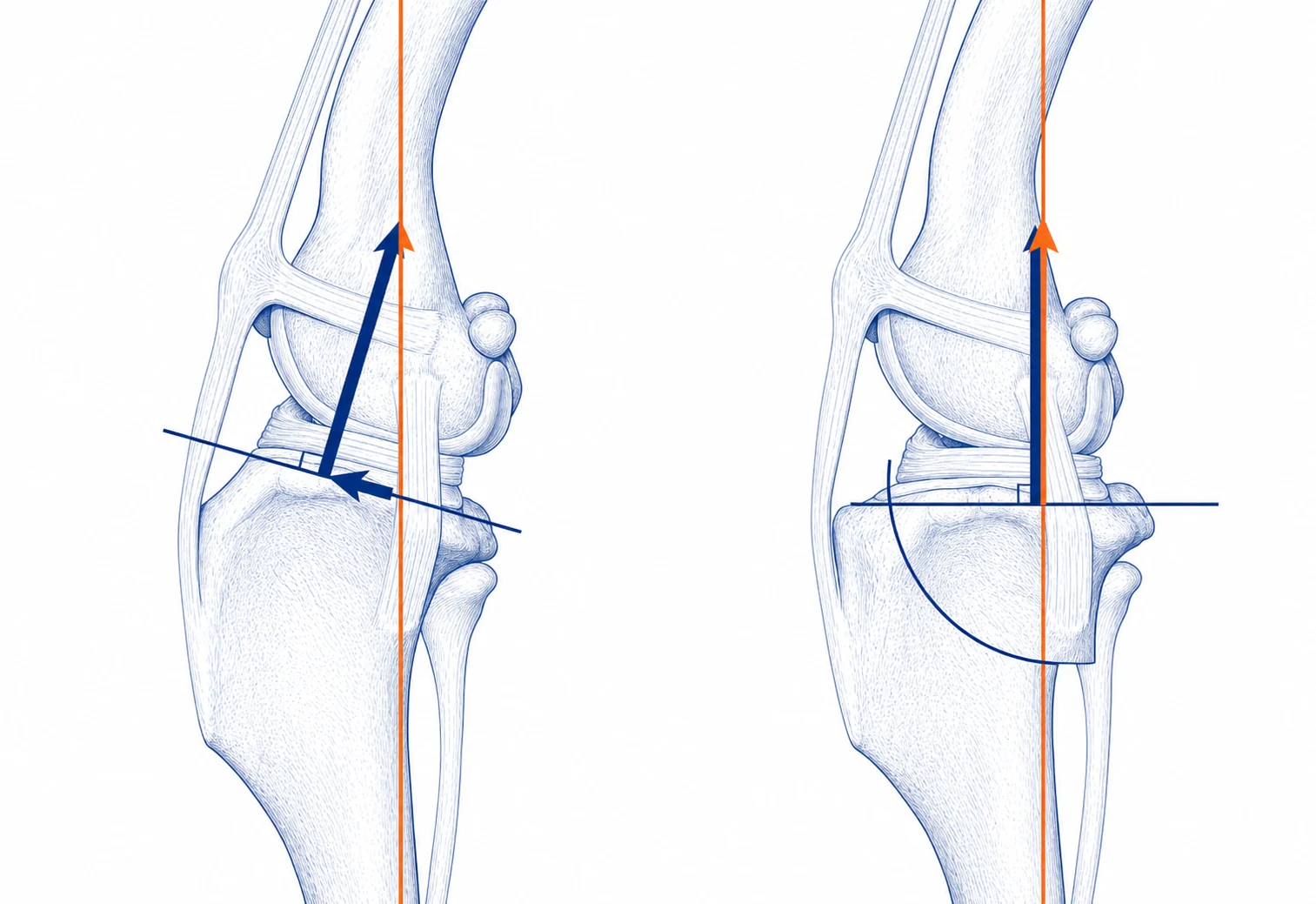
- Bone cut
- Yes
- Implants
- Plate and screws
- Healing focus
- Protect the bone while it heals
- Typical role
- Usual recommendation for canine cruciate disease
Lateral suture
Strong material is placed outside the joint to limit abnormal motion. The repair is protected while supportive scar tissue develops around the knee.
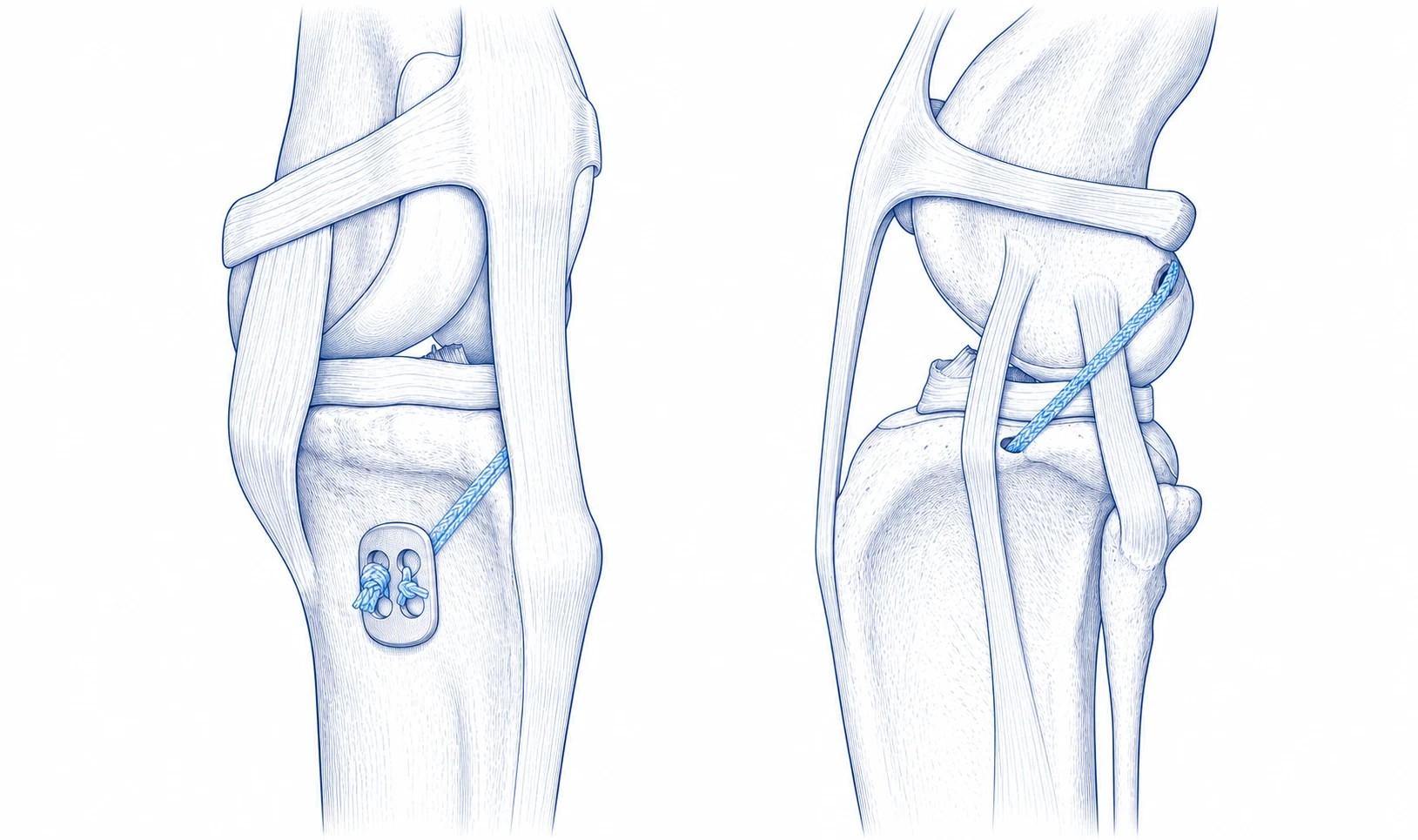
- Bone cut
- No
- Implants
- Extracapsular suture or brace
- Healing focus
- Protect the repair while supportive scar tissue develops
- Typical role
- Cats or selected small dogs
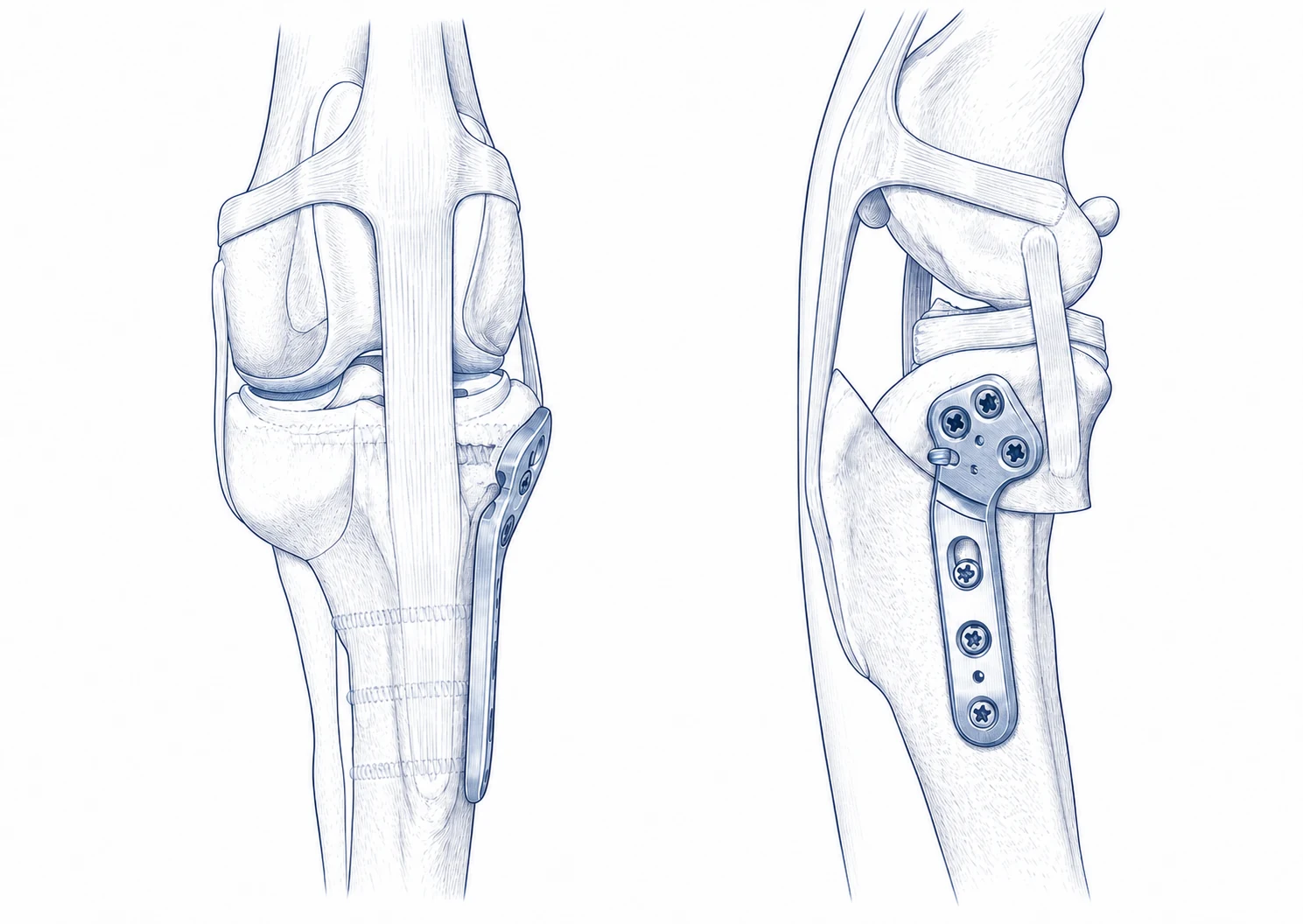
See TPLO and TPLO with added lateral support
What published studies show
Studies differ in their patients, outcome measures, and follow-up periods, so the results need context.
Read the TPLO and lateral-suture evidence
TPLO compared with lateral suture
In a randomized clinical trial, dogs improved after both operations. Objective measurements of how much weight dogs placed on the operated leg favoured TPLO at several follow-up points, while several other clinical measurements were not significantly different. A systematic review found stronger support for return to normal function after TPLO, but still did not establish one best operation for every patient.
Body weight is an important part of my decision. A separate retrospective general-practice study followed 370 extracapsular procedures. Depending on the technique, the predicted chance of needing repeated anti-inflammatory medication during the next 18 months was about 9% for dogs under 15 kg, compared with 37% to 39% for dogs weighing 15 kg or more. Weight and age also affected complications and medication use.
This was not a direct comparison with TPLO, and 15 kg is not a universal cutoff. However, the increased likelihood of ongoing medical management in heavier dogs is one reason I generally do not recommend a lateral suture for larger dogs and reserve it for cats or selected small dogs.
Why add a lateral suture to TPLO?
The cranial cruciate ligament runs diagonally across the knee joint. It helps control forward and backward movement as well as rotation.
TPLO is designed mainly to reduce the forward sliding force in the upper shin during weight bearing, often called cranial tibial thrust. During a specialist assessment, I look at both forward movement and rotation. Some knees can still twist abnormally after the forward movement has been reduced. This rotational instability is sometimes described as pivot shift.
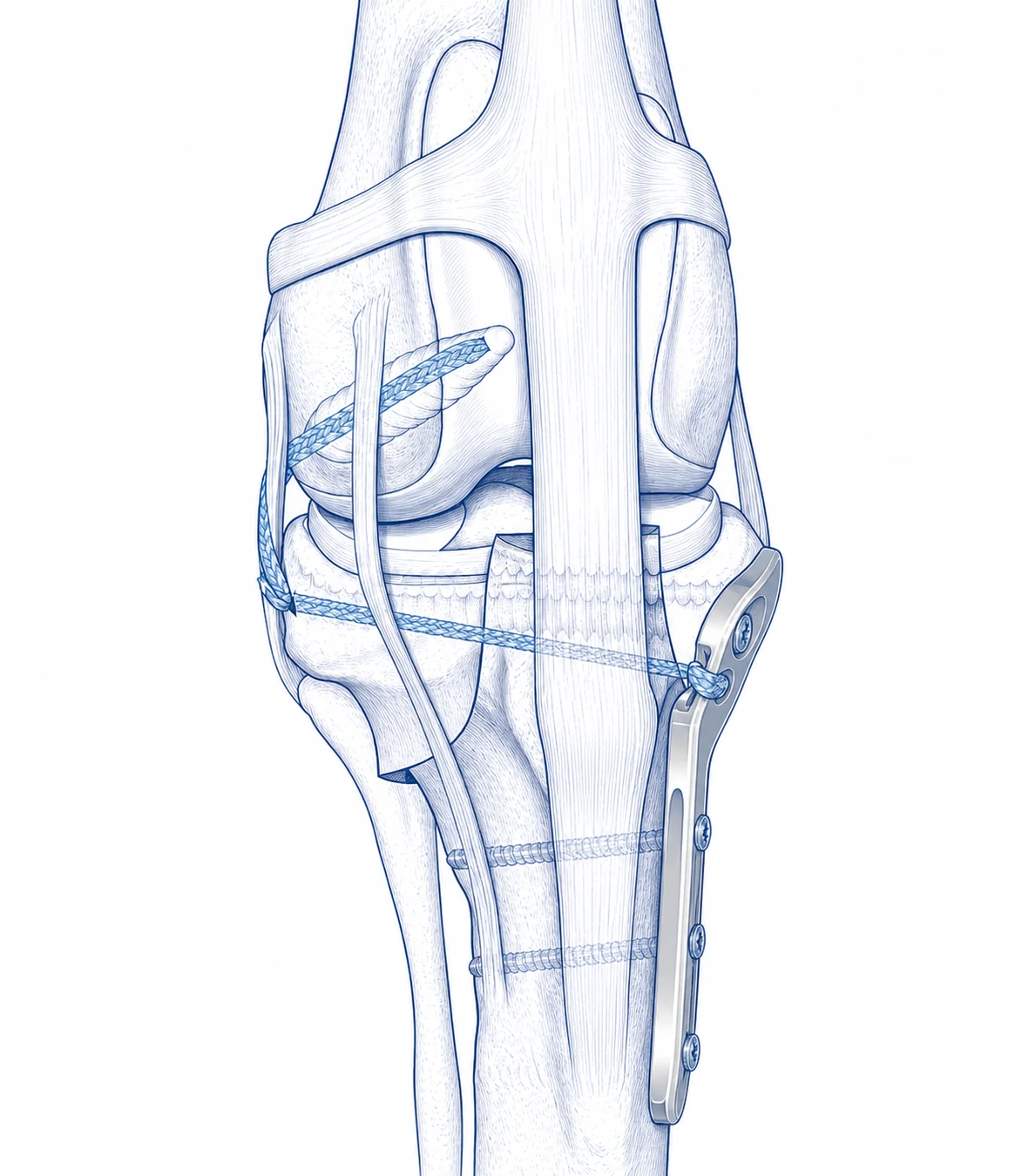
An extracapsular brace, sometimes called an internal brace, adds support outside the joint to help control that twisting movement. The anchor system I use is the Arthrex SwiveLock® system.
How the final brace decision is made
This pattern may be especially relevant in a very acute, complete cruciate tear, before the body has formed stabilizing scar tissue, called fibrosis, around the knee. Experimental evidence supports this as a model of a very loose knee, but it does not mean every acute tear needs a brace.
The decision is not made before surgery. The consultation, imaging, and earlier stability tests provide clues, but they do not predetermine whether a brace will be used. As with the meniscus assessment, the operative findings allow me to adjust the plan in real time.
Immediately after completing the TPLO, I test the knee again to determine how much rotational instability remains. This is when I make the final brace decision. The ability to interpret the findings and adjust the plan during surgery is part of a specialist surgical assessment.
The decision is not determined by breed or body weight alone, and an extracapsular brace is not a standard addition to every TPLO.
Why I preserve important muscle attachments
Preserving important muscle attachmentsWhy I preserve the pes anserinus
The pes anserinus is where several substantial hamstring and adductor muscle-tendon attachments join the inside of the upper shin bone. Preserving it keeps these important muscles attached to the tibia. In a human high tibial osteotomy paper, the pull from these attachments was separated into backward and upward force components. The authors proposed that these forces help compress and stabilize the bone cut, while releasing the attachment could allow the lower bone segment to rotate outward.
I preserve this attachment during TPLO rather than routinely releasing it for surgical exposure. This muscle-sparing approach is intended to retain the muscles' natural contribution to stability around the bone cut.
Important limit: this mechanical rationale is extrapolated from human knee surgery. It has not been proven to improve TPLO outcomes in dogs, and it does not replace an extracapsular brace when important pivot shift remains after TPLO.
See the difference between the two approachesWhen I assess rotational stability
I assess the knee's abnormal forward and rotational movement, including a tibial pivot compression test. This identifies the pattern but does not make the final brace decision.
I repeat the stability assessment under anesthesia. This is also when I inspect the meniscus through a mini arthrotomy, so both the stability findings and the condition of the meniscus can guide real-time adjustments to the plan.
After the joint and pes fascia have been closed and the TPLO has been completed, I test the knee again. This is when I make the final decision about adding an extracapsular brace.
Read the evidence behind the assessment
It does not always settle on its own
Persistent rotational instability after TPLO was uncommon in one retrospective study: it was identified after 15 of 476 procedures, or 3.1%.
However, when pivot shift did occur, it did not always resolve by itself. A later study reported that it disappeared over four to six months in only four of 14 affected dogs.
This does not mean every dog needs an extracapsular brace. It explains why I test for pivot shift after completing the TPLO rather than assuming that any remaining rotational instability will settle on its own.
The pivot test looks beyond tibial thrust
The standard tibial compression test, often called the tibial thrust test, mainly asks whether loading the knee causes the upper shin bone to move abnormally forward.
The tibial pivot compression test is not another name for the tibial thrust test. I perform it by adding external rotation and sideways pressure, called valgus stress, before applying compression. This assesses whether the knee moves forward and rotates at the same time.
In the first ten-limb laboratory study, the pivot test produced the greatest forward movement and internal rotation among the three tests examined.
In a second ten-limb study, knees treated with TPLO alone, without an extracapsular brace, appeared stable during the standard tibial-thrust test. Under deliberate pivot testing, however, they showed approximately six times more forward movement than intact knees. Adding the brace reduced this movement by approximately fourfold and returned the tested mechanics closer to the intact knee.
During the same pivot test, knees after TPLO alone rotated an average of 27 degrees. This was about 72% more than intact knees at 15.7 degrees. Adding the brace reduced that rotation by approximately 55% and returned it close to the intact range.
This is why I do not assess a TPLO only by confirming that the usual tibial thrust has been controlled. I also assess coupled forward and rotational instability before deciding whether a selected knee needs additional support.
Important limit: these findings came from deliberate rotational loading of ten cadaver limbs in each study. They do not describe normal walking, prove that every living dog has this movement after TPLO, or mean that every TPLO needs an extracapsular brace.
How the brace is intended to mimic ligament function
Parts of the normal cruciate ligament are close to isometric: their attachment points remain almost the same distance apart as the knee bends and straightens. Research has also identified corresponding isometric regions on the outside of the knee. The extracapsular brace is anchored at these external points so it follows a similar length pattern and can mimic part of the ligament's stabilizing action from outside the joint.
A 2025 retrospective study examined 39 dogs and 46 knees treated with TPLO plus an extracapsular brace. These were selected knees in which pivot shift remained after TPLO. They were not routine TPLO patients.
Thirty-three knees returned for examination at six weeks. Pivot-shift severity improved in 30 of 33 knees (90.9%), no pivot shift could be detected in 23 of 33 knees (69.7%), and lameness improved in 32 of 33 knees (96.7%).
Important limit: there was no TPLO-only control group. Only 33 of 46 knees had the six-week assessment, and the same surgeon who performed the operations assessed the dogs without blinding. Scar-tissue formation may also have contributed to the improvement. The study cannot prove that the brace caused the clinical improvement or that every TPLO benefits from one.
What I consider before recommending surgery
See all treatment-selection factors
- Body weight, body condition, age, activity level, and the home recovery environment.
- Whether the knee mainly moves forward, rotates abnormally, or has both forms of instability.
- How the stability changes after completing the TPLO. I repeat both the standard tibial-thrust assessment and the pivot-compression assessment rather than assuming the bone correction has addressed movement in every direction.
- Whether the cruciate tear appears acute or chronic and whether stabilizing scar tissue has developed around the knee.
- The tibial plateau angle and other features of the bone anatomy assessed during virtual surgical planning.
- The condition of the meniscus and whether patellar luxation, hip disease, or another orthopedic problem is also present.
- The owner's priorities, recovery constraints, and the relative advantages and limitations of each appropriate option.
TPLO is my usual recommendation for canine cruciate disease. A standalone extracapsular brace is generally reserved for cats or selected small dogs. An extracapsular brace may also be added to TPLO when the post-TPLO assessment identifies important residual rotational instability.
Clear answers about surgical options
Does every TPLO need a lateral suture or extracapsular brace?
No. Added lateral support is not a routine part of every TPLO. It is considered for selected knees when testing after TPLO identifies important remaining rotational instability.
Are a lateral suture, internal brace, and extracapsular brace the same thing?
The terms are sometimes used interchangeably, but they do not always describe exactly the same construct. The material, attachment points, intended role, and whether the brace is used alone or added to TPLO can differ.
How is the final brace decision made?
The consultation and preoperative examination provide clues, but the decision is not made before surgery. I assess stability at the start of surgery and again after completing the TPLO. The final decision is based on the amount of forward and rotational instability that remains.
Does my dog's size change which cruciate surgery is usually recommended?
Yes, size and body weight are important parts of the recommendation, but there is no single weight that decides the operation. TPLO is usually my recommendation for canine cruciate disease. A standalone extracapsular brace is generally reserved for cats or selected small dogs, while the final plan also considers age, activity, anatomy, other knee problems, and the home recovery environment.
Review TPLO planning, recovery, and current Ottawa pricing
The TPLO cornerstone explains the consultation, virtual planning, meniscus assessment, surgery-day care, and referral pathway.
Sources used for this guide
View the evidence sources
- American College of Veterinary Surgeons: Cranial Cruciate Ligament Disease
- Bergh et al.: systematic review of surgical treatments for canine CCL disease
- Gordon-Evans et al.: randomized comparison of TPLO and lateral fabellar suture
- Franklin et al.: weight, complications, and anti-inflammatory use after extracapsular stabilization
- Gatineau et al.: postoperative pivot shift after TPLO
- Lampart et al.: experimental evaluation of the tibial pivot compression test
- Husi et al.: biomechanical TPLO and TPLO-plus-augmentation comparison
- Wylie et al.: internal-brace placement and pivot-shift follow-up after TPLO
- Nakamura et al.: pes-preserving human high tibial osteotomy and proposed force components
- Yilmaz et al.: human high tibial osteotomy outcomes with and without pes release
- Arthrex Vet Systems: TPLO plate surgical technique with InternalBrace ligament augmentation
- Arthrex Vet Systems: TPLO InternalBrace augmentation using a SwiveLock anchor