
Temporary occlusion times
Read the draft explanation
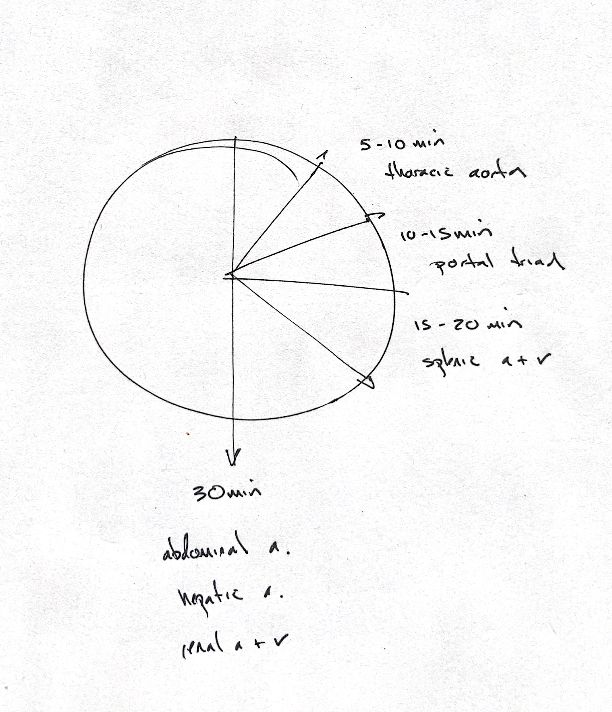
This clock groups the suggested temporary occlusion times for normothermic animals. All six vessel-time pairs in my drawing match Box 18.2 in the supplied textbook.
Start at the upper right: 5–10 minutes for the descending thoracic aorta. Next comes 10–15 minutes for the portal triad, or Pringle manoeuvre. Then 15–20 minutes for the splenic artery and vein.
The downward 30-minute group contains three entries: the abdominal aorta, the hepatic artery, and the renal artery and vein. Keep each artery-and-vein pair together.
The Pringle manoeuvre involves the hepatic artery, portal vein and common bile duct. It interrupts hepatic arterial and portal venous inflow together. That differs from occluding the hepatic artery alone, which sits in the separate 30-minute group.
These are suggested study-note values, not a safe countdown for every dog or cat. The chapter explains that much of the evidence comes from historical experimental work. The exact limits have not all been checked in their original full papers, so they remain textbook-supported recall cues.
Keep the original conditions in mind: temporary occlusion and normal body temperature. Do not apply these numbers to permanent ligation or assume that they define tolerance during hypothermia. Bleeding can return when flow is restored, and reperfusion can also cause systemic problems.
References
Johnston/Tobias, 2nd ed., Chapter 18, Box 18.2 and context. Owning reference: Herold et al. 2008 review; full-text access limits are recorded with the source checkpoint.