
Mechanical, active and sealant topical agents
Read the draft explanation
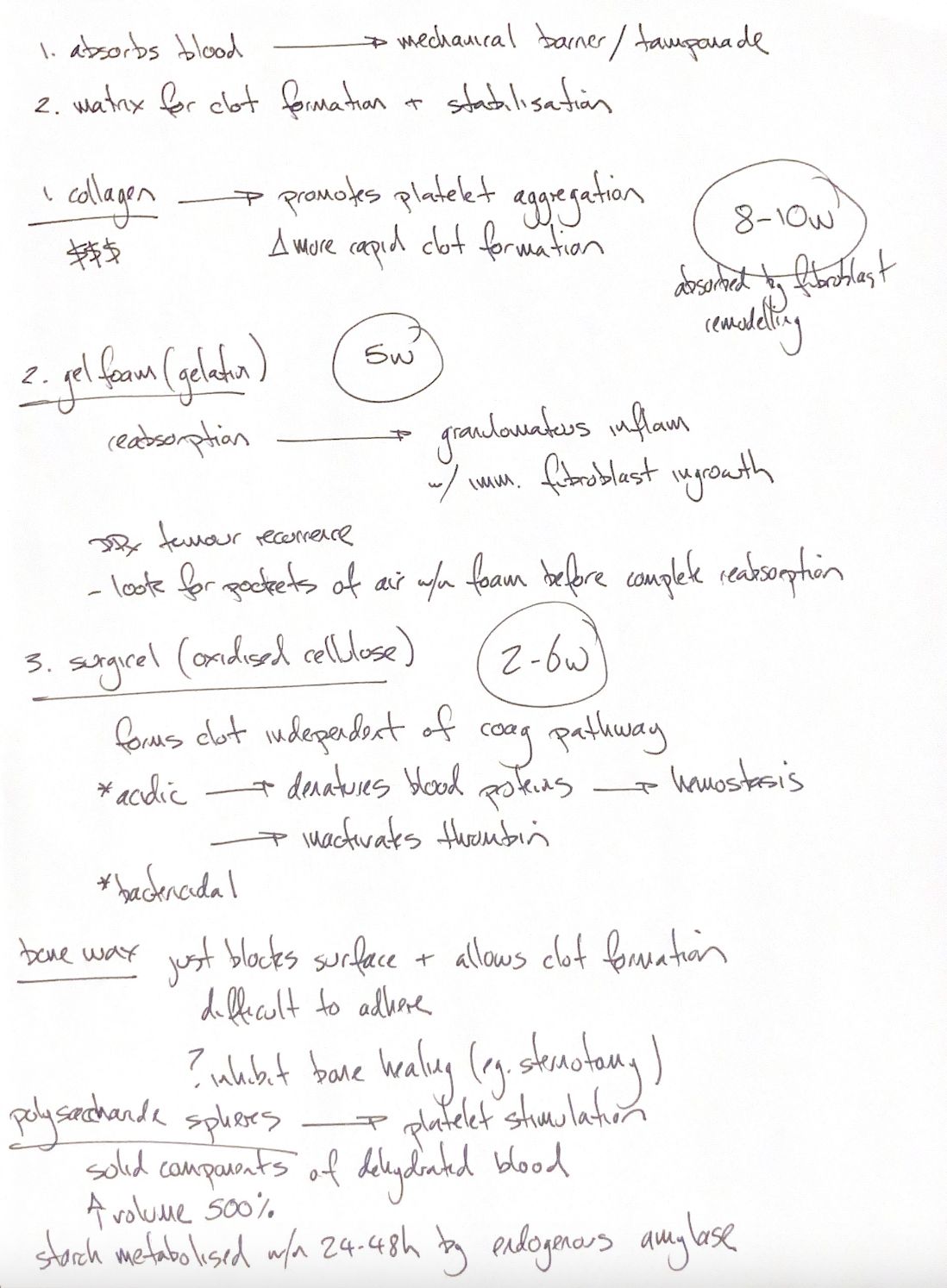
Mechanical agents absorb blood and support a clot. Collagen also promotes platelet aggregation. The collagen > gelatin > cellulose ranking is a laboratory memory cue; formulation changes the order.
My absorption cues are collagen 8–10 weeks, Gelfoam about 5 weeks and Surgicel 2–6 weeks. They are book approximations. Product, amount and site matter. Current Surgicel Original/Fibrillar information gives 7–14 days. Retained gelatin foam may mimic tumour on imaging. Air pockets can help interpretation, but do not rule out tumour or infection.
Bone wax plugs bleeding bone and can inhibit bone healing. Starch particles draw water from blood and concentrate its solid components. Amylases break down starch; 24–48 hours is a product-dependent cue. The original “500%” swelling cue has an unclear denominator. Arista AH describes about five times the starting volume.
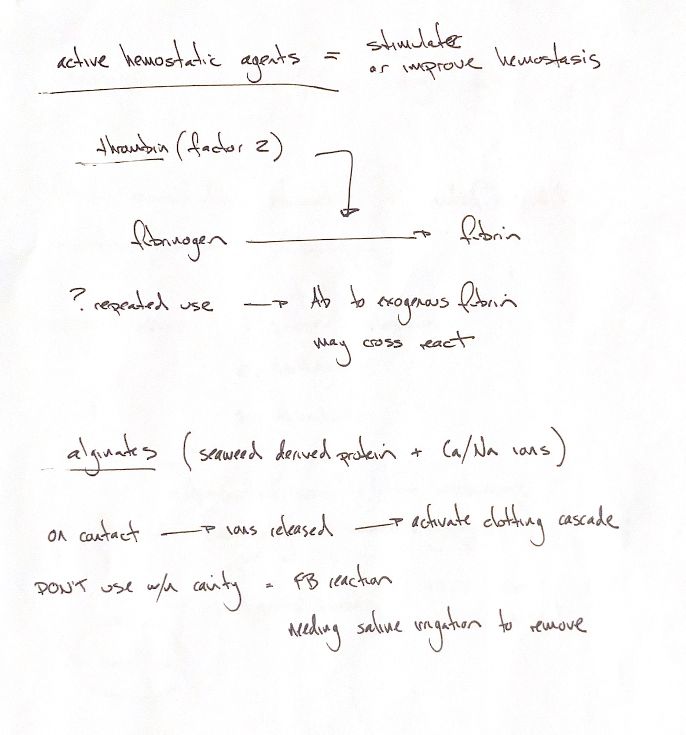
Active thrombin is factor IIa, not II. It converts fibrinogen to fibrin. Repeat exposure raises product-specific antibody concerns about thrombin-product proteins, not fibrin. Alginate is a seaweed polysaccharide, not a protein. Calcium release can support clotting. An external wound cavity differs from the abdomen or thorax, where these dressings should not be left. Saline can help dressing removal.
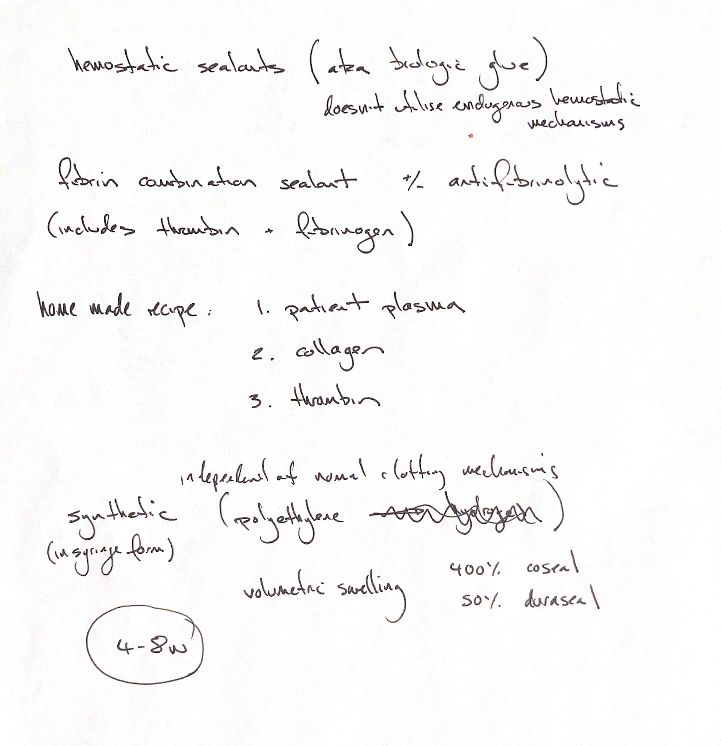
Fibrin sealants supply thrombin and fibrinogen, sometimes with an antifibrinolytic. The autologous plasma, collagen and thrombin concept still needs adequate plasma fibrinogen.
PEG sealants need separate product checks. COSEAL may reach four times its starting volume within 24 hours, with further swelling during resorption. Classic DuraSeal may swell up to 50% in any direction; that is not a volume percentage. Its approximate absorption is 4–8 weeks. It supports sutured dural closure after haemostasis. These human device data are not universal veterinary rules, and DuraSeal formulations differ.
References
Johnston/Tobias, 2nd ed., Ch. 18; Wagner 1996; product information.