
Direct pressure and tourniquets
Read the draft explanation
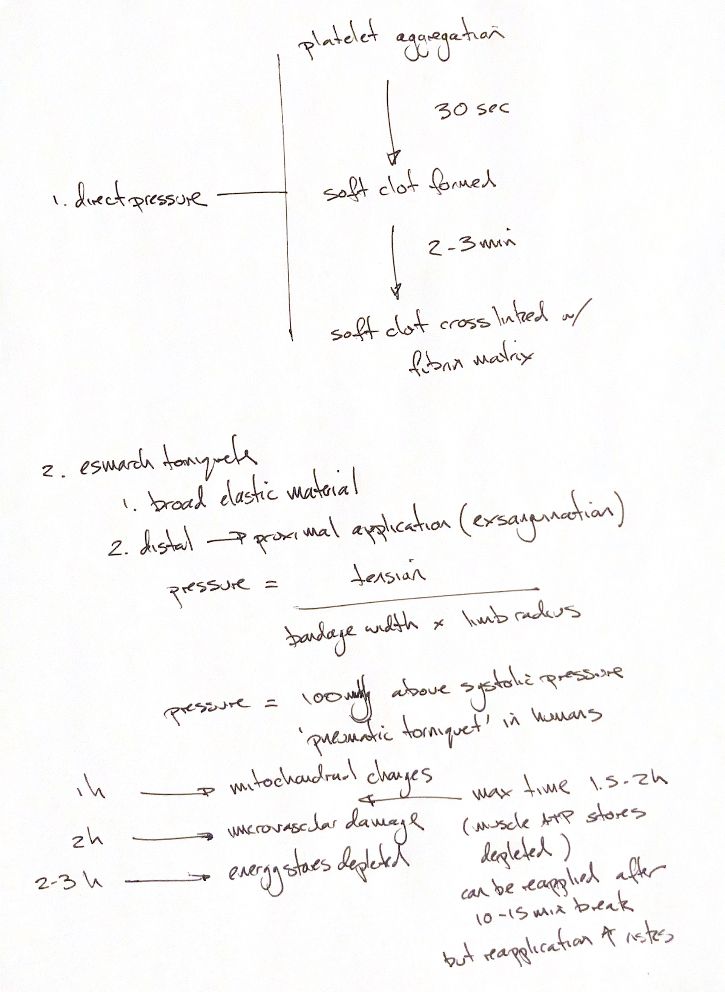
Pressure buys time for clot formation. The note gives about 30 seconds for platelet aggregation to form a soft clot, then a further 2–3 minutes for a stabilising fibrin matrix. Minor bleeding may stop with 2–3 minutes of gentle pressure. The vessel, blood pressure and coagulation status change what is needed. Severe bleeding still needs definitive control, and lifting a sponge can dislodge the clot.
An Esmarch bandage is broad and elastic. A distal-to-proximal wrap pushes blood out of the limb: exsanguination. The book describes securing it proximally as a tourniquet. An older veterinary review instead recommends using it for exsanguination only, with a pneumatic cuff for occlusion. Those descriptions differ.
The note's pressure model is P = T/(W × R): tension divided by bandage width and limb radius. In SI units, tension is in N, width and radius in m, and pressure in Pa. At the same tension, a narrower bandage or smaller limb gives higher pressure. This model does not verify the pressure applied by a real wrap.
The source's pneumatic-cuff figure of about 100 mmHg above systolic pressure is human practice, not a universal dog or cat setting.
The human-review figures give mitochondrial changes after 1 hour, microvascular injury after 2 hours, and depleted energy stores at 2–3 hours. The 1.5–2-hour healthy-adult human cue is linked to muscle ATP depletion. These are source teaching figures, not a proven safe window for every limb. The book says safe limb-ischaemia duration in dogs and cats is not established.
It describes a possible 10–15-minute release before reapplication, while warning that reapplication raises reperfusion and prolonged-ischaemia risks. Trauma or sepsis can reduce tolerance. Exsanguination is not recommended with malignant neoplasia or infection. Record time and monitor; a break does not reset the risk.
References
Johnston/Tobias, 2nd ed., Chapter 18; Blass & Moore 1984. Access limits accompany the lesson.