
Methods of operative bleeding control
Read the draft explanation
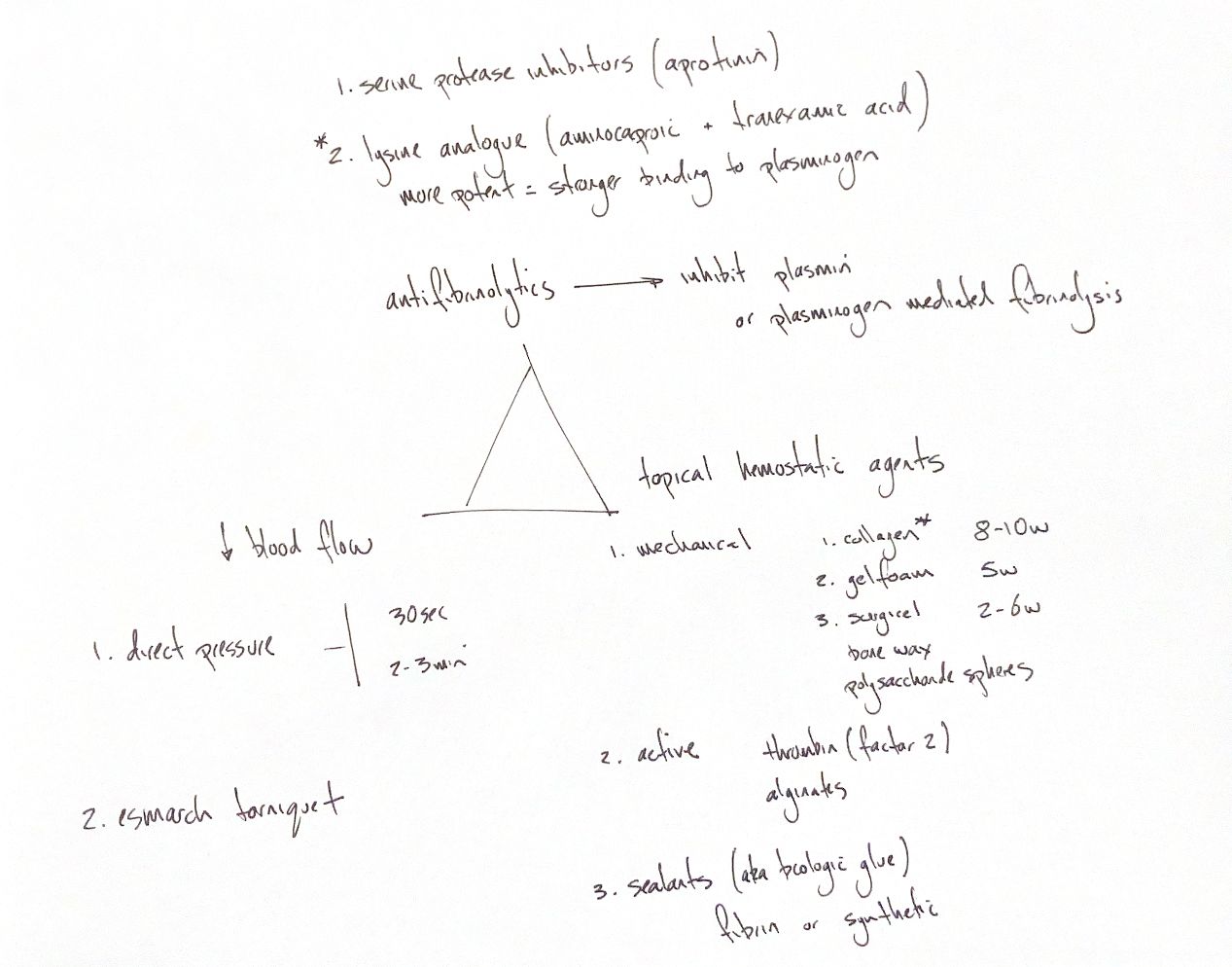
Think of three approaches: reduce blood flow, add a topical haemostat, or slow fibrin breakdown.
Pressure gives the clot time to build. The book describes about 30 seconds for a soft platelet plug, then a further 2–3 minutes for fibrin crosslinking. These are approximate biological times, not a guarantee that bleeding has stopped. An Esmarch wrap pushes blood out from distal to proximal. Occlusion needs its own plan. Ischaemia and bleeding after release still matter.
Mechanical agents provide a barrier or clot matrix. My source lists collagen at 8–10 weeks, Gelfoam at about 5 weeks and Surgicel at 2–6 weeks for absorption, plus bone wax and polysaccharide spheres. These are book recall ranges, not fixed canine or feline timelines. Gelfoam's label gives 4–6 weeks in soft tissue; Surgicel manufacturer literature also gives 7–14 days. Product, amount and tissue site affect absorption. Traditional bone wax is nonabsorbable.
Active agents include thrombin and alginate dressings. Thrombin is active factor IIa; factor II is prothrombin. It turns endogenous fibrinogen into fibrin. Sealants act like glue. Fibrin sealants supply fibrinogen and thrombin; synthetic sealants seal tissue without depending on the normal clotting cascade.
Antifibrinolytics preserve the clot. Aprotinin inhibits serine proteases. The starred lysine analogues are epsilon-aminocaproic acid and tranexamic acid. They block plasminogen binding to fibrin. My note/book links stronger binding with greater potency, but that is not a reliable blanket ranking over aprotinin. Potency depends on the drug, assay and endpoint.
These methods support careful surgical haemostasis. Much of the chapter's product evidence comes from people or experiments.
References
Johnston/Tobias, 2nd ed., Chapter 18; Pfizer GELFOAM; Ethicon SURGICEL.