
Transfusion compatibility and adverse reactions
Read the draft explanation
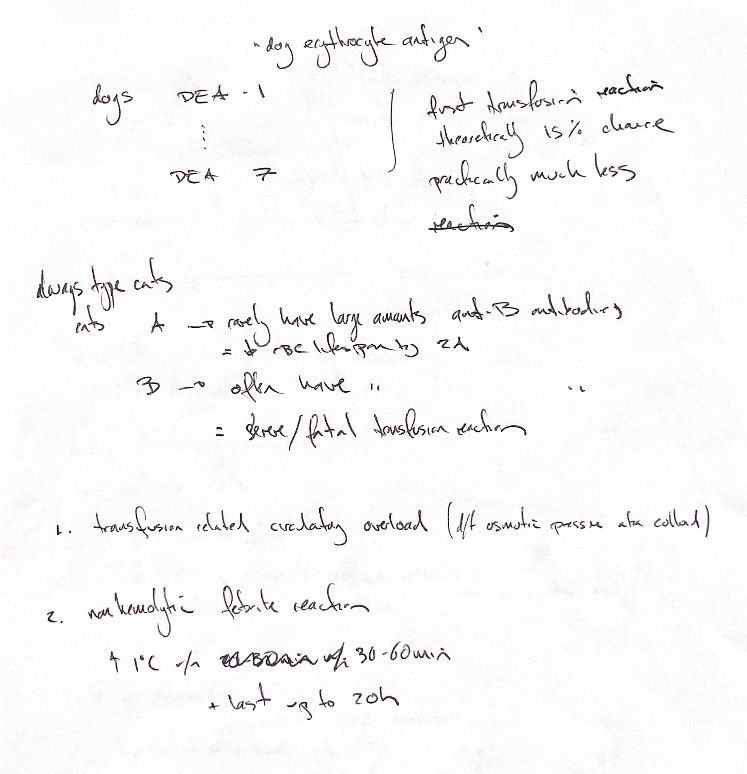
In dogs, DEA means dog erythrocyte antigen. The original “DEA 1…7” is a memory cue, not a complete blood-group list. Type both donor and recipient, including before the first transfusion. DEA 1-negative recipients need DEA 1-negative red cells. DEA 1-negative red cells can go to DEA 1-positive recipients. The book’s theoretical 15% first-transfusion reaction cue is not a measured clinical risk. A first transfusion can still cause other reactions and may sensitise the dog. Crossmatching depends on history, urgency and method; TRACS recommends it if the dog was transfused more than four days earlier.
Cats can have naturally occurring antibodies. Type B cats often have strong anti-A, so type A donor blood given to a type B recipient can cause severe, potentially fatal haemolysis. Type A cats usually have lower anti-B, but B donor blood is still incompatible. Type both cats and crossmatch where possible. Type AB also exists, and AB matching does not rule out other incompatibilities.
TACO is volume overload with hydrostatic pulmonary oedema and breathing difficulty. Oncotic pull can add to volume loading. TRACS places it during or within six hours of transfusion. Timing alone does not diagnose it. Stop the transfusion and assess the patient promptly if a reaction is suspected.
The older fever cue is a rise of at least 1°C within 30–60 minutes, lasting up to 20 hours, with other causes excluded. TRACS defines FNHTR as temperature over 39°C AND a rise over 1°C from baseline, during transfusion or within four hours of its END. Rule out external warming, underlying infection, haemolysis, acute lung injury and transfusion-transmitted infection. Fever alone is not enough.
References
Johnston & Tobias, Veterinary Surgery: Small Animal, 2nd ed., Ch. 5; AVHTM TRACS 2021, Parts 1–2.