
CVP and dynamic volume response
Read the draft explanation
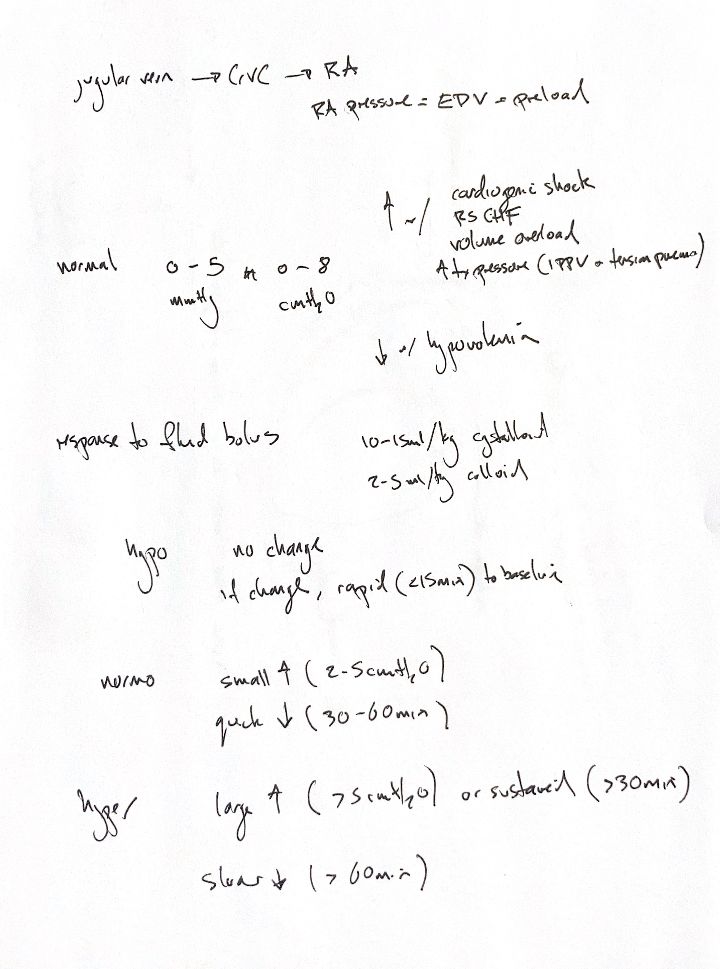
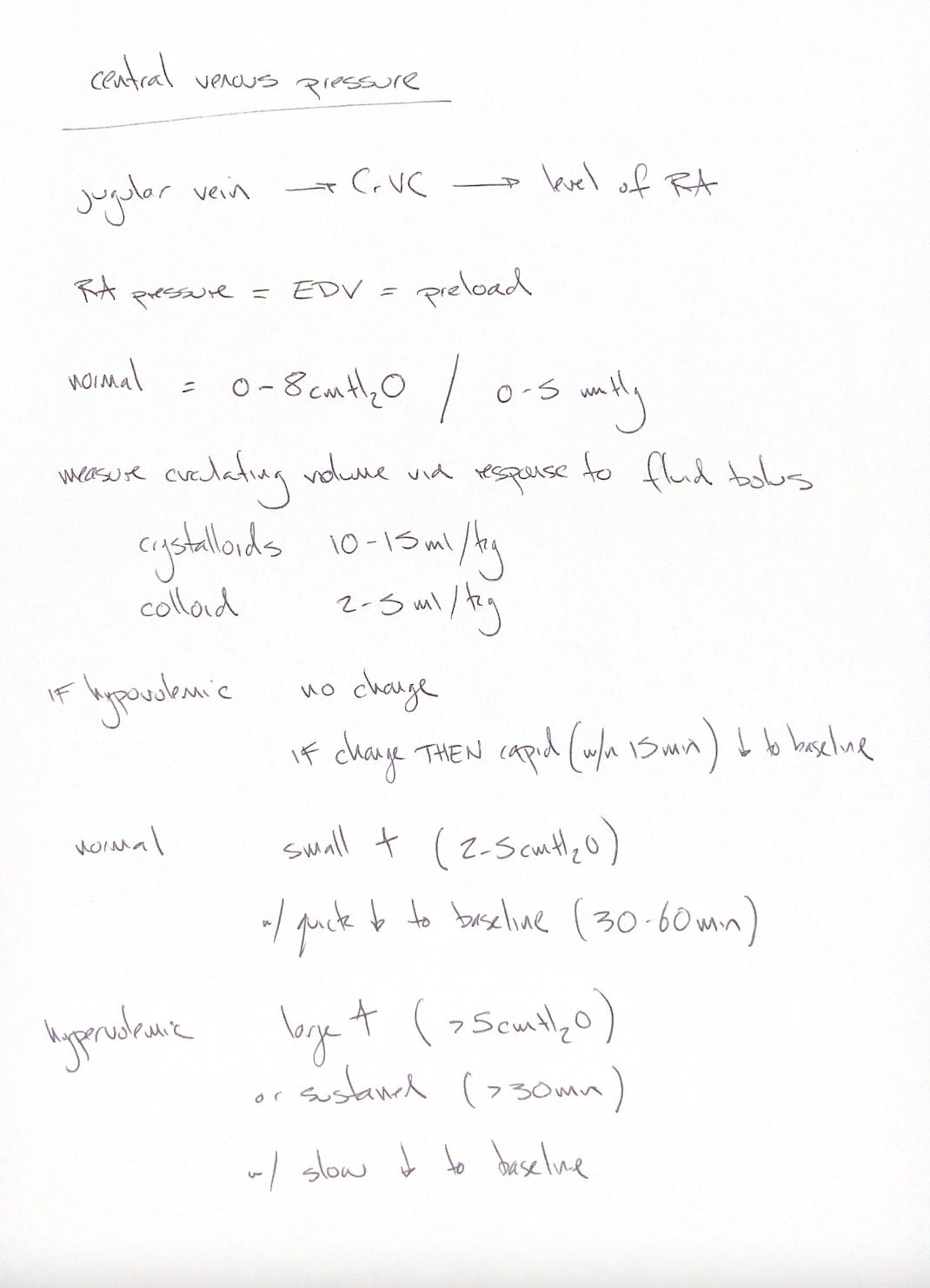
Central venous pressure (CVP) measures pressure near the right atrium. It relates to right-heart filling, but pressure is not end-diastolic volume. Compliance and pressure around the heart affect that link. CVP alone cannot tell us whether more fluid will raise stroke volume.
Keep the units attached. My notes give 0–5 mmHg or 0–8 cmH₂O. Johnston/Tobias gives a physiologic range of 0–5 cmH₂O in dogs and cats. These ranges differ; they are not precise unit conversions.
The challenge curves are historical teaching patterns. The notes describe little change or a brief rise with hypovolaemia, a small rise with euvolaemia, and a larger, lasting rise with hypervolaemia. Their euvolaemic return time is 30–60 minutes; the book says within 15 minutes. The colloid challenge doses also differ. Neither version is a universal fluid protocol. Current AAHA guidance favours avoiding synthetic colloids when alternatives work.
A sustained rise calls for reassessment. Volume load, right-heart dysfunction and raised intrathoracic pressure can all raise CVP. Positive-pressure ventilation and tension pneumothorax are examples of the last mechanism. A single reading cannot diagnose overload or rule out hypovolaemia. Check perfusion, cardiac function and congestion together.
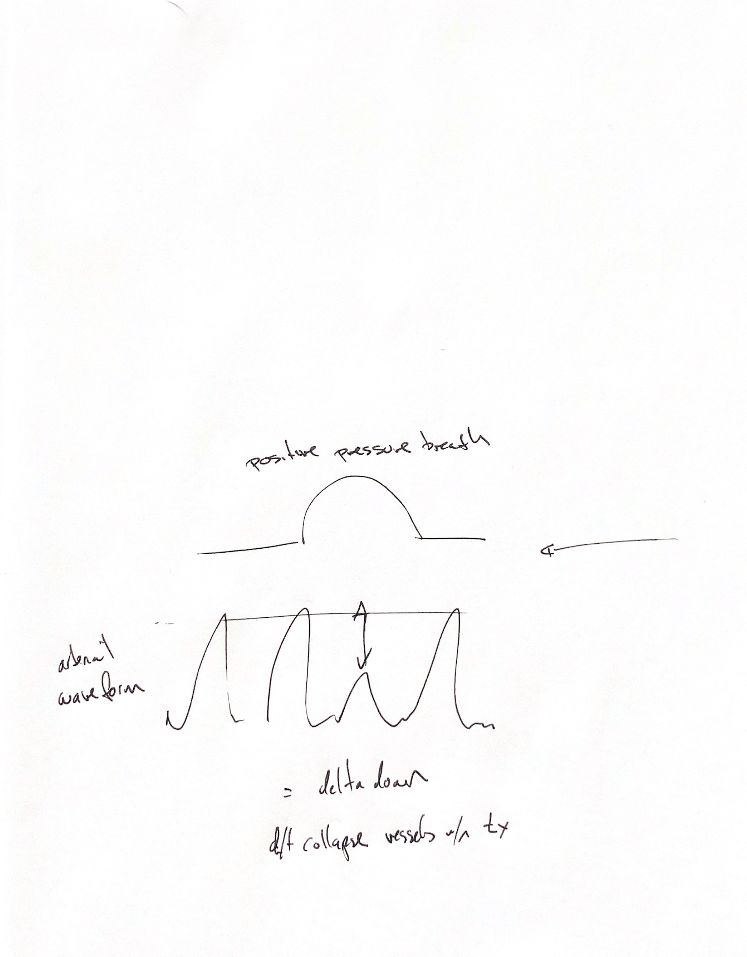
The last drawing shows delta down: the fall from an apnoeic systolic reference to the lowest systolic peak after a positive-pressure breath. This is part of systolic pressure variation, not pulse-pressure variation. Heart–lung interactions change filling and stroke volume. These tests need suitable controlled ventilation; settings and patient condition affect the result. No universal cutoff is shown.
References
Johnston/Tobias, 2nd ed.; Perel 1987 (indexed abstract); Endo 2017; AAHA 2024.