
Resuscitation boluses and endpoints
Read the draft explanation
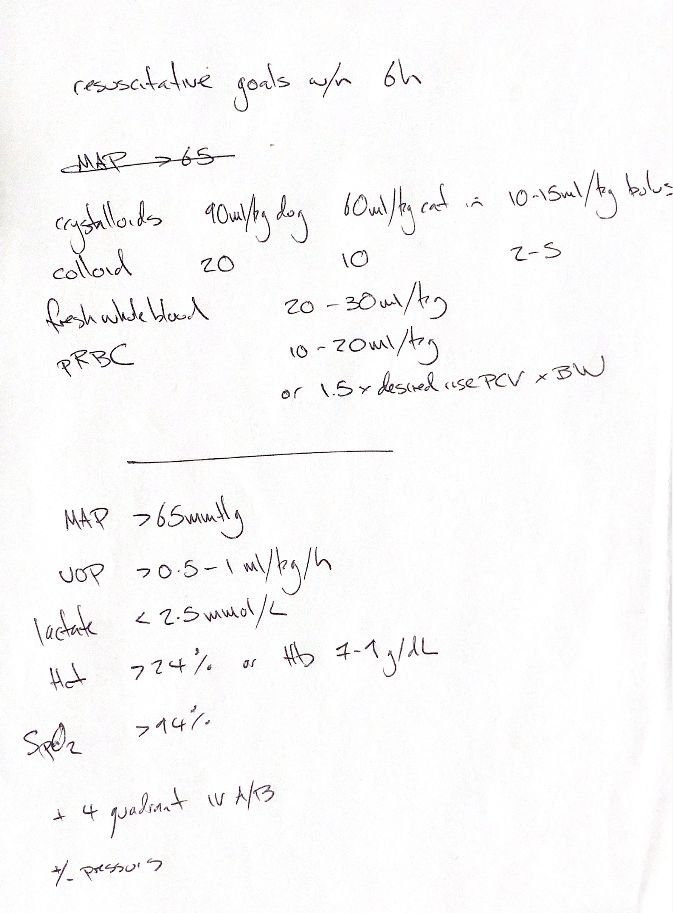
Keep total shock-volume cues separate from each aliquot. My crystalloid totals are 90 mL/kg for dogs and 60 for cats, with 10–15 mL/kg aliquots. These totals are not single boluses or volumes every patient must receive. AAHA 2024 uses buffered isotonic boluses of 15–20 mL/kg in dogs and 5–10 in cats over 15–30 minutes, followed by reassessment. The old and current regimens are comparisons, not additive steps.
My colloid totals are 20 mL/kg for dogs and 10 for cats, with 2–5 mL/kg aliquots. These historical cues are not validated safe maxima. Avoid synthetic colloids when alternatives work; if used, minimise dose and duration.
The blood-product cues are 20–30 mL/kg for fresh whole blood and 10–20 for pRBC. These are transfusion-volume estimates, not automatic rapid boluses. The simple pRBC formula is 1.5 × desired PCV rise × body weight in kg. Enter PCV rise in percentage points. It was studied in anaemic dogs; this does not validate it for cats. Reassess the actual response.
My endpoint list includes MAP >65 mmHg, urine output >0.5–1 mL/kg/h, lactate <2.5 mmol/L, Hct >24% or Hb 7–9 g/dL, and SpO2 >94%. The six-hour framework draws on human sepsis literature. Reassess continuously and tailor goals to the patient; these are not universal veterinary transfusion triggers or proof that shock has resolved.
Use serial lactate and urine-output trends with renal function and fluid balance. Healthy puppies and adult cats can have higher lactate. A normal SpO2 can coexist with anaemia, so oxygenation and red-cell quantity need separate assessment.
Four-quadrant IV antibiotics belong to suspected sepsis, with cultures, source control and later narrowing. Persistent hypotension after appropriate resuscitation may need vasoactive support rather than more fluid alone.
References
Johnston & Tobias, 2nd ed.; Short et al. 2012; ProCESS 2014; AAHA 2024.