
Compensation in hypovolaemic shock
Read the draft explanation
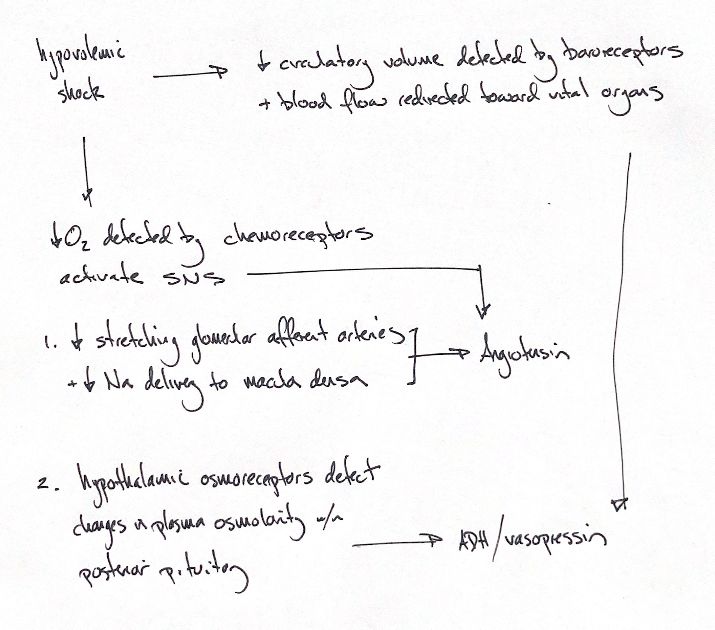
When circulating volume falls, baroreceptors respond to reduced pressure and stretch. Their firing falls, sympathetic activity rises and parasympathetic drive falls. Arteriolar constriction helps redirect flow toward vital organs. Venoconstriction supports venous return, while a faster heart rate can support cardiac output. These responses aim to preserve perfusion; they do not guarantee normal flow in every organ or replace lost volume.
The second sensory branch in my notes is the chemoreceptor response to low oxygen. Peripheral chemoreceptors contribute to sympathetic and ventilatory responses. The oxygen signal depends on arterial oxygen tension and local perfusion. Low tissue oxygen delivery does not always mean low arterial PaO2, so hypovolaemia and arterial hypoxaemia are not the same finding.
The kidneys also sense the fall. Reduced stretch in the glomerular afferent arteriole and reduced sodium chloride delivery to the macula densa stimulate the renin–angiotensin–aldosterone system, or RAAS. Sympathetic stimulation can activate it too. Renin acts on angiotensinogen to form angiotensin I, which is converted to angiotensin II. Angiotensin II causes vasoconstriction and promotes aldosterone release. Aldosterone increases sodium retention, and water follows.
Vasopressin is also called antidiuretic hormone, or ADH. It is made in the hypothalamus and released from the posterior pituitary. Hypothalamic osmoreceptors help control its release as plasma osmolality rises. A fall in blood volume or pressure provides a separate, non-osmotic stimulus, so hypovolaemia can stimulate ADH even without increased osmolality. ADH promotes collecting-duct water retention and, during marked hypovolaemia, vasoconstriction.
References
Johnston & Tobias, Veterinary Surgery: Small Animal, 2nd ed., shock chapter; Lahiri et al. 1980, experimental feline chemoreceptor responses.