
Dehydration fluid plan
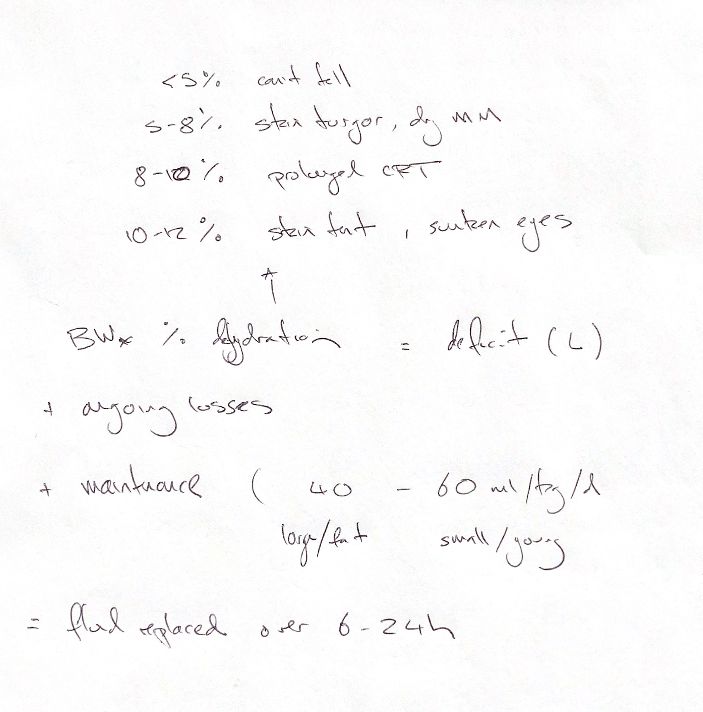
Read the draft explanation
Treat hypovolaemic shock first. The calculation in these notes is a rehydration plan, not an emergency shock-bolus prescription.
Estimate the dehydration deficit by multiplying body weight in kilograms by the dehydration fraction. Enter 8% as 0.08, not 8. The answer is in litres; multiply by 1000 to convert it to millilitres.
Then add ongoing losses and maintenance for the same time interval. Ongoing losses may include vomiting, diarrhoea and excess urine. Measure them where possible and revise the estimate as losses change. Keep all volumes in the same units before adding them.
My notes and the book describe replacing stable dehydration over 6–24 hours. AAHA 2024 usually uses 12–24 hours, adjusted to the patient's response. This slower replacement period does not apply to initial shock resuscitation.
The original maintenance cue is 40–60 mL/kg/day, with “large/fat” at the lower end and “small/young” at the higher end. Keep that as a memory cue, not a dosing rule. Species, age, body condition, disease and actual intake matter. AAHA lists 60 mL/kg/day for adult dogs and 40 for adult cats as simple estimates; pediatric needs differ and require their own calculation.
Multiply the daily mL/kg estimate by the patient's weight to get mL/day. For a shorter plan, multiply that daily volume by the interval in hours and divide by 24. Add the dehydration deficit and ongoing losses over that same interval.
Account for enteral water, feeds, medication volumes and fluid already given so that none is counted twice. Monitor hydration, perfusion, intake and output, then adjust the plan rather than leaving the first calculation unchanged.
References
Johnston & Tobias, Veterinary Surgery: Small Animal, 2nd ed., fluid therapy chapter; AAHA Fluid Therapy Guidelines 2024, sections 2–3.