
Mean arterial pressure and its measurement
Read the draft explanation
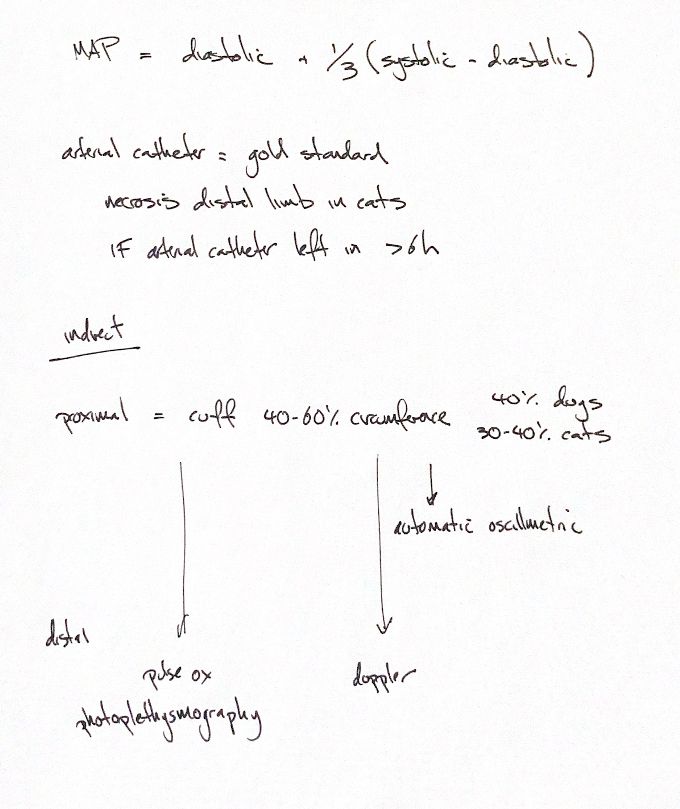
Mean arterial pressure, or MAP, is the average arterial pressure over a cardiac cycle. The familiar estimate is DAP + one-third of the pulse pressure, where pulse pressure is SAP − DAP. It gives diastole more weight. It is not the simple average of systolic and diastolic pressure.
An arterial catheter connected to a transducer gives direct, continuous pressure measurements. It is the reference method. Thrombosis can impair blood flow beyond the catheter and cause tissue necrosis. The original warning highlights cats with catheters left in for more than six hours. That is a risk cue, not a six-hour safety boundary. A retrospective study of 35 cats with 38 catheters linked longer use with more complications; it did not establish that cutoff.
Indirect methods use an occlusive cuff. Place the Doppler probe or pulse-oximeter detector distal to the cuff. During deflation, the return of a Doppler sound or pulse-oximeter waveform marks the pressure estimate. The latter method is photoplethysmography. A saturation number on its own does not measure pressure. Oscillometric devices instead analyse pressure oscillations in the cuff and estimate MAP, SAP and DAP.
Doppler and optical methods usually give a systolic estimate, but feline bias matters. In eight isoflurane-anaesthetised cats studied during hypotension, both tracked direct MAP more closely than SAP. That finding does not turn every feline Doppler reading into MAP.
Cuff width is a fraction of the limb circumference at the cuff site. The original general cue is 40–60%, alongside 40% for dogs and 30–40% for cats. The anaesthesia chapter also gives 40–60%; the shock chapter gives the species values. ACVIM's 2018 protocol uses 30–40% for Doppler and many oscillometric units, with special cuffs for some devices. Match the device and protocol rather than blending these ranges. A normal pressure can still coexist with poor tissue perfusion.
References
Johnston & Tobias, Veterinary Surgery: Small Animal, 2nd ed., Chs. 6, 21; Caulkett et al., Vet Surg 1998;27:370–377; Acierno et al., JVIM 2018;32:1803–1822; Mooshian et al., JFMS 2019;21:173–177.