
Acid-base disorders and compensation
Read the draft explanation
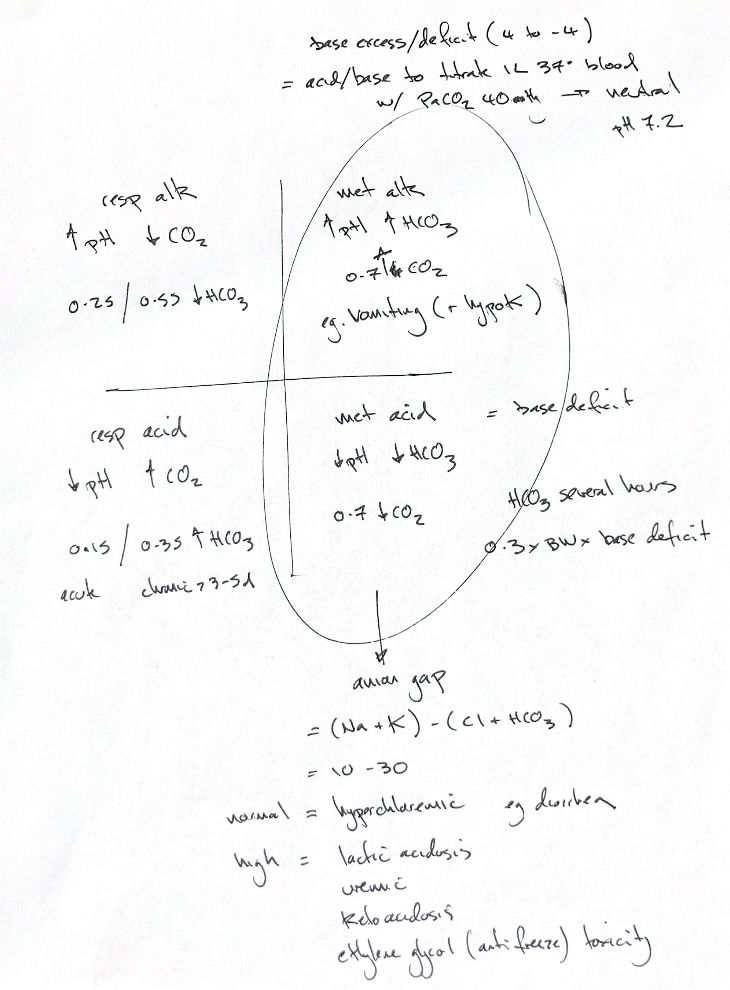
Start with pH and the primary change. Respiratory alkalosis raises pH as PaCO₂ falls; bicarbonate falls in compensation. Respiratory acidosis lowers pH as PaCO₂ rises; bicarbonate rises. Metabolic alkalosis raises pH and bicarbonate; PaCO₂ rises. Vomiting often accompanies hypokalemia. Metabolic acidosis lowers pH and bicarbonate; PaCO₂ falls.
These slopes are textbook approximations for simple canine disorders. For each 1 mmHg change in PaCO₂, bicarbonate falls 0.25 mEq/L acutely or 0.55 chronically in respiratory alkalosis. It rises 0.15 acutely or 0.35 chronically in respiratory acidosis. Renal adaptation takes 3–5 days. For metabolic disorders, PaCO₂ moves 0.7 mmHg per 1 mEq/L bicarbonate change in the same direction. These rules do not establish feline responses. Mixed disorders can have a normal pH.
The anion gap is (Na⁺ + K⁺) − (Cl⁻ + HCO₃⁻). The original 10–30 cue is rough; use the laboratory and calculation method. Book examples are 11–26 mEq/L in dogs and 13–27 in cats. A normal-gap, hyperchloremic acidosis can follow diarrhea. High-gap examples include lactic acidosis, uremia, ketoacidosis and ethylene glycol, or antifreeze, toxicosis.
Base excess describes the metabolic component. Its reference titrates 1 L of blood at 37°C and PaCO₂ 40 mmHg to pH 7.4. The original’s 7.2 needs correction here; the book uses 7.2 separately as a therapy goal. The source/book range is −4 to +4 mEq/L. A negative BE is a base deficit; it does not identify the cause.
The source bicarbonate estimate is 0.3 × BW (kg) × positive base deficit (mEq/L), giving mEq. The 0.3 L/kg distribution assumption varies. The book describes gradual partial replacement over several hours and reassessment. Calculation does not establish the indication. Treat the cause and assess severity and ventilation: bicarbonate generates CO₂ that must be ventilated.
References
Chris Wood’s drawing; Johnston & Tobias, 2nd ed., ch. 5, Table 5.10; de Morais & DiBartola 1991 (compensation review).