
Crystalloids: composition, tonicity and redistribution
Read the draft explanation
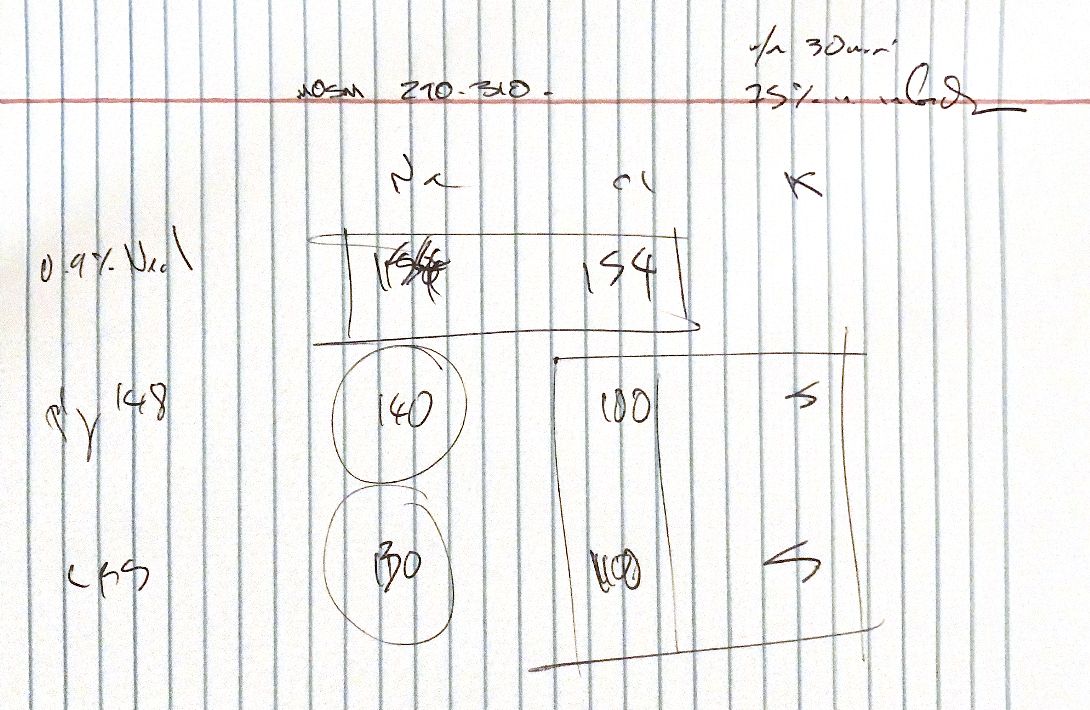
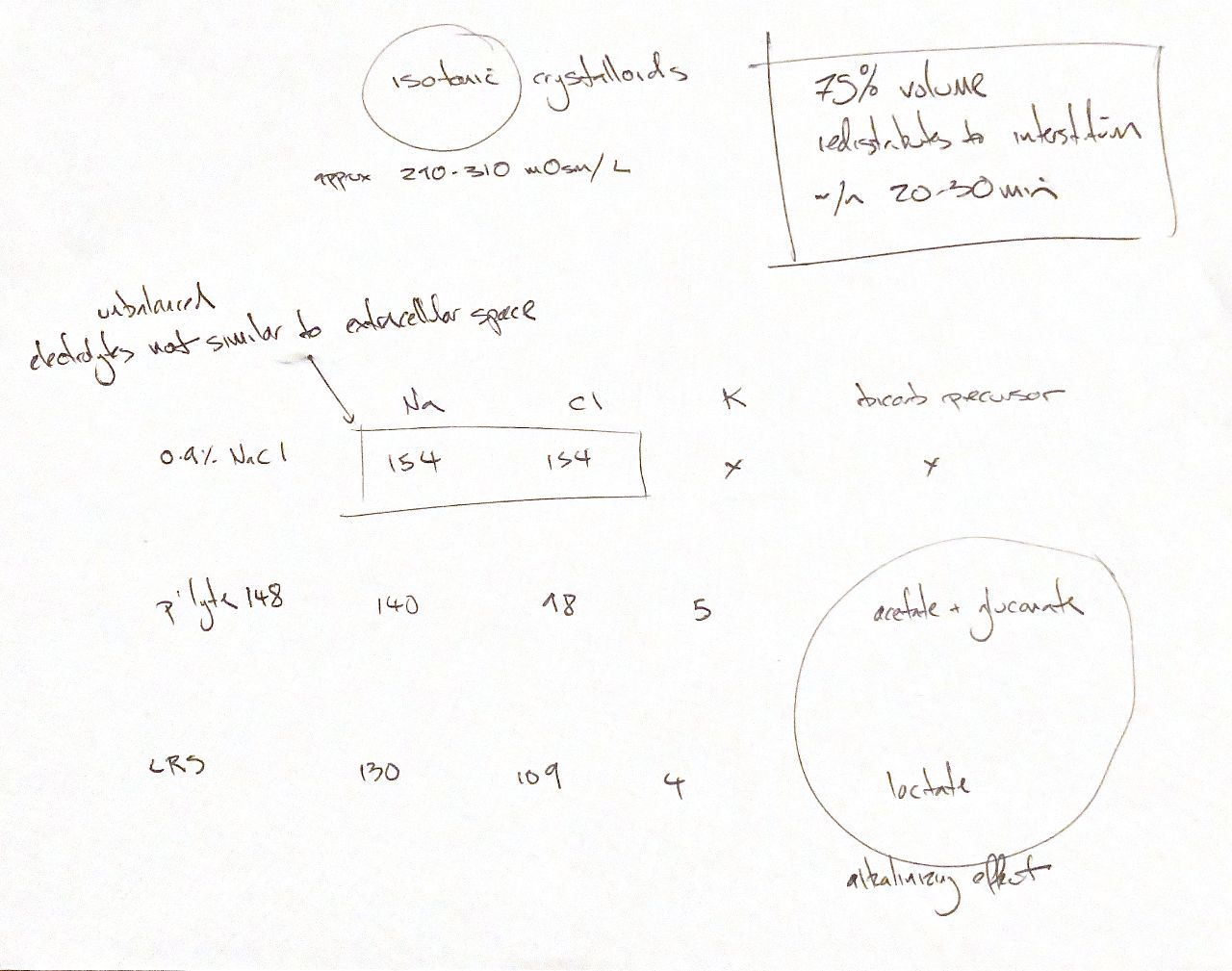
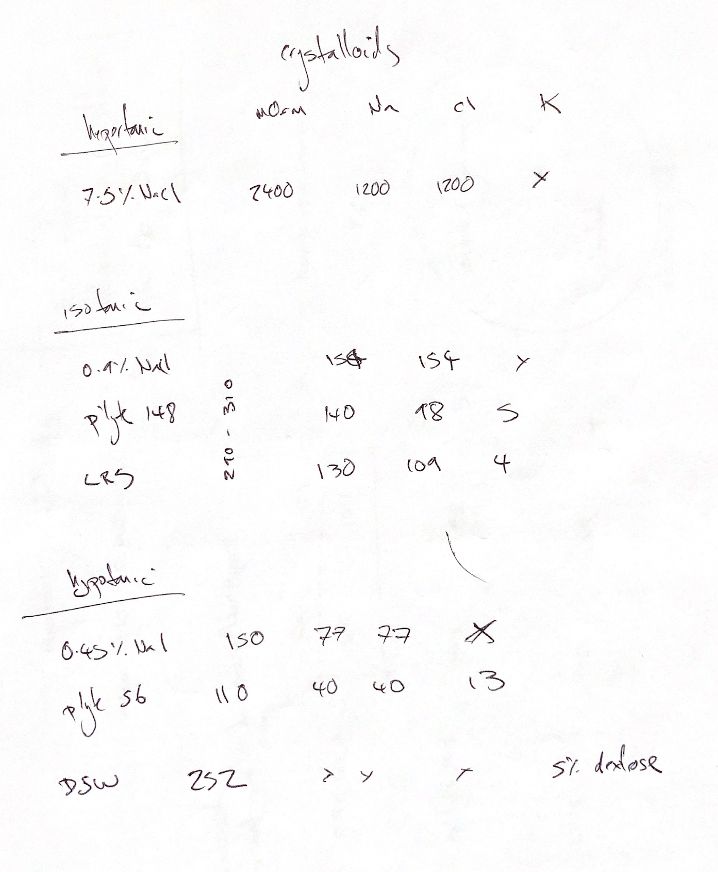
Isotonic crystalloids mainly expand extracellular fluid. Compare the ions rather than treating the bags as identical. The note's range is roughly 270–310 mOsm/L; LRS is commonly classed as isotonic despite its 273 mOsm/L bag osmolarity.
Saline 0.9% contains sodium and chloride without potassium or a bicarbonate precursor. Plasma-Lyte 148 contains acetate and gluconate; LRS contains lactate. Metabolism of these organic anions consumes hydrogen ions and has an alkalinizing effect.
The familiar cue is about 25% plasma and 75% interstitial after equilibration over 20–30 minutes. The rough note says within 30 minutes. These percentages describe a classical model of infused fluid distribution, not a fixed intravascular half-life. Infusion timing, volume status, permeability and elimination change retention.
The 7.5% saline row needs correction. The note and textbook list sodium 1200, chloride 1200 and osmolarity 2400. The B.Braun 7.5% label gives sodium and chloride 1283 mmol/L each and theoretical osmolarity 2566 mOsm/L. For these monovalent ions, mmol/L and mEq/L have equal numerical values. Theoretical osmolarity is not measured osmolality.
For 0.45% saline, the note gives 150 mOsm/L; the label gives 154 calculated. Plasma-Lyte 56's 110 mOsm/L entry is the book's base formulation without dextrose. Adding 5% dextrose changes the formulation. D5W contains 5% dextrose and no sodium, chloride or potassium. Once glucose is metabolized, its water distributes across extracellular and intracellular spaces. Bag osmolarity and effective tonicity differ.
The rough-note variants also need correction: Plasma-Lyte 148 chloride 100 becomes 98; LRS chloride 100 and potassium 5 become 109 and 4 mEq/L, as in the clearer drawing and product labels.
References
Johnston/Tobias, Veterinary Surgery: Small Animal, 2nd ed., Ch. 5, Tables 5.3–5.5; Baxter Plasma-Lyte 148 SmPC; DailyMed LRS, 0.45% saline and D5W labels; B.Braun Vet Care 75 mg/mL label.