
Body water, ions and transcellular shifts
Read the draft explanation
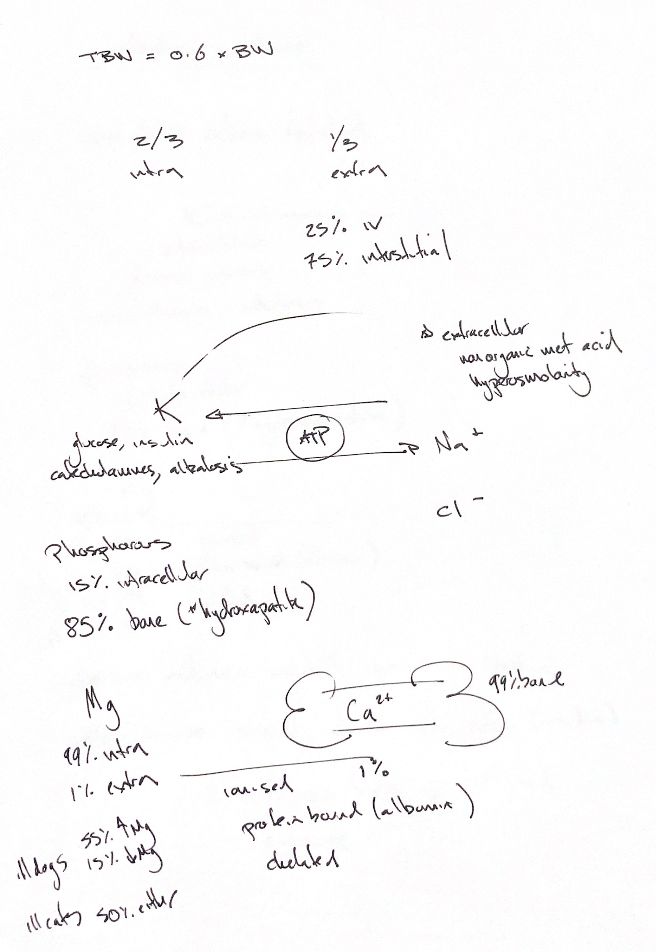
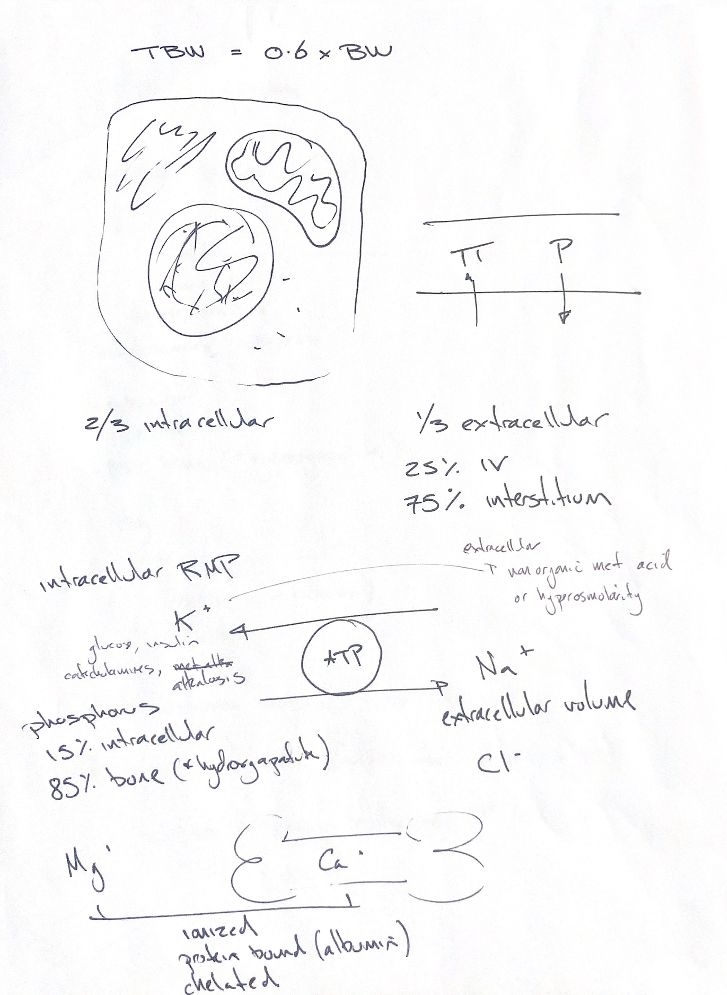
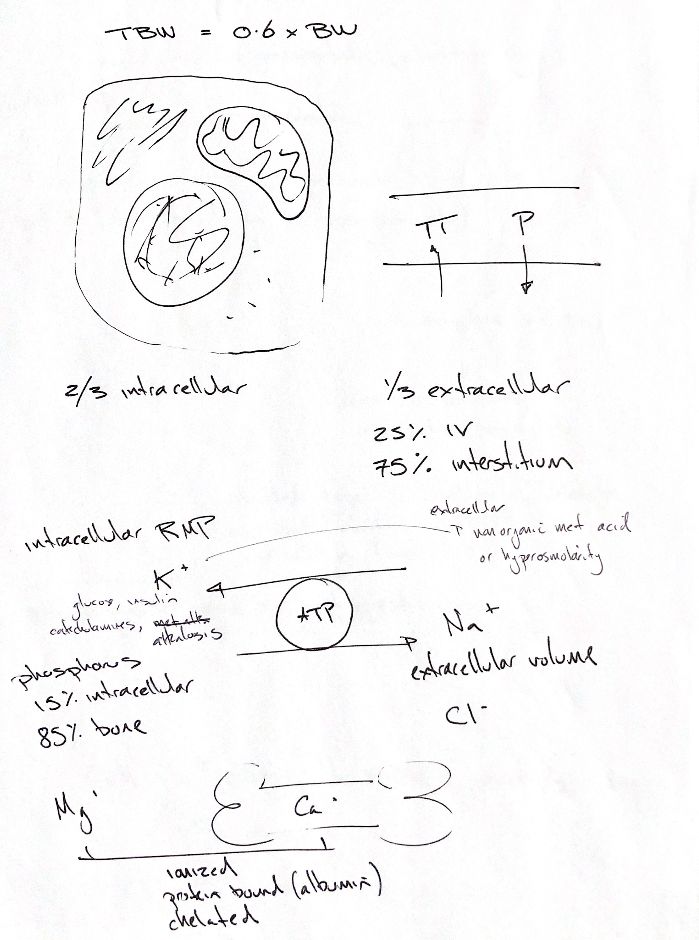
In a nonobese adult dog or cat, total body water is roughly 60% of body weight. About two-thirds is intracellular and one-third extracellular. Plasma holds about 25% of extracellular fluid; interstitial fluid holds 75%. These are estimates, and age, body fat and disease change them.
Capillary hydrostatic pressure favours filtration. Plasma oncotic pressure opposes it. The endothelial barrier and glycocalyx affect net movement. An inward force arrow does not mean sustained venous reabsorption. Lymph returns interstitial fluid to the circulation.
Potassium is the main intracellular cation. Phosphate and proteins supply major intracellular anions. Sodium dominates outside cells, with chloride and bicarbonate as major anions. ATP powers the Na+/K+ pump to move sodium out and potassium in. Potassium gradients and membrane permeability help set the resting membrane potential. Sodium content helps determine extracellular volume.
Insulin, glucose through insulin release, beta-2 stimulation and metabolic alkalosis favour potassium entry. Mineral metabolic acidosis and hypertonicity favour exit. Glucose with insulin deficiency can shift potassium outward. A shift can change serum potassium without changing total body stores.
About 85% of phosphorus is in bone as hydroxyapatite and 15% intracellular. About 99% of calcium is in bone. Its remaining 1% spans intracellular and extracellular fluid. Serum calcium and magnesium occur as ionized, protein-bound and chelated forms; the ionized fraction is active.
About 99% of magnesium is in bone and soft tissues. The note's “intracellular” cue includes bone stores. Martin's 48 critically ill dogs had low total serum magnesium in 54% and high values in 13%; the note rounds low values to 55%. Toll's 57 ICU cats had 46% abnormal total magnesium during hospitalization, the note's roughly 50% cue. These are study-specific proportions.
References
Johnston/Tobias, Veterinary Surgery: Small Animal, 2nd ed., Ch. 5; Martin et al., JVECC 1994;4:15–20; Toll et al., JVIM 2002;16:217–221; Ogrodny et al., JVIM 2022;36:2002–2008.