
Acute-phase proteins
Read the draft explanation
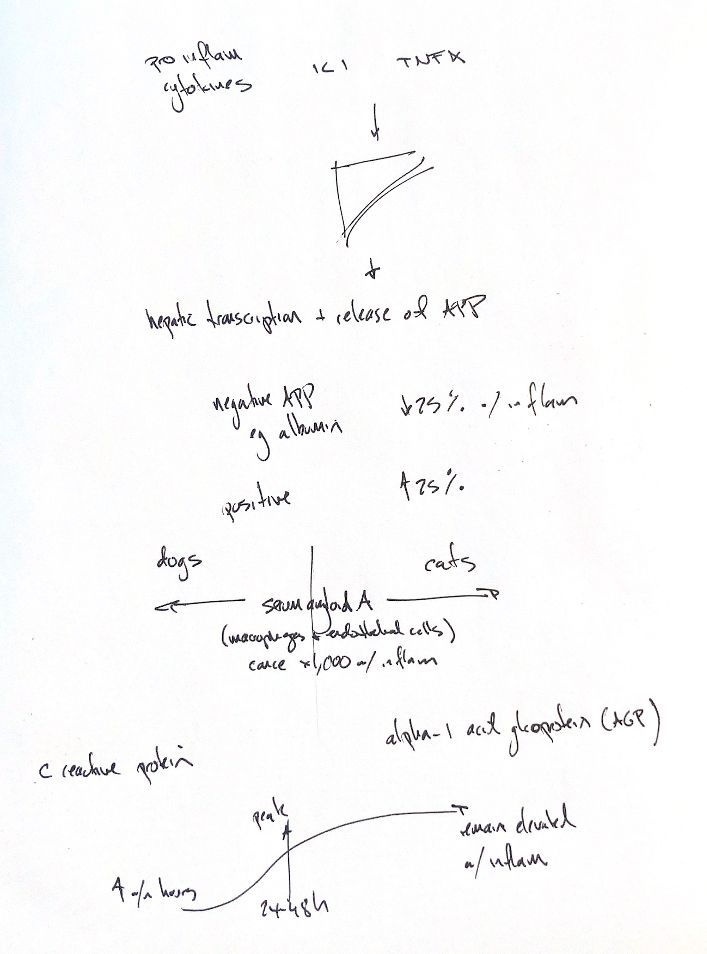
Inflammatory cytokines tell the liver to change protein production. IL-6 acts with signals such as IL-1 and TNF-α to drive hepatic transcription and release of acute-phase proteins, or APPs.
Negative APPs fall during inflammation. Albumin is the main example in most species. Positive APPs rise. The textbook defines these categories as a change of at least 25% from baseline. That is a classification rule, not a diagnostic cutoff for an individual patient.
The dog–cat layout is a memory map. CRP is a useful positive APP in dogs. Feline CRP is much less responsive. SAA is useful in both species, and AGP is another positive APP in cats. SAA is a major feline reactant; AGP does not have to share the same fold increase to be useful.
SAA comes from hepatocytes, macrophages and endothelial cells. The original note's roughly 1000-fold rise is the textbook's broad inflammatory-response example. Its size depends on the species and disease. It is not an expected rise in every dog or cat, and the feline primary study does not establish that exact magnitude.
Canine CRP can start rising within hours and commonly peaks around 24–48 hours after an inflammatory stimulus. It may stay high while inflammation continues, then fall as the stimulus resolves. The curve is a schematic, not measured patient data. Orthopaedic surgery studies show that peak timing varies, so a delayed rise needs its own clinical context. The other APPs do not all follow this exact curve.
References
Johnston/Tobias, Veterinary Surgery: Small Animal, 2nd ed., Ch. 1; Kajikawa et al., Vet Immunol Immunopathol 1999;68:91–98; Kanno et al., Acta Vet Scand 2019;61:33.