
Cell-cycle checkpoints
Read the draft explanation
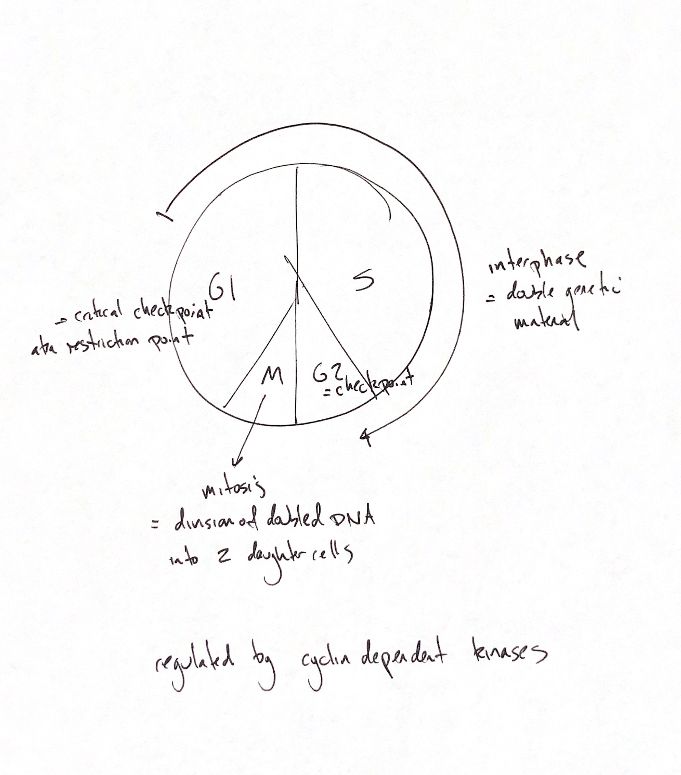
Follow the circle from G1 to S, then G2 and M. G1 is a period of growth and preparation. The restriction point in G1 is a key control point for commitment to keep cycling.
Interphase includes G1, S and G2. The original “doubling of genetic material” cue belongs within interphase, specifically in S phase. DNA is copied during S, rather than throughout all three phases. G2 follows replication and prepares the cell for mitosis. Its checkpoint can delay entry into mitosis when DNA remains damaged or incompletely replicated.
Mitosis separates the duplicated chromosomes into two daughter nuclei. Cytokinesis divides the cell body, producing two daughter cells. The original two-cell cue combines these linked parts of M phase.
Cyclin-dependent kinases, or CDKs, regulate entry into and progression through the cycle. Binding to cyclins helps control when these kinases act. The source highlights the G1 restriction point and the G2 checkpoint; other controls also operate. Commitment at the restriction point and arrest after DNA damage are related controls, but they are not identical events.
The sector sizes are a memory layout, not a measured clock. Cell-cycle timing varies with the cell type and its conditions.
References
Johnston/Tobias, Veterinary Surgery: Small Animal, 2nd ed., Ch. 25; Pardee, PNAS 1974;71:1286–1290; Weinert & Hartwell, Mol Cell Biol 1990;10:6554–6564; NCI CDK resources.