
Cerebral oxygen requirement
The explanation corrects the handwritten cerebral oxygen-consumption unit to mL/min per 100 g and qualifies the shivering cue.
Read the draft explanation
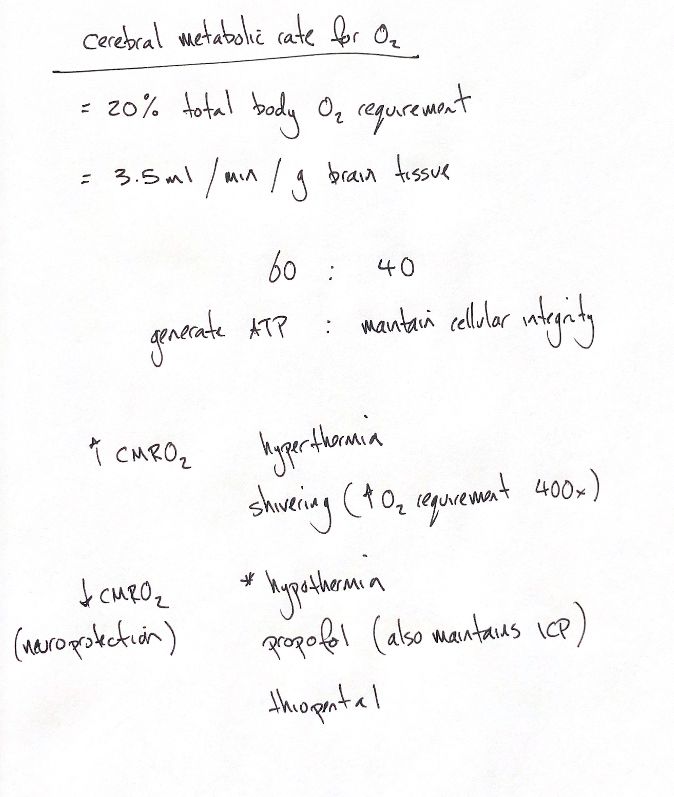
CMRO₂ is the rate at which the brain consumes oxygen. The note gives 20% of total-body oxygen requirement. The supplied textbook uses this as an approximate share of whole-body oxygen consumption.
The handwritten 3.5 mL/min/g needs a unit correction: the book gives about 3.5 mL/min per 100 g of brain in dogs. That is a mass-normalised consumption estimate, not oxygen delivery or a universal value across species, ages and anaesthetic conditions.
The 60:40 comparison is within cerebral oxygen use: about 60% supports neuronal activity through ATP production and 40% supports cellular integrity. It does not mean that the cellular-integrity component uses no ATP.
Hyperthermia raises CMRO₂. Shivering also raises oxygen demand, but the note’s 400× cue needs a separate qualification. The recovery chapter says oxygen requirements may rise “by 400%”; its context is whole-body demand, not a 400-fold rise in brain metabolism. Human postoperative studies show a variable response, and do not establish a fixed canine cerebral multiplier.
The lower group links reduced CMRO₂ with a neuroprotective rationale: hypothermia, propofol and thiopental. Drugs can reduce the neuronal-activity component; hypothermia can also reduce maintenance metabolism. A lower metabolic rate does not by itself prove a better clinical outcome, and hypothermia has important risks.
The propofol note also says “maintains ICP”. It can reduce cerebral blood flow and intracranial pressure, but pressure effects depend on dose, time and conditions. In experimental dogs, CSF pressure initially fell then returned towards baseline, while high-dose propofol reduced CPP. It does not guarantee preservation of cerebral perfusion.
References
Johnston & Tobias, 2nd ed., Ch36; McPherson et al. 1997; Artru et al. 1992; Frank et al. 1995; Hutchison et al. 2008.