
Postural reactions: pathways and interpretation
Read the draft explanation
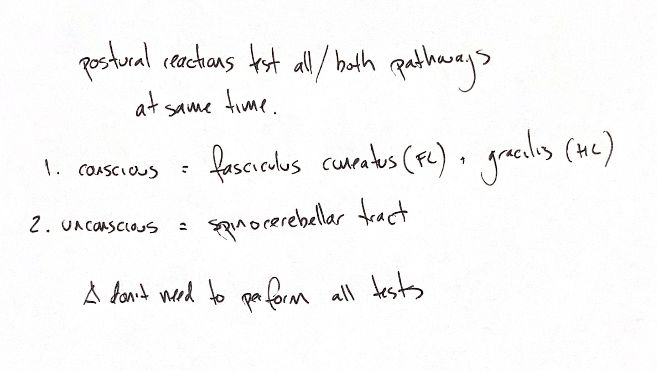
Postural reaction tests challenge overlapping sensory and motor systems together. They are useful for finding subtle problems with strength and coordination, but they are not a pure test of conscious proprioception or an isolated tract-localisation test.
The original numbered reminders are “conscious”: fasciculus cuneatus for the forelimb and gracilis for the hindlimb; and “unconscious”: spinocerebellar tract. These are simplified pathway examples, not a complete inventory or a one-to-one separation of function. Veterinary neuroanatomy also describes thoracic-limb fibres in the cuneate fasciculus that relay to the cerebellum.
A successful response needs sensory input as well as upper and lower motor-neuron performance. A severely weak animal may fail to replace a paw despite intact proprioceptive pathways. The supplied textbook explains that conscious and unconscious proprioceptive deficiencies cannot be separated practically by postural reaction testing.
The small triangle in the note marks “don’t need to perform all tests”. The textbook authors find hopping and placing most useful, with other postural reactions helping when those results are equivocal. This supports choosing useful tests for the examination, rather than assuming every named manoeuvre must be performed in every animal.
Interpret the response with gait, muscle mass, muscle tone, spinal reflexes and the rest of the neurological examination. A delayed response alone does not identify one sensory tract or one lesion site.
References
Johnston & Tobias, 2nd ed., Ch26, Postural Reactions and Fig26.2; University of Minnesota Canine Brain Atlas glossary and spinocerebellar teaching pages; Parent, WSAVA2001.