
Cutaneous nerve territories and sciatic injury
Read the draft explanation
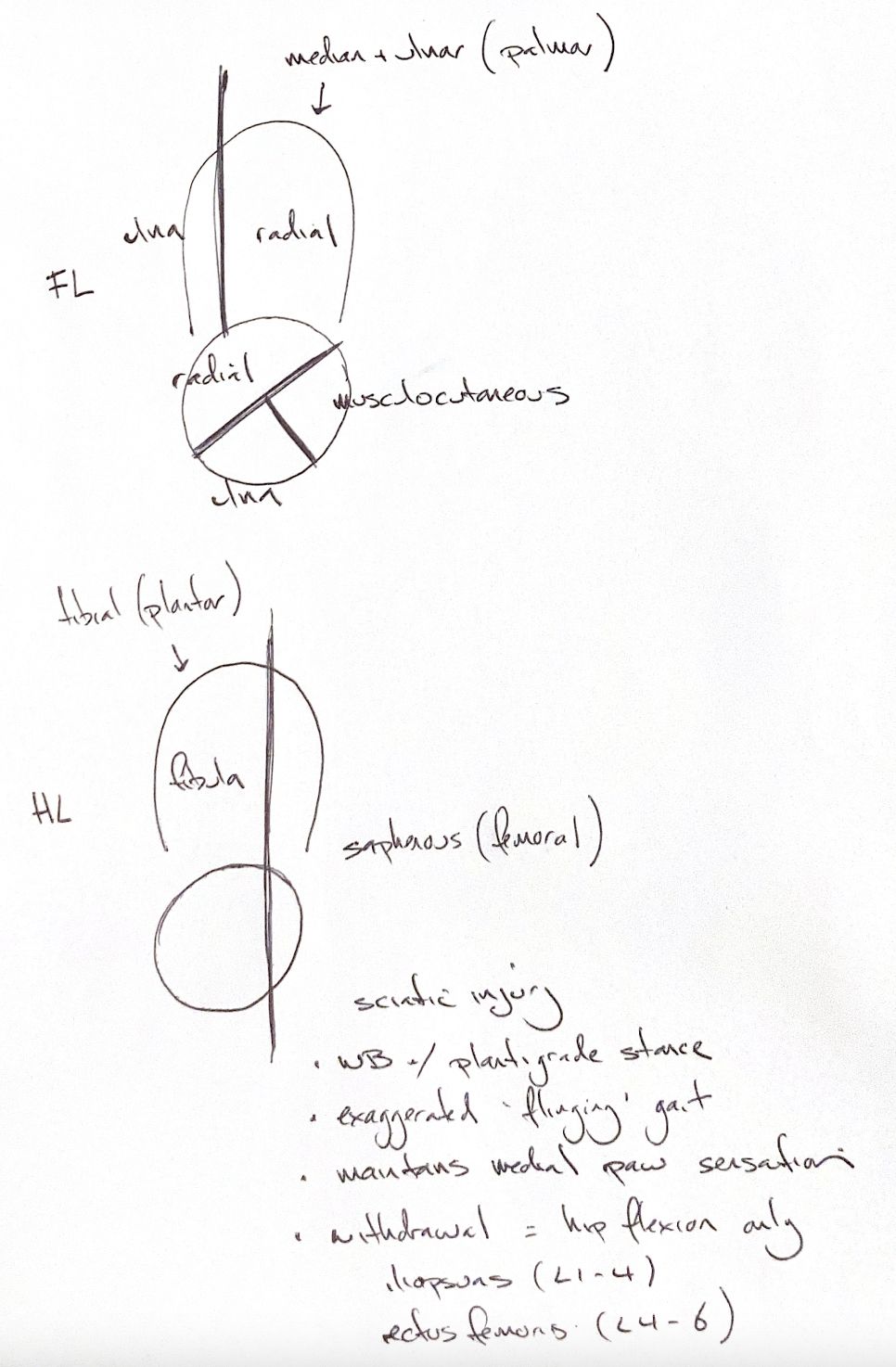
Cutaneous territories describe skin sensation. In the forelimb, radial supply reaches the dorsal paw, while median and ulnar supply reach the palmar surface. Musculocutaneous supply is medial on the antebrachium. Ulnar supply includes its caudal surface and the lateral side of digit V.
A broad cutaneous territory is different from an autonomous zone, where one nerve supplies the skin without overlap from its neighbours. My supplied table lists the canine test sites. Its median entry says no autonomous zone. This should not be extended to cats: an electrophysiological study described a median autonomous zone in cats. Fields overlap, and individual variation matters.
In the pelvic limb, fibular branches supply dorsal paw skin and tibial branches supply plantar skin. The saphenous branch of the femoral nerve supplies the medial side. Its distal reach varies; in some patients it does not extend below the hock.
An isolated sciatic injury can allow weight bearing if femoral function remains intact, while tibial dysfunction gives a plantigrade stance. The limb may advance with exaggerated hip flexion, the source's “flinging” gait. Medial paw sensation may remain through the saphenous nerve.
Medial paw input can still produce hip flexion through unaffected iliopsoas and rectus femoris. My segment cues are L1–L4 for iliopsoas and L4–L6 for the femoral supply to rectus femoris. Stifle, tarsal and digital flexion can be lost. Partial injuries vary, and withdrawal alone does not prove conscious nociception.
The drawings are memory sketches, not precise or proportional maps of every skin field.
References
Johnston & Tobias, 2nd ed., Ch26; Kitchell et al.1980/1982, indexed abstracts; original supplied thoracic-limb table.