
Trigeminal and facial nerve functions
Read the draft explanation
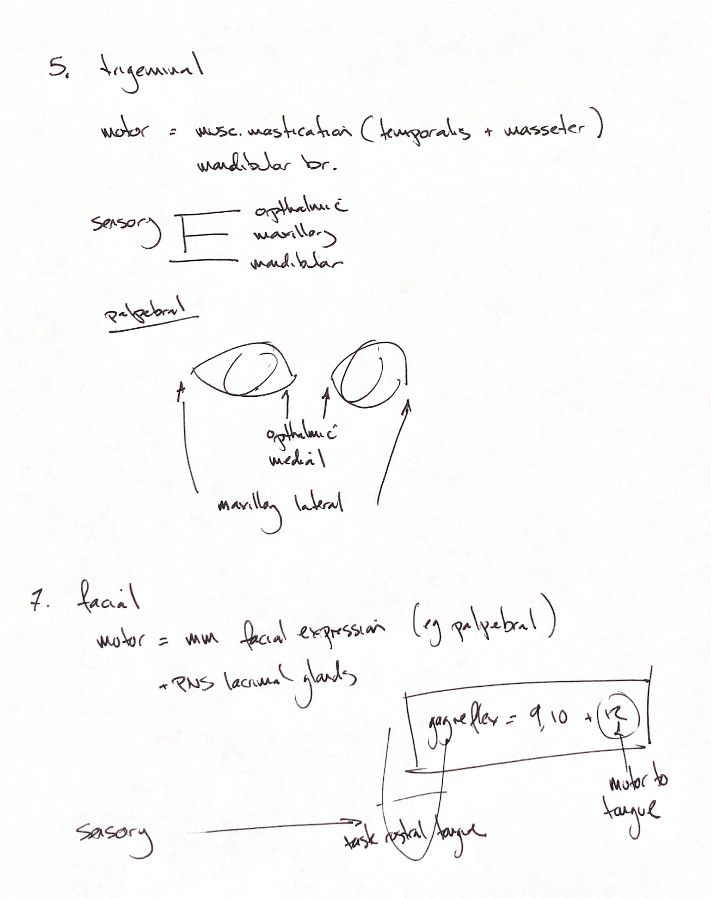
The trigeminal nerve, V, carries both sensory and motor fibres. Its mandibular branch supplies the muscles of mastication, including temporalis and masseter. Sensory information from the face travels in the ophthalmic, maxillary and mandibular divisions.
The palpebral reflex shows how V and VII work together. At the medial canthus, the sensory limb is ophthalmic; at the lateral canthus, it is maxillary. These trigeminal inputs form the afferent limb. The palpebral branch of the facial nerve supplies the efferent motor limb for eyelid closure.
The facial nerve, VII, supplies muscles of facial expression, including that eyelid response. It also carries parasympathetic supply to lacrimal glands and taste sensation from the rostral tongue. Taste and tongue movement are separate functions.
The original inset says “gag reflex = 9, 10 + 12”, with 12 circled and linked to “motor to tongue”. This is shorthand for a combined assessment: IX and X serve the pharyngeal component, while XII supplies tongue movement. It does not make XII the motor nerve of the pharyngeal gag response. Normal gag responses vary, and the supplied textbook describes dysphagia as a more reliable indicator of IX/X dysfunction.
References
Johnston & Tobias, 2nd ed., Ch26, Table26.1 and facial/trigeminal and tongue–pharyngeal sections; Fletcher & Clarkson, veterinary gross anatomy, p45; University of Guelph cranial nerve teaching notes.