
Aortic body tumours and pericardiectomy
Read the draft explanation
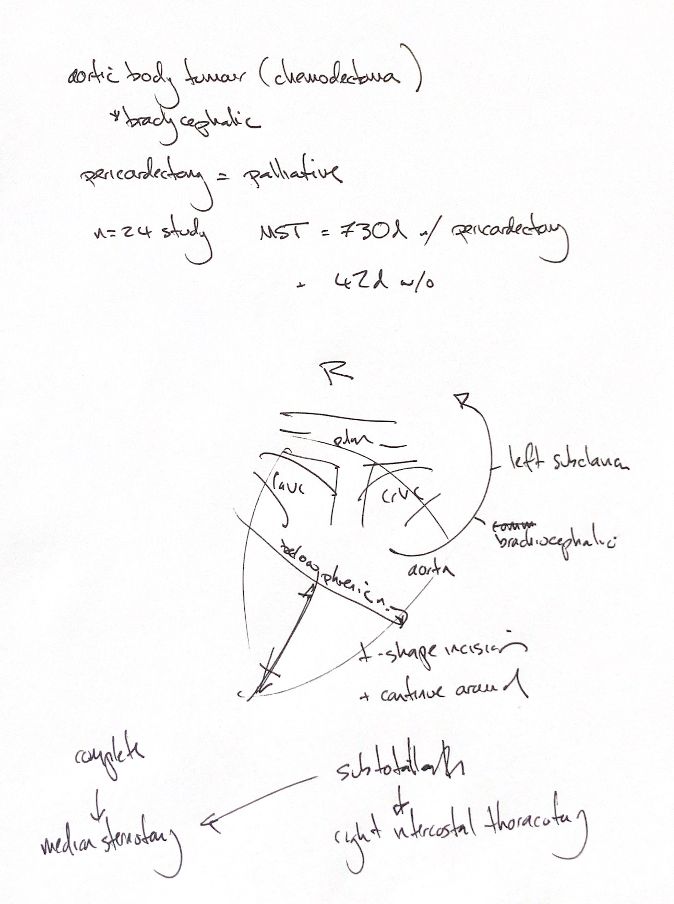
Aortic body tumours are chemodectomas at the heart base. The traditional brachycephalic breed association is not exclusive, and the textbook cautions that overrepresentation is not clearly established. Pericardiectomy is a palliative option: removing pericardium can reduce recurrent tamponade, but it does not remove the primary tumour. Treatment still depends on the individual lesion and patient.
The 730-versus-42-day comparison comes from a retrospective series of 24 dogs with histologically confirmed aortic body tumours. Median survival from diagnosis to euthanasia or death was 730 days with pericardectomy versus 42 days without it. This observational association does not prove that surgery caused the difference or predict an individual dog's survival.
For subtotal pericardiectomy, the important relation is to identify and protect both phrenic nerves and incise the pericardium ventral to them. The T-shaped incision is a schematic guide to pericardial removal.
Complete pericardiectomy is usually approached by median sternotomy. The original also links subtotal pericardiectomy to both right intercostal thoracotomy and median sternotomy. The textbook prefers median sternotomy for subtotal removal and lists right lateral thoracotomy as an alternative. The arrows therefore do not mean that each extent has only one possible approach.
References
Johnston & Tobias, 2nd ed., Heart-Base Tumors and Pericardial Surgery; Ehrhart et al. 2002.