
physiology behind pulsus paradoxus
Read the draft explanation
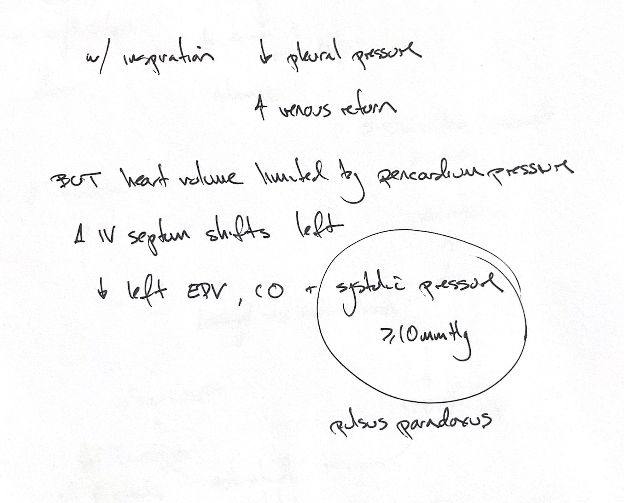
During spontaneous inspiration, pleural pressure falls and systemic venous return to the right heart increases. In cardiac tamponade, the tense pericardium limits the space available for cardiac filling. Greater right-heart filling therefore competes with left-heart filling: the interventricular septum can shift leftward, reducing left-ventricular end-diastolic volume and left-heart stroke output. Systolic arterial pressure falls during inspiration.
The circled >10 mmHg is an inspiratory fall in systolic arterial pressure, not an absolute systolic pressure of 10 mmHg. The textbook describes this magnitude as often present during severe tamponade. It is a clinical teaching cue, not a universal canine diagnostic cutoff or a prediction for every breath. Controlled canine studies support the interaction between right- and left-heart filling, but their models and measured pressure endpoints differ. They illustrate the mechanism rather than supplying one diagnostic threshold for every dog.
Pulsus paradoxus is not pathognomonic for tamponade. The textbook also lists obstructive lung disease, restrictive cardiomyopathy and hypovolaemic shock. Its absence does not exclude tamponade: experimental observations include severe low-pressure states without a large paradoxical fall. Interpret the respiratory pressure pattern in its clinical and measurement context. The spontaneous-breathing mechanism should not simply be copied to positive-pressure ventilation.
References
Johnston & Tobias, 2nd ed., Pericardial Surgery; Shabetai et al. 1965; Gonzalez et al. 1991; Savitt et al. 1993.