
Tracheal anastomosis: tension, age and healing
Read the draft explanation
Precise apposition under low tension favours primary epithelialisation. A gap can heal through granulation tissue and narrow the lumen.
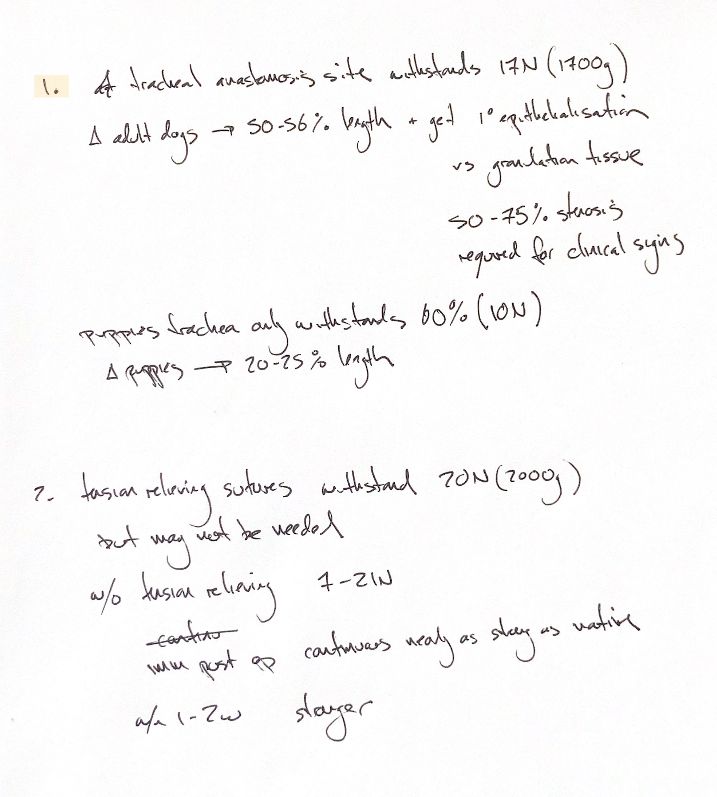
My adult-dog cue is 17 N, about 1700 g-force, and 50–56% resection. The textbook says 50–58%, with substantial mobilisation. These historical summaries are not universal safe limits. Its 50–75% luminal-stenosis cue for clinical signs has no defined measurement basis here.
Puppies are more fragile. The book gives 60% of adult force and 20–25% resection; my note rounds the force to 10 N. Elasticity does not mean the tissue is stronger.
For tension-relieving sutures, my note says 20 N, about 2000 g-force. The book describes protection at forces above 2000 g. These are historical experimental cues, not strength guarantees.
The “without tension relief” finding came from sheep: my note rounds the load to 7–21 N; the book gives 7.2–21.4 N without avulsion. Stenosis still increased with tension. This does not mean relief is never needed; the textbook authors still recommend it.
The immediate continuous-suture strength close to native trachea came from an ex vivo sheep study. It compared continuous polypropylene with interrupted polydioxanone or polyglactin 910. My 1–2-week “stronger” cue also needs context. The primary sheep abstracts report failure at the join at one week and away from it later, with no significant breaking-force difference between continuous and interrupted patterns. That is a mechanical endpoint, not proof that all outcomes match. A canine study found more stenosis with continuous sutures despite mild stenosis and no clinical abnormalities in either group.
References
Johnston & Tobias, 2nd ed., Ch102; Behrend et al.2001/2002; Fingland et al.1995; Demetriou et al.2006, indexed abstracts.