
Bernoulli, stenosis and VSD
Read the draft explanation
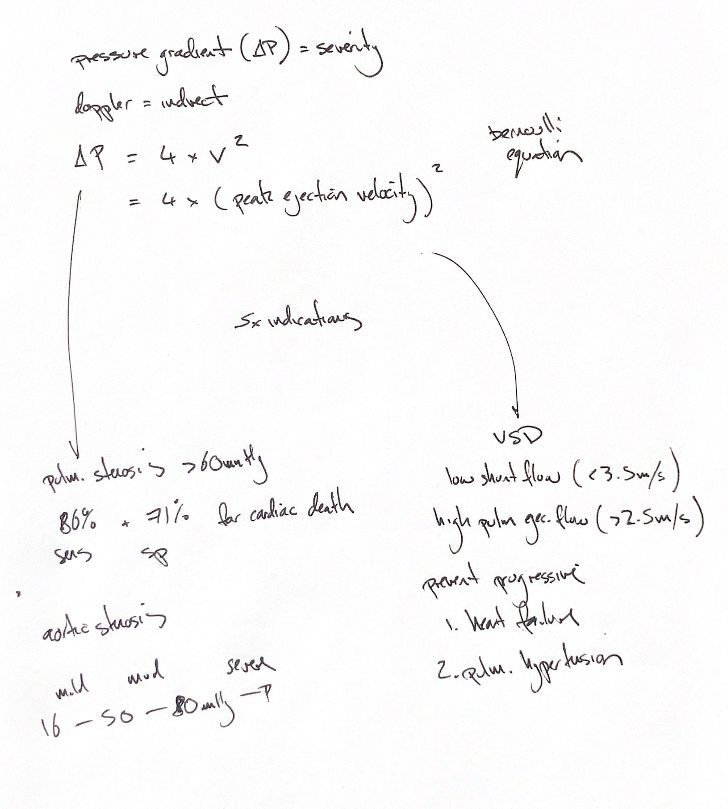
Doppler measures velocity and estimates the pressure gradient indirectly. The simplified Bernoulli equation is ΔP = 4V²: use V in m/s to obtain ΔP in mmHg. Peak ejection velocity gives a peak instantaneous gradient. It is not the same measurement as a catheter peak-to-peak gradient. Beam alignment and recording conditions matter.
The pulmonic-stenosis cue comes from 55 dogs that had no balloon valvuloplasty or surgery. Francis and colleagues reported that a gradient >60mmHg predicted cardiac death with 86% sensitivity and 71% specificity. Those are test-performance figures, not an 86% chance of death. Tricuspid regurgitation and severe stenosis were separate predictors. The supplied textbook states ≥60mmHg in an awake animal; the primary abstract and my drawing use >60.
For canine aortic stenosis, the textbook gives mild16–50mmHg, moderate50–80mmHg and severe>80mmHg. The bands share50, and Eason's primary study used ≥80 for severe subaortic stenosis. Exact boundaries therefore depend on the classification; they are not a sharp biological switch.
The VSD branch needs a different reading. VSD means ventricular septal defect. The textbook lists shunt velocity <3.5m/s and pulmonic ejection velocity >2.5m/s as findings that suggest haemodynamic importance. My note says “flow,” but m/s measures speed, not shunt volume. A lower jet speed can occur with a large shunt. High-flow shunts can lead to progressive heart failure or pulmonary hypertension; preventing that progression is the intervention aim. These are suggestive textbook cues, not independently validated standalone thresholds. The full echocardiogram and clinical findings guide the decision.
References
Johnston & Tobias,2nd ed.,Ch106; Francis et al.2011; Eason et al.2014; Lehmkuhl & Bonagura1994; Lehmkuhl et al.1995; Bussadori et al.2000.