
Pressure-volume loops and the Frank-Starling principle
Read the draft explanation
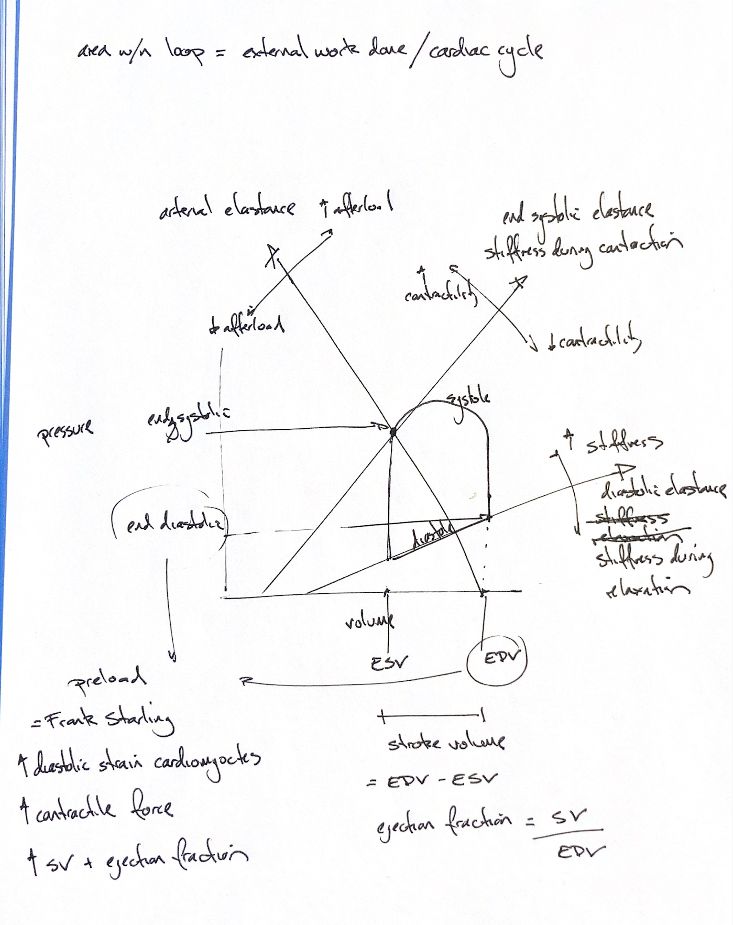
A pressure-volume loop pairs ventricular pressure with volume during one heartbeat. Filling is followed by isovolumetric contraction, ejection and isovolumetric relaxation. The enclosed area is external stroke work. Stroke volume is EDV minus ESV. Ejection fraction is stroke volume divided by EDV. These sketches have no numerical scale.
The three slope guides describe different properties. Effective arterial elastance, Ea, summarises the arterial load faced by the ventricle. It is not simply arterial-wall stiffness. The descending guide has a negative plotted slope, but Ea is a positive load index.
End-systolic elastance is the slope of the end-systolic pressure-volume relationship. A steeper relationship generally indicates greater contractility under comparable conditions. My “stiffness during contraction” cue is shorthand, and a single drawn loop does not establish a fitted relationship or perfect independence from loading.
Diastolic elastance describes pressure-volume stiffness. Greater local stiffness means more pressure change for the same volume change. My “stiffness during relaxation” cue needs a distinction: passive stiffness is not the rate of active relaxation. The straight guide is a schematic; real diastolic relationships need not be straight.
Frank–Starling links greater end-diastolic cardiomyocyte stretch with more forceful contraction and greater stroke volume, within limits. This does not require an increase in intrinsic contractility. The note also says “↑ stroke volume + ejection fraction”. EF can change with preload, but that upward cue is conditional: loading and contractility still matter. Filling pressure and volume are not interchangeable when stiffness changes. These are physiology relationships, not a fluid-treatment rule.
References
Johnston & Tobias, 2nd ed., Ch106; Sunagawa1983; Suga & Yamakoshi1977; Palacios1985; Nikolić1988; Kelly1992 (human model), indexed abstracts.