
Pleural pressure gradients and effusion
Read the draft explanation
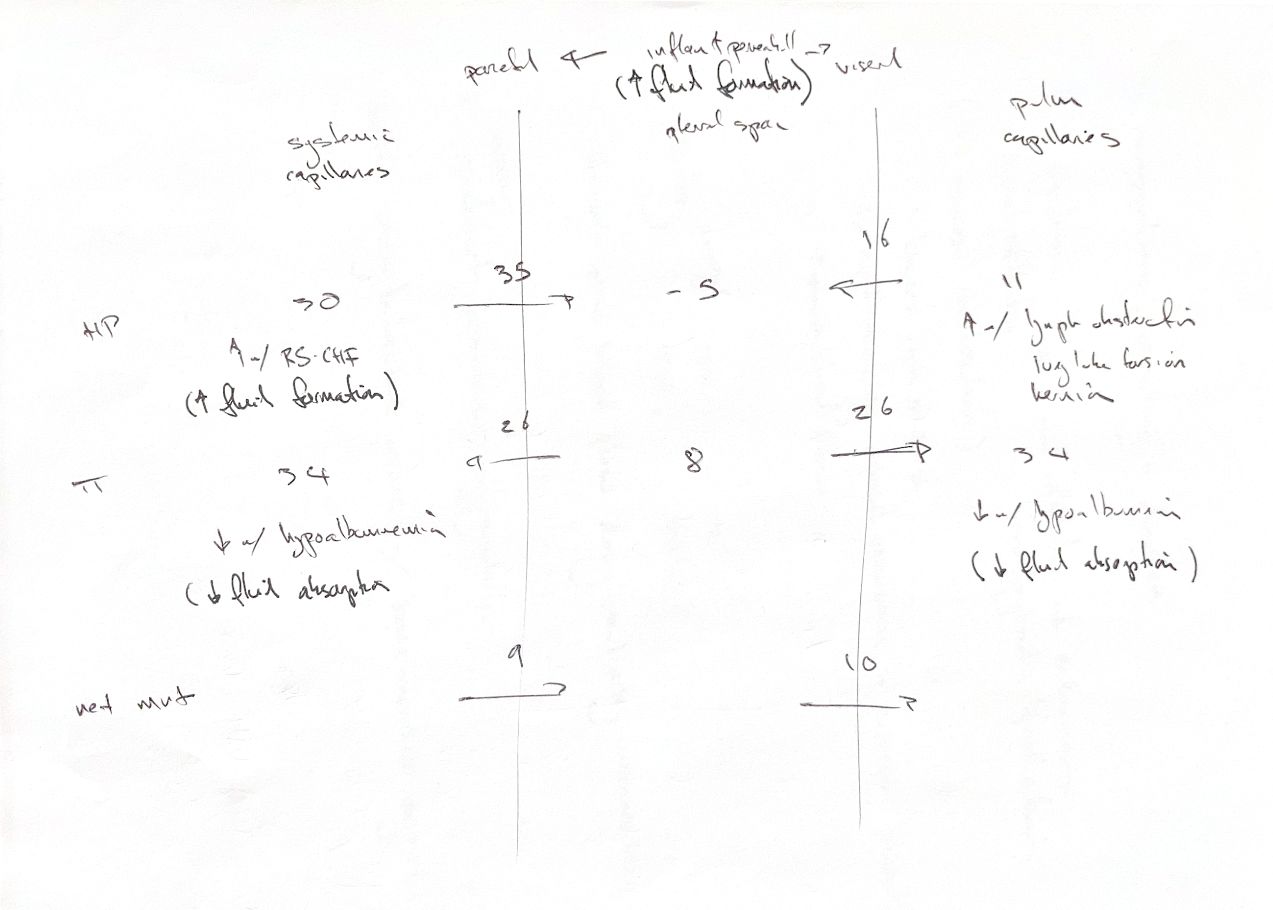
My diagram compares systemic capillaries, the pleural space and pulmonary capillaries. The parietal and visceral pleura form the two boundaries. These columns are compartments, not the patient's left and right sides.
Hydrostatic pressure pushes fluid toward the pleural space. In this source and textbook model, the values are 30, −5 and 11 cm H2O. The resulting gradients are 35 across the parietal side and 16 across the visceral side, both directed into the space.
Colloid osmotic pressure pulls fluid toward the capillaries. The model uses 34 cm H2O in each capillary bed and 8 in the pleural space. That creates an outward gradient of 26 on each side. Combining the opposing pressures leaves 9 into the space on the parietal side and 10 out on the visceral side.
These are model pressure gradients, not measured fluid volumes or flow rates. We cannot subtract them to calculate how much fluid accumulates. Actual pressure varies with location, breathing and the conditions studied. Parietal lymphatics also remove pleural fluid, so the drawing does not show every clearance route.
Effusion can develop when formation increases or clearance falls. Pleural inflammation can increase permeability. Right-sided congestive heart failure can raise systemic hydrostatic pressure. Lung lobe torsion can cause local vascular congestion. With diaphragmatic hernia, the effect depends on the organ and any venous obstruction; effusion is not inevitable.
Hypoalbuminaemia lowers plasma colloid osmotic pressure and weakens the gradient that favours absorption. Lymphatic obstruction can reduce fluid removal as well as alter pressures. These mechanisms can overlap.
References
Johnston & Tobias, 2nd ed., Ch85/105, Fig105.6; Agostoni et al.1989; Payne et al.1988. Primary studies support context, not these exact model values.