
Hypoxemia, VQ and oxygen response
Read the draft explanation
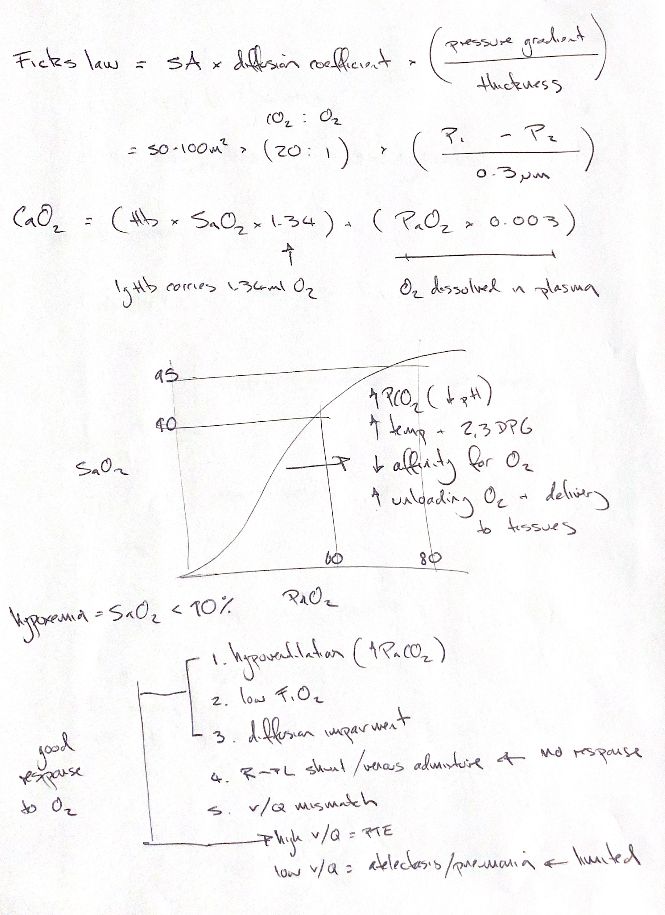
Hypoxemia means low arterial oxygen. My note and the supplied book use SaO₂ below 90% as a recall cue. Saturation, oxygen tension and oxygen content describe different things. The curve and measurement conditions matter, so this is not a universal treatment trigger.
The five source causes are hypoventilation, low inspired oxygen fraction, diffusion impairment, right-to-left shunt or venous admixture, and V/Q mismatch. Hypoventilation raises PaCO₂. Supplemental oxygen can improve oxygenation in hypoventilation, low FiO₂ and diffusion impairment, but oxygen alone does not correct inadequate ventilation or every underlying cause.
V/Q compares alveolar ventilation with perfusion. My high-V/Q example is pulmonary thromboembolism: ventilation exceeds the available blood flow. The note groups it with a good oxygen response. Oxygen may improve overall oxygenation, but it does not restore perfusion through an embolized vessel.
The low-V/Q examples are atelectasis and pneumonia. The note calls their oxygen response limited, and the textbook makes the same broad comparison. This needs a distinction: finite low-V/Q regions can improve with increased inspired oxygen. A perfused region with no ventilation has V/Q = 0 and behaves as a shunt. Atelectasis and pneumonia can contain both kinds of regions.
The source’s “no response” cue belongs to true right-to-left shunting. Oxygen cannot reach the blood that bypasses ventilated gas exchange. The whole patient may still show some improvement through other lung regions. Venous admixture is a broader functional concept than a single fixed anatomical shunt. Mixed disease, inspired oxygen and circulation affect the observed response.
These are mechanism comparisons, not oxygen doses or a ventilation protocol.
References
Johnston & Tobias, 2nd ed., Ch103; Marukawa & Iwai1981; Haskins et al.2005; Araos et al.2021, selected discussion.