
Oxygen diffusion, content and unloading
Read the draft explanation
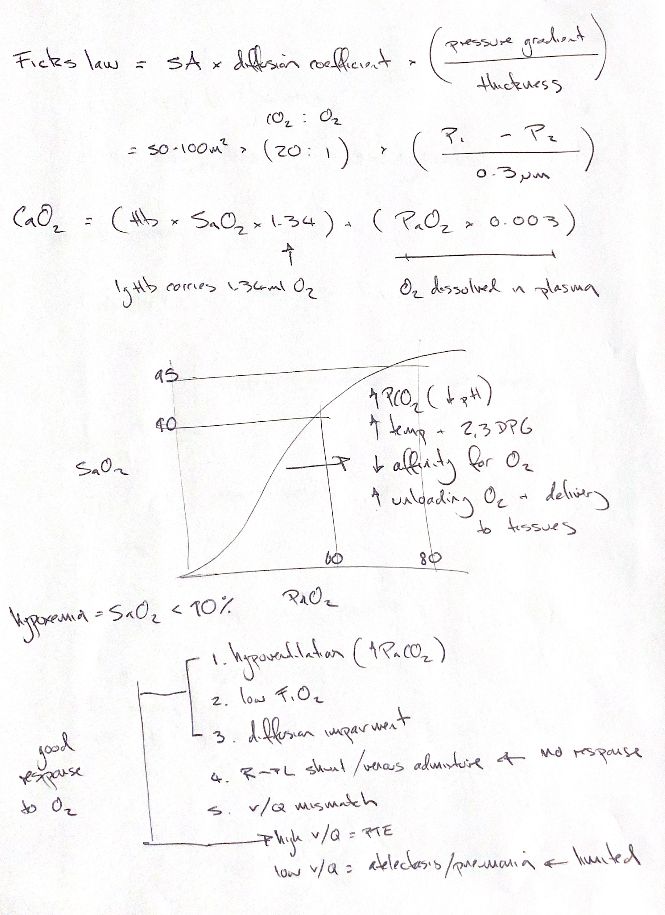
Fick’s law links gas diffusion to surface area, the gas’s diffusion coefficient and the partial-pressure gradient. A thicker barrier slows diffusion. The note and book use 50–100 m² and 0.3 µm as reference examples. These are not fixed measurements for every dog or cat. Their exact primary source is unverified. The CO₂:O₂ coefficient cue is about 20:1 for the same pressure gradient in liquid; it is not a rule that actual CO₂ flow is always 20 times O₂ flow.
Arterial oxygen content adds oxygen bound to haemoglobin to oxygen dissolved in plasma. My equation uses 1.34 mL O₂/g Hb, while its annotation and the supplied book use 1.36. Both are approximate calculation conventions. Keep the chosen coefficient explicit. With Hb in g/dL and PaO₂ in mmHg, CaO₂ is in mL O₂/dL. SaO₂ must be a fraction, or a percentage divided by 100. The dissolved term is 0.003 × PaO₂.
The curve links saturation, SaO₂, with oxygen tension, PaO₂. My 60/90 and 80/95 recall pairs are a schematic, not a fixed conversion for every dog or cat. Species, pH, temperature and CO₂ change the relationship.
A right shift means lower oxygen affinity at a given PaO₂. Increased CO₂, lower pH and higher temperature favour unloading. The note also includes increased 2,3-DPG. Its effect is species dependent, and it is a weaker regulator in feline blood. The textbook’s Figure 103.4 repeats right-shift drivers beneath its left-shift label; the original note agrees with the owning text’s rightward relationship.
Easier unloading does not guarantee better tissue oxygen delivery. Haemoglobin concentration, oxygen content and blood flow still matter.
References
Johnston & Tobias, 2nd ed., Ch103; Haskins et al.2005; Cambier et al.2004; Wong & Haskins2007.