
Recoil, surfactant and airway resistance
Read the draft explanation
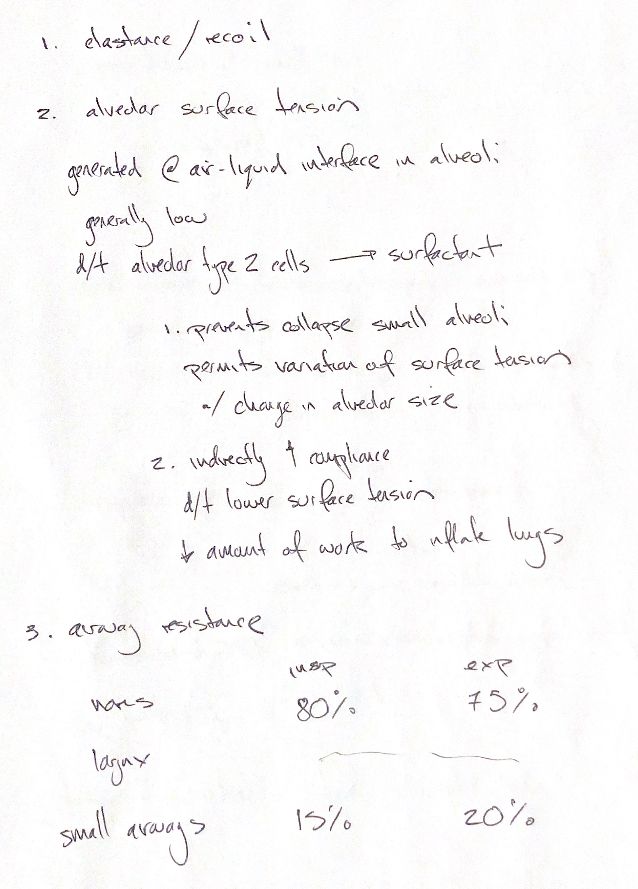
Inflating the lungs requires work against tissue elastance, alveolar surface tension and airway resistance. Elastance describes the pressure change needed for a given volume change. Compliance describes distensibility: a more compliant lung needs less pressure for the same expansion.
Alveolar surface tension arises at the air–liquid interface. Type II alveolar cells produce surfactant, which lowers that tension. Surfactant helps keep small alveoli open as their size changes. By lowering surface tension, it increases compliance and reduces the work needed to inflate the lungs. This supports alveolar stability; it does not guarantee that collapse cannot occur.
The resistance table needs its source context. My note records nares contributions of 80% during inspiration and 75% during expiration, with small-airway contributions of 15% and 20%. The larynx row has wavy marks but no numerical entries, so I leave those values unfilled.
The supplied textbook gives these historical canine teaching partitions for normal, quiet breathing: 79%, 6% and 15% for nares, larynx and small airways during inspiration; expiration is 74%, 3% and 23%. I keep these figures separate from the handwritten table. They are not percentages of affected animals or fixed values for every airway.
The cited older dog studies have no indexed abstracts, and their full methods were not available here. The exact sample sizes, partition definitions and measurement conditions remain unverified. No missing percentage is calculated from the source table, and no clinical target is inferred.
References
Johnston & Tobias, 2nd ed., Ch103; Dobbs et al.1982, isolated rat type II-cell secretion; Ohnishi & Ogura1969 and Onishi et al.1972, primary metadata only for the resistance references.