
Cheyne-Stokes breathing
Read the draft explanation
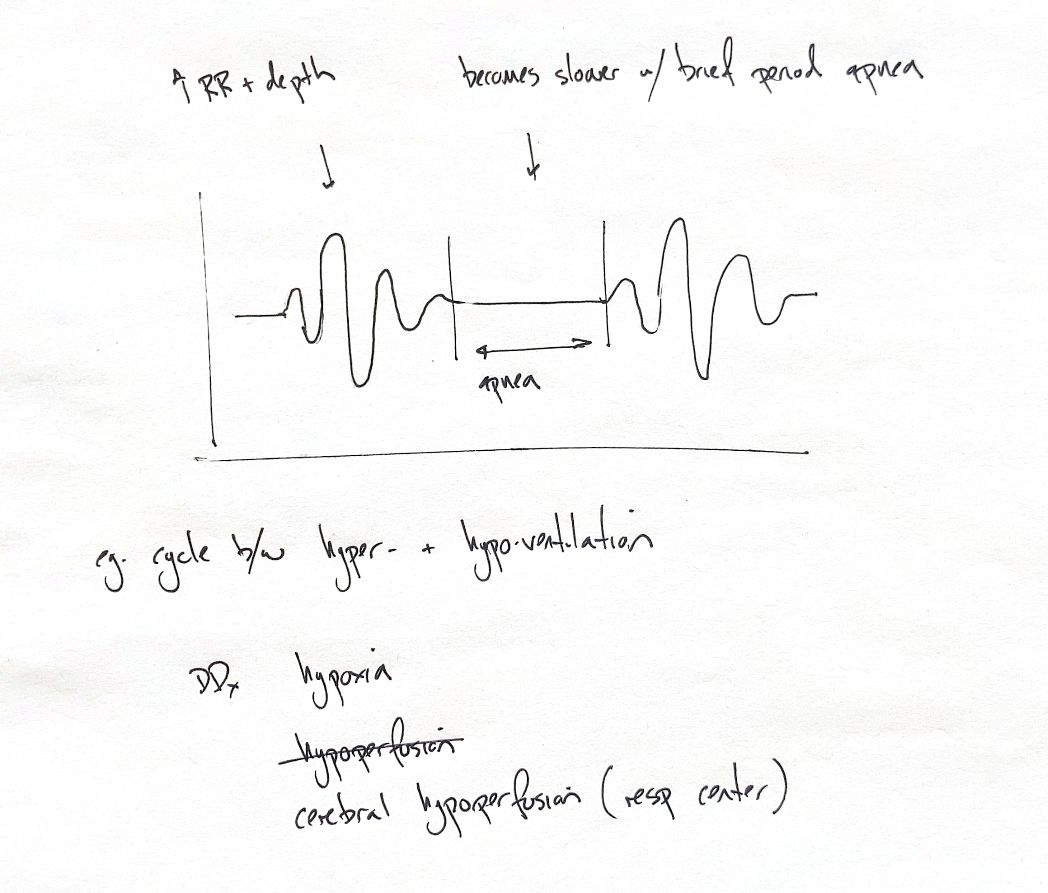
Cheyne–Stokes breathing is a repeating pattern. Breaths grow deeper, then become shallower and may slow before a pause. The cycle then starts again. Apnoea means a period with no breathing.
My drawing labels the rising phase with increased respiratory rate and depth. It calls the cycle hyperventilation and hypoventilation. The trace is a memory sketch of breathing excursions. Its height and spacing are not calibrated, and it does not measure PaCO2 or alveolar ventilation.
The source differential cues are hypoxia and cerebral hypoperfusion affecting the respiratory centre. These are possible contributors, not diagnoses that the pattern proves. Experimental animal studies show that changes in breathing control and circulatory delay can produce periodic breathing. They do not make this pattern specific for one cause in a clinical patient.
The book includes Cheyne–Stokes respiration among abnormal patterns to assess when monitoring neurological patients. Interpret it with oxygenation, ventilation, circulation and the rest of the examination.
References
Johnston & Tobias, 2nd ed., Chapter 35; Basic Oscillating Mechanism of Cheyne-Stokes Breathing, 1956, publisher abstract; Cherniack et al. 1979, complete indexed abstract.