
Alveolar–arterial oxygen gradient
Read the draft explanation
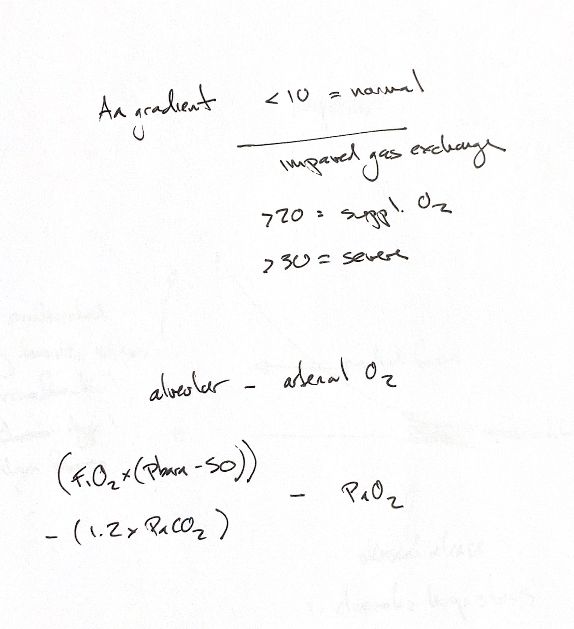
The A–a gradient compares calculated ideal alveolar oxygen pressure, PAO2, with measured arterial oxygen pressure, PaO2. Calculate the alveolar estimate first, then subtract PaO2. A larger gap supports impaired gas exchange. It does not identify one disease by itself.
The book’s approximation is:
A–a = [FiO2 × (Pbar − 47) − (1.2 × PaCO2)] − PaO2.
Use mmHg for every pressure. FiO2 is a fraction: room air is 0.21. Pbar is barometric pressure. PaCO2 and PaO2 come from arterial blood measurements.
My original drawing uses 50 where the book uses 47 for water vapour pressure. Both are shown with their source identified. Keep the calculation assumptions clear instead of treating the two written equations as identical.
The room-air study cues are below 10 mmHg for normal, above 20 for the book’s recommendation to add oxygen, and above 30 for severe gas-exchange impairment. These are source teaching cues, not universal cutoffs or a treatment decision on their own. They should not be carried over unchanged when the patient is receiving supplemental oxygen. Reference values vary with population and method. Interpret the gradient with the patient, inspired oxygen and measurement conditions.
References
Johnston & Tobias, 2nd ed., Chapter 103; Haskins et al. 2005, complete indexed abstract; Holopainen et al. 2022, selected methods and Table 2.