
Arterial pressure and organ perfusion
Read the draft explanation
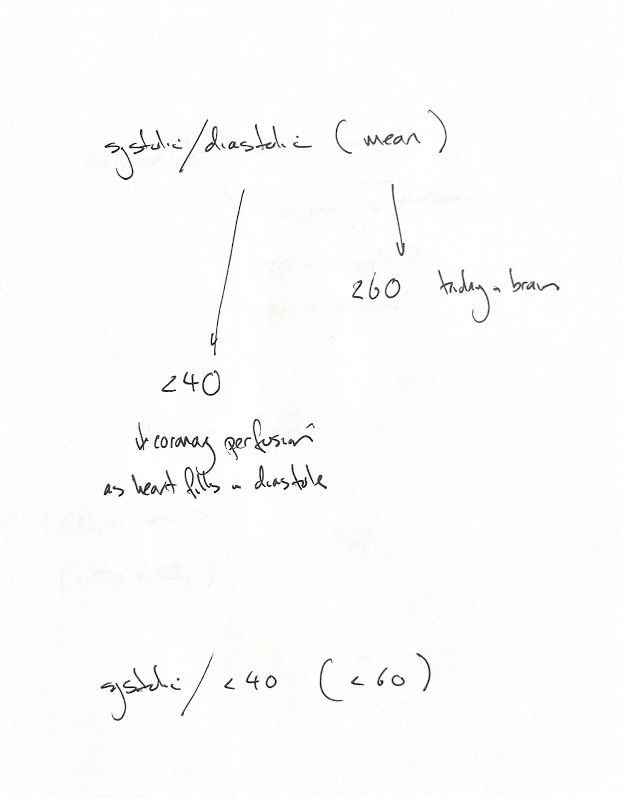
My shorthand is systolic / diastolic (mean), with pressure in mmHg. This drawing focuses on two warning cues. It does not give a systolic cutoff.
A diastolic pressure below 40 mmHg may mean poor coronary perfusion. The heart fills during diastole. Coronary flow to the left ventricle also occurs mainly during diastole. Those are related ideas, but ventricular filling and coronary blood flow are different processes.
A mean arterial pressure below 60 mmHg raises concern about kidney and brain perfusion. Prolonged hypotension can contribute to cerebral or renal ischaemia and acute kidney injury. Poor coronary perfusion can cause myocardial ischaemia.
These numbers are warning cues, not points where injury suddenly starts in every patient. The book uses the 60 mmHg mean-pressure cue. AAHA’s 2020 guidance describes hypotension at a mean pressure below 60–70 mmHg. Duration, the patient’s condition and the quality of the measurement all matter. Coronary pressure studies also show that heart rate and physiological setting change the response.
References
Johnston & Tobias, 2nd ed., Chapter 21; AAHA Anesthesia and Monitoring Guidelines 2020, hypotension section; Farhi et al. 1989; Canty et al. 1990. Primary papers were checked through their available indexed abstracts.