
Local anaesthetics: actions, timing, toxicity and epinephrine
Read the draft explanation
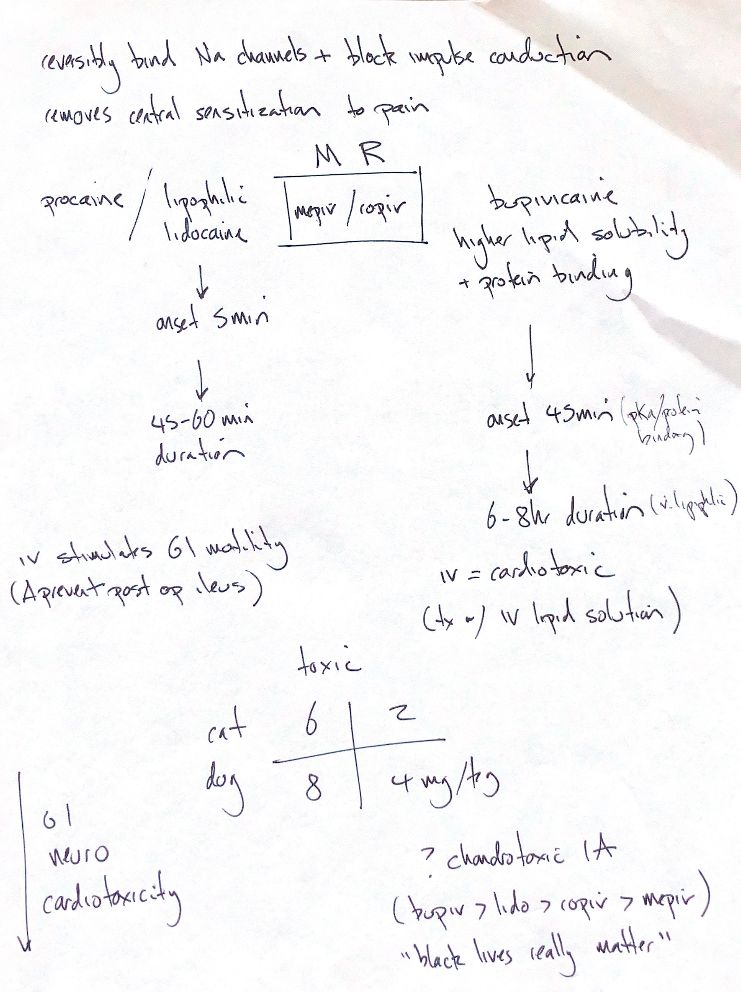
Local anaesthetics reversibly block fast sodium channels and nerve conduction. Reducing nociceptive input can limit central sensitisation; it does not guarantee reversal once sensitisation is established.
Lipid solubility, protein binding, pKa and local blood flow affect the response. The book gives lidocaine an onset within 5 minutes after subcutaneous injection and a 45–60-minute duration. Bupivacaine may take up to 45 minutes after subcutaneous or epidural injection and last up to 6–8 hours. These are context-dependent summaries. My M/R box names mepivacaine and ropivacaine, without giving them identical times. The timing figures belong to lidocaine, rather than the neighbouring procaine label.
IV lidocaine may aid gut transit. A healthy-dog experiment found mildly faster transit but unchanged gastric emptying; this does not prove prevention of postoperative ileus. IV bupivacaine is highly cardiotoxic. Lipid emulsion may assist resuscitation, without guaranteeing recovery.
The toxicity table preserves historical source/book cautions, not administered doses or safe ceilings. Feline lidocaine is 6 mg/kg in the chapter text but 4 mg/kg in Table 22.2. Route, injection speed, absorption and patient factors matter. The GI→neurologic→cardiac progression is not guaranteed in every case.
“Black lives really matter” recalls my bupivacaine→lidocaine→ropivacaine→mepivacaine chondrotoxicity order. It is not a fixed clinical ranking. Human experiments found mepivacaine more toxic than ropivacaine; concentration, exposure time and tissue condition change the result.
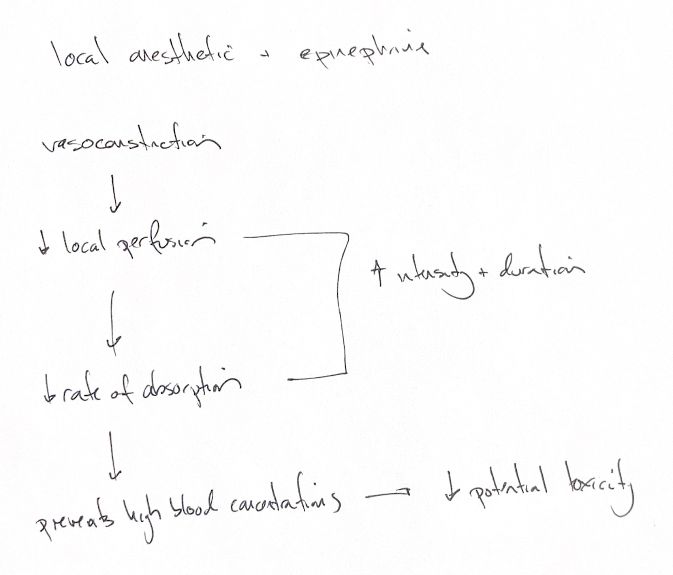
Epinephrine causes vasoconstriction and slows absorption. This can lower peak blood concentrations and strengthen and prolong block effects. In a dog study, motor effects lasted longer but sensory-block duration did not differ significantly. Toxicity remains possible.
References
Johnston & Tobias, 2nd ed., Ch21/22; Breu2013; Johnson2017; Choquette2017; Weinberg2003.