
Neuromuscular blockade and reversal
Read the draft explanation
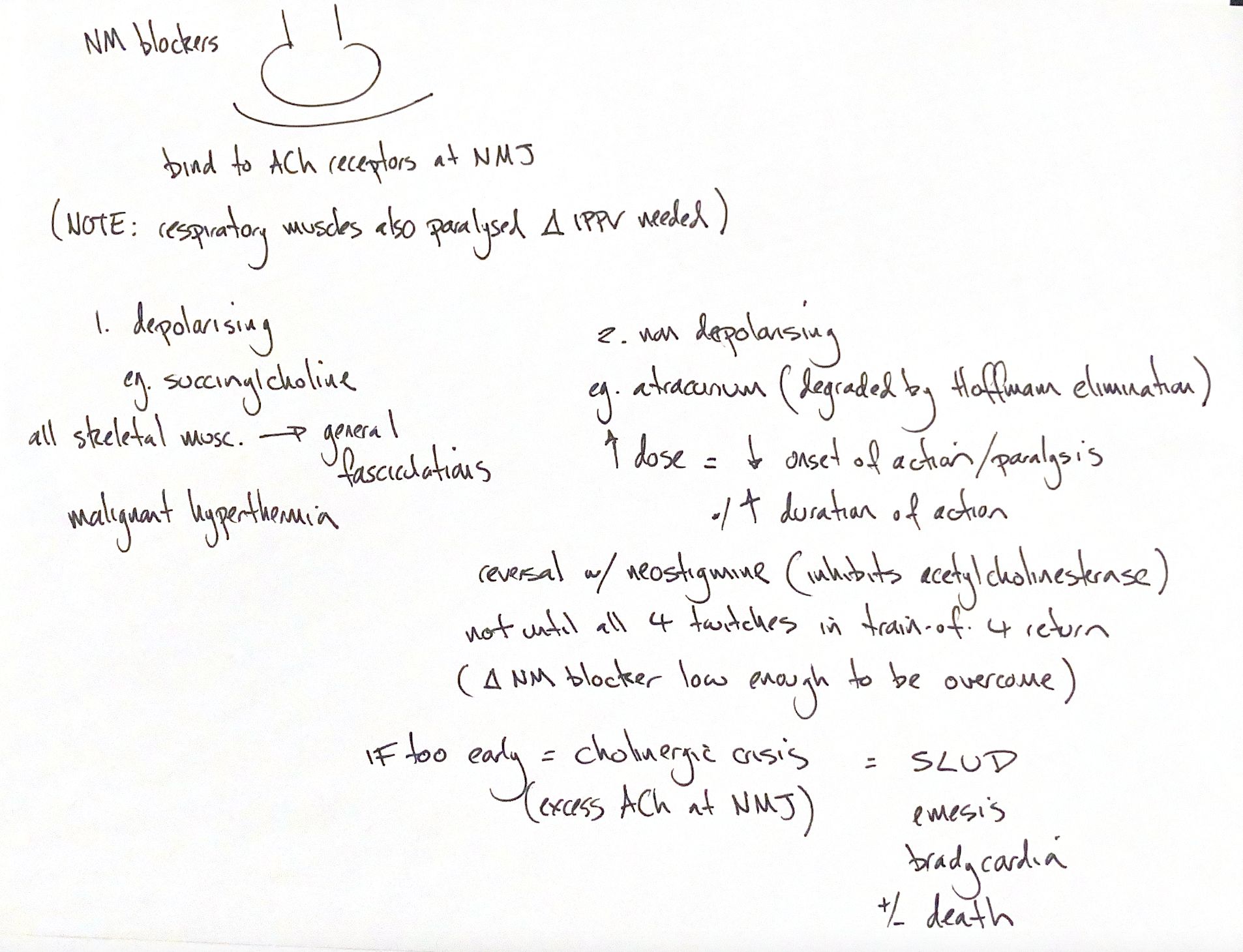
Neuromuscular blockers act at nicotinic acetylcholine receptors on skeletal muscle. They also paralyse respiratory muscles, so ventilation must be supported. Paralysis does not provide unconsciousness or analgesia.
Succinylcholine mimics acetylcholine. Initial depolarisation can cause generalised fasciculations before transmission is blocked. It can trigger malignant hyperthermia in susceptible patients. Atracurium instead competes with acetylcholine without activating the receptor.
Atracurium undergoes Hofmann elimination, a nonenzymatic reaction that depends on pH and temperature. Ester hydrolysis also contributes. Higher doses can act sooner and last longer, but the pattern varies with the drug and anaesthetic conditions.
Neostigmine inhibits acetylcholinesterase. More acetylcholine remains to compete with a nondepolarising blocker. It can prolong succinylcholine Phase I block instead of reversing it.
My note and the book say to wait for all four train-of-four twitches. An eight-dog isoflurane/vecuronium study also tested reversal at two twitches. Waiting for four shortened the time after neostigmine but did not shorten total blockade time. Four visible twitches alone do not prove full recovery. Block depth and quantitative monitoring matter.
The “too early” warning recalls inadequate reversal and cholinergic excess; timing alone does not define a cholinergic crisis. Excess acetylcholine affects muscarinic sites as well as the NMJ. SLUD recalls salivation, lacrimation, urination and defecation/diarrhoea. Emesis, bradycardia and severe weakness can occur, with possible respiratory failure and death. Atropine or glycopyrrolate limits muscarinic effects; it does not reverse skeletal-muscle blockade.
References
Johnston & Tobias, 2nd ed., Ch21; Lorenzutti2014; Kastrup2005; official drug labels.