
Alfaxalone and etomidate
Read the draft explanation
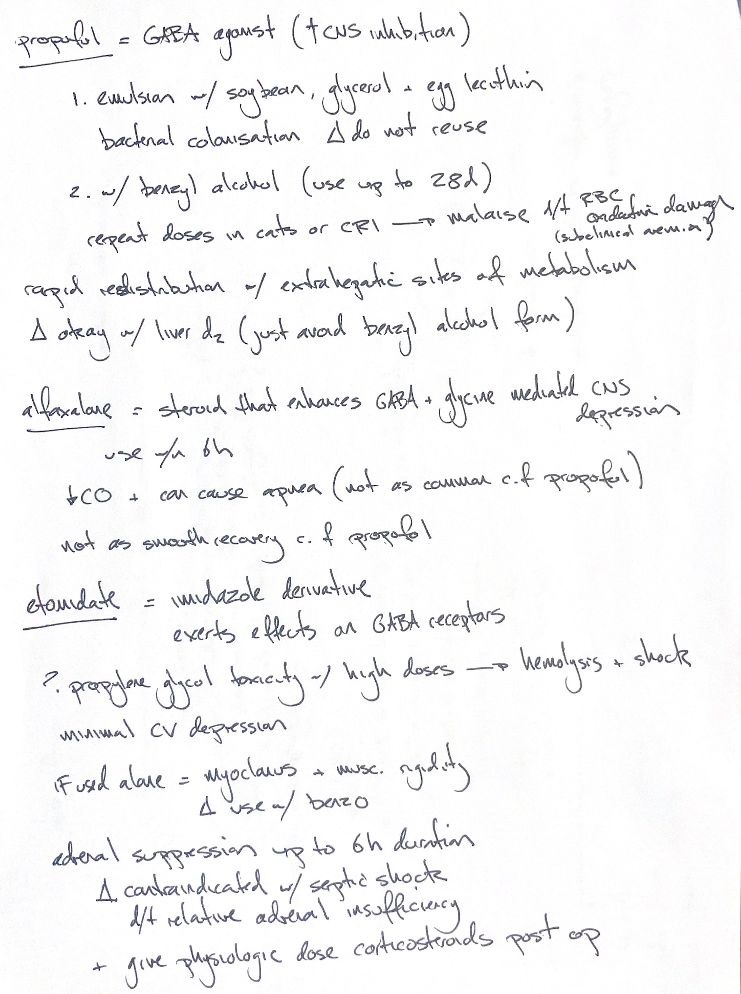
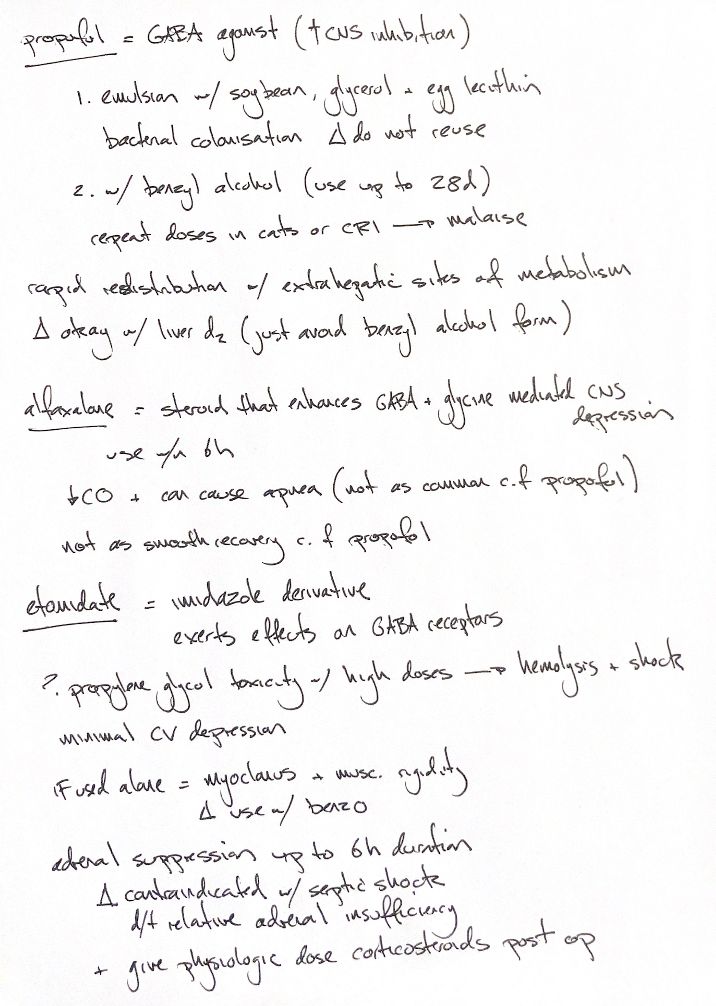
Alfaxalone is a steroid anaesthetic that enhances GABA_A-mediated inhibition. My source also names glycine. Recombinant-receptor work found glycine effects at much higher concentrations, so the two pathways should not be treated as equally established clinical mechanisms in dogs and cats.
The source and textbook give a 6-hour opened-storage limit. That is a historical formulation cue. Preserved multidose products have different labels, so this is not a universal limit for all alfaxalone.
Alfaxalone can depress cardiac output and cause apnoea. The source says apnoea is less common and recovery less smooth than with propofol. These comparisons depend on the protocol. One feline trial found less assisted ventilation with alfaxalone, but equal apnoea counts. A dog trial found longer recovery and more adverse events, while overall recovery scores did not differ.
Etomidate is an imidazole derivative acting at GABA_A receptors. It usually causes little cardiovascular depression. Given alone, it can cause myoclonus and rigidity; the source's benzodiazepine cue relates to those effects.
High-exposure propylene-glycol formulations have been associated with haemolysis and toxicity. “Shock” is source/book wording. This is not a universal toxicity threshold for the etomidate molecule.
The textbook's up-to-6-hour adrenal cue is a single-induction summary. Primary dog and cat experiments show suppression lasting several hours, not guaranteed recovery by 6 hours. The source/book advises avoiding etomidate in septic shock because of relative adrenal insufficiency. Its postoperative physiologic-steroid advice is historical and context dependent. Human evidence does not establish automatic supplementation for every dog or cat.
References
Johnston & Tobias, 2nd ed., Ch21; Alfaxan US label; Weir2004; Maney2013; Campagna2015; Dodam1990; Moon1994/1997; Cuthbertson2009.