
Peripheral and central sensitisation
Read the draft explanation
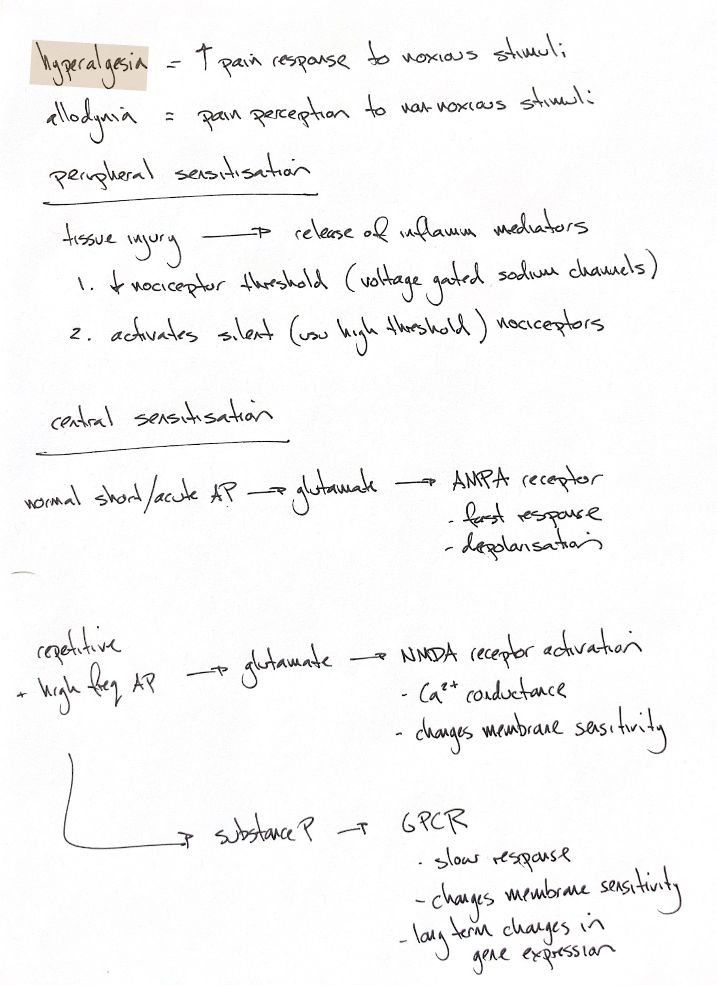
Hyperalgesia means more pain from a stimulus that normally hurts. Allodynia means pain from input that would normally be nonpainful. These terms describe what happens. They do not, on their own, tell us whether the change is peripheral or central.
After tissue injury, inflammatory mediators can make peripheral nociceptors more responsive and lower their activation threshold. Changes in voltage-gated sodium channels are one part of this process. Some previously silent nociceptors can also become responsive during inflammation. Silent and high-threshold do not mean the same thing: a high-threshold nociceptor can already respond to a strong enough stimulus.
Brief action-potential input leads to glutamate signalling, and AMPA receptors support fast depolarisation. With repeated input, depolarisation can also recruit NMDA receptor signalling. Calcium entry helps activate intracellular pathways that change neuronal responsiveness. AMPA and NMDA signalling can act together; this is not a simple switch between two separate systems.
Substance P also acts through neurokinin receptors such as NK1, a G protein-coupled receptor, and can produce slower, prolonged excitation. These signalling pathways can also contribute to longer-term changes in gene expression. Direct substance P–linked transcription has been demonstrated in neonatal rat spinal-cell cultures; it is not a fixed outcome or time course for every dog or cat.
Central sensitisation means greater responsiveness within nociceptive CNS circuits. A fast AMPA response is part of normal transmission. By itself, it does not establish sensitisation.
References
Johnston & Tobias, 2nd ed.; IASP; Gold 1996; De Koninck & Henry 1991; Seybold 2006.