
Inhalant MAC and blood-gas solubility
Read the draft explanation
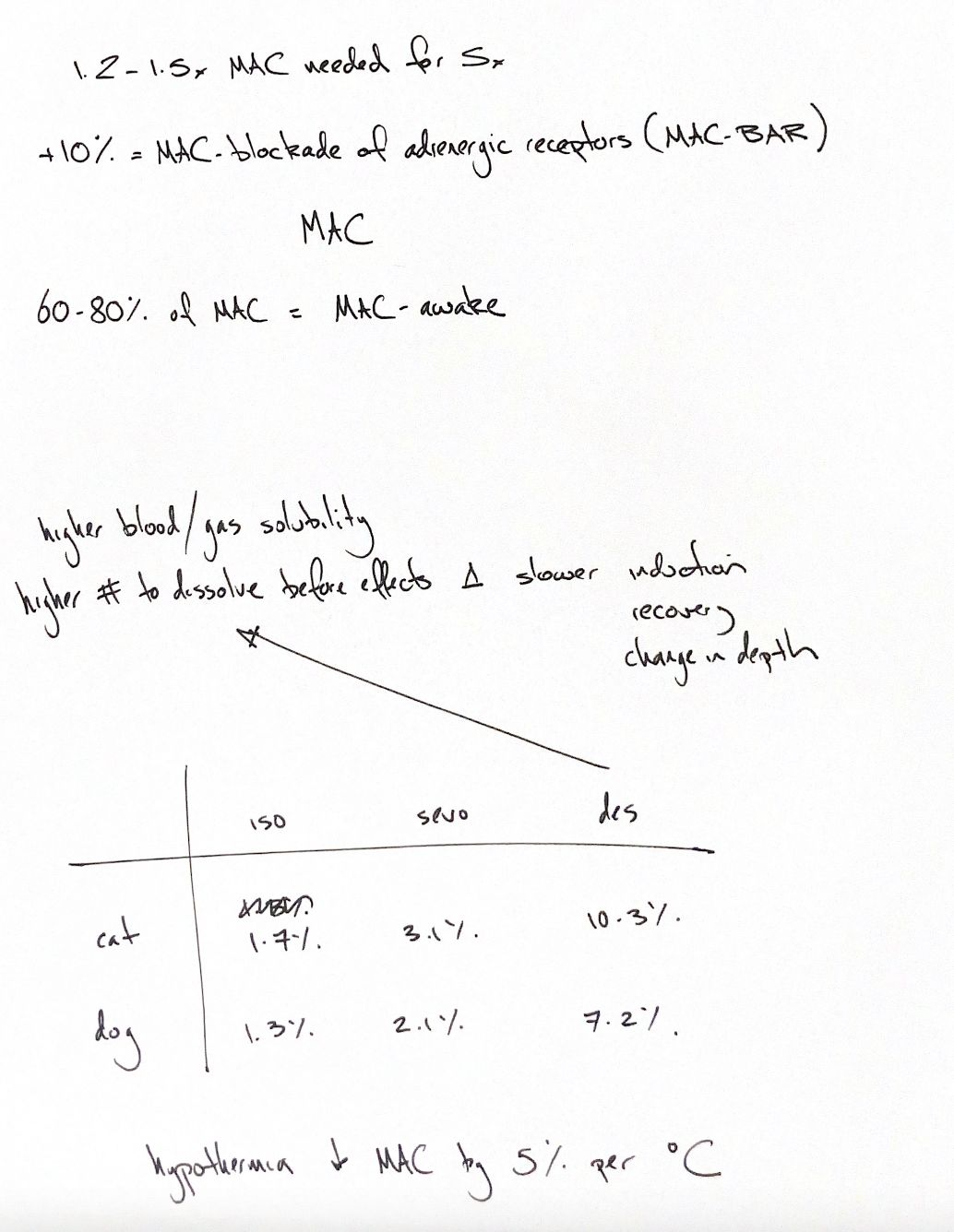
MAC means minimum alveolar concentration. At equilibrium, it is the end-tidal concentration that prevents purposeful movement to a standard noxious stimulus in 50% of a test group. It measures potency, not awareness or pain control by itself. Lower MAC means greater potency.
My source gives 1.2–1.5 × MAC as a usual surgical cue. It is not a fixed dose or a guarantee for every patient. Other drugs, temperature, disease and the stimulus change the requirement. Titrate and monitor.
MAC-awake uses return of consciousness as its endpoint. The 60–80% of MAC cue comes from dogs given isoflurane or sevoflurane, not a universal awakening threshold.
MAC-BAR means blunting the adrenergic response to stimulation, not blocking adrenergic receptors. The book's “10% higher” cue concerns cats with isoflurane. The ratio varies with agent, species and method. No movement alone does not exclude autonomic or cortical responses.
The source/book MAC table, in volume %, is:
Cat: isoflurane 1.7; sevoflurane 3.1; desflurane 10.3.
Dog: isoflurane 1.3; sevoflurane 2.1; desflurane 7.2.
These are reference values. The cited cat desflurane study instead reports 9.79 ± 0.70% in eight cats. That source conflict stays explicit; protocols and individuals vary.
The solubility arrow points from desflurane towards isoflurane. Higher blood-gas solubility means more agent dissolves at the same partial pressure. This slows the rise in effective partial pressure, and usually slows induction, changes in depth and washout. Ventilation, circulation and tissue uptake also matter. Solubility and MAC describe different things.
My hypothermia cue is MAC falling about 5% per °C drop. The book says “in people,” but its cited study used rats. Keep this as a qualified recall cue, not a dog or cat dose formula.
References
Johnston & Tobias, 2nd ed., Ch21/Table21.3; cited primary studies.