
Rebreathing and non-rebreathing circuits
Read the draft explanation
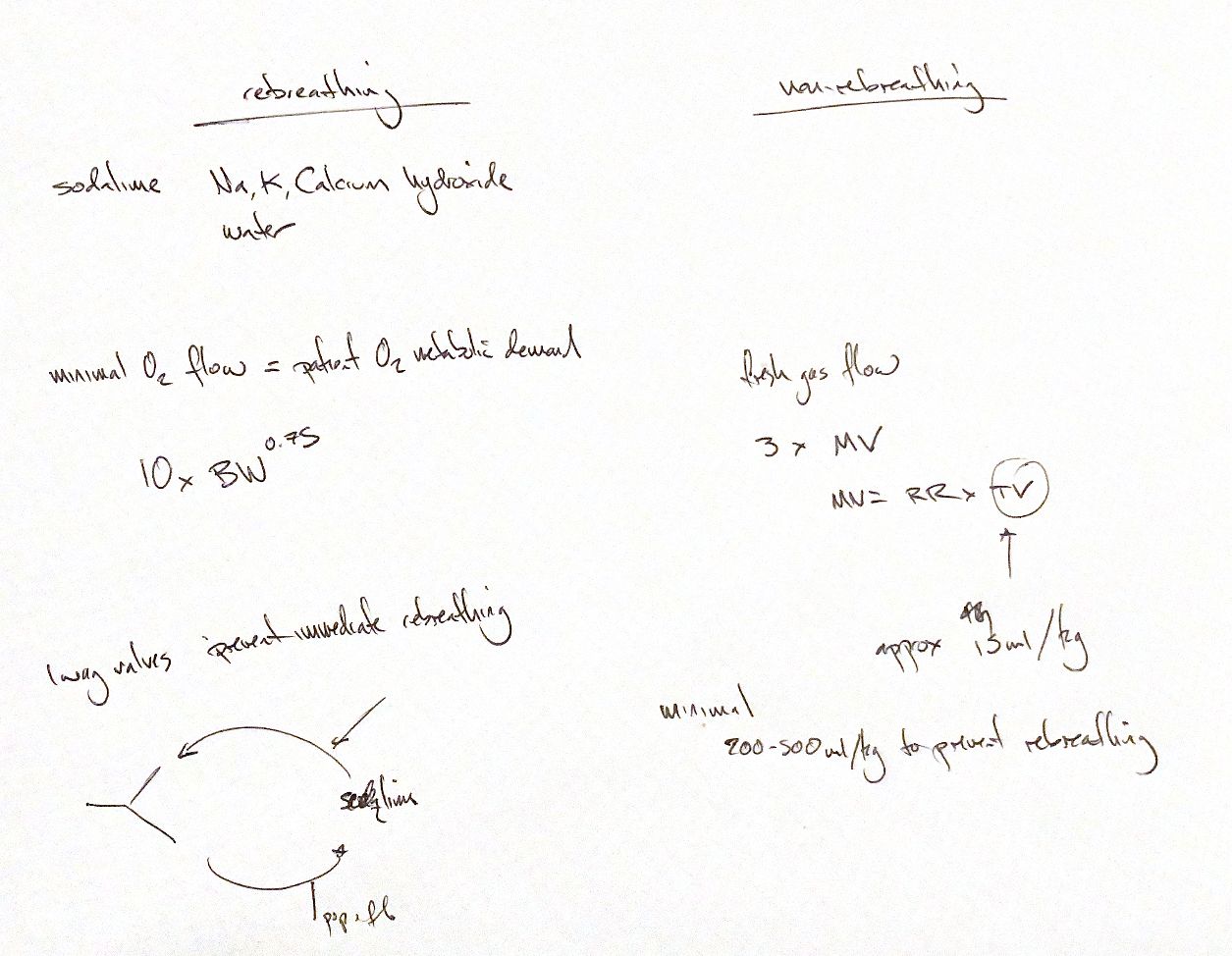
A circle system reuses exhaled gas after removing CO₂. One-way valves keep gas moving around the loop and prevent expired gas taking a shortcut back to the patient. The absorber removes the CO₂. The pop-off, or adjustable pressure-limiting valve, provides an escape route for excess gas.
Traditional soda lime contains calcium hydroxide, sodium hydroxide, potassium hydroxide and water. Moist granules absorb CO₂ and generate heat and water. Formulations differ; some modern soda limes contain no potassium hydroxide. Valves and absorbent do different jobs, so one cannot replace the other.
The metabolic oxygen estimate is approximately 10 × body weight in kg raised to 0.75, giving mL O₂/min. This is a textbook estimate of oxygen consumption, not a complete fresh-gas flow setting. Circuit leaks, gas sampling, system wash-in and equipment limits also matter.
Non-rebreathing systems here use high fresh-gas flow to wash expired CO₂ out rather than relying on an absorber. The study rule is at least 3 × minute volume. Minute volume is respiratory rate × tidal volume. The 15 mL/kg tidal volume is an estimate used in that calculation, not a prescribed ventilator setting.
A circuit’s minimum washout flow depends on its design and breathing pattern. The study-note range is 200–500 mL/kg/min. These are flow-rate units, so “per minute” matters. AAHA's 2020 guidance gives approximately 200–400 mL/kg/min for non-rebreathing circuits. Inspired CO₂ monitoring checks washout. If fresh-gas flow is too low, expired CO₂ can still be rebreathed.
References
Johnston & Tobias, 2nd ed., Ch21; Borland et al. 2019; Elzahaby et al. 2026; AAHA 2020 anesthesia guidelines; Intersurgical absorbents.