
Vaporiser mechanisms and calibration
Read the draft explanation
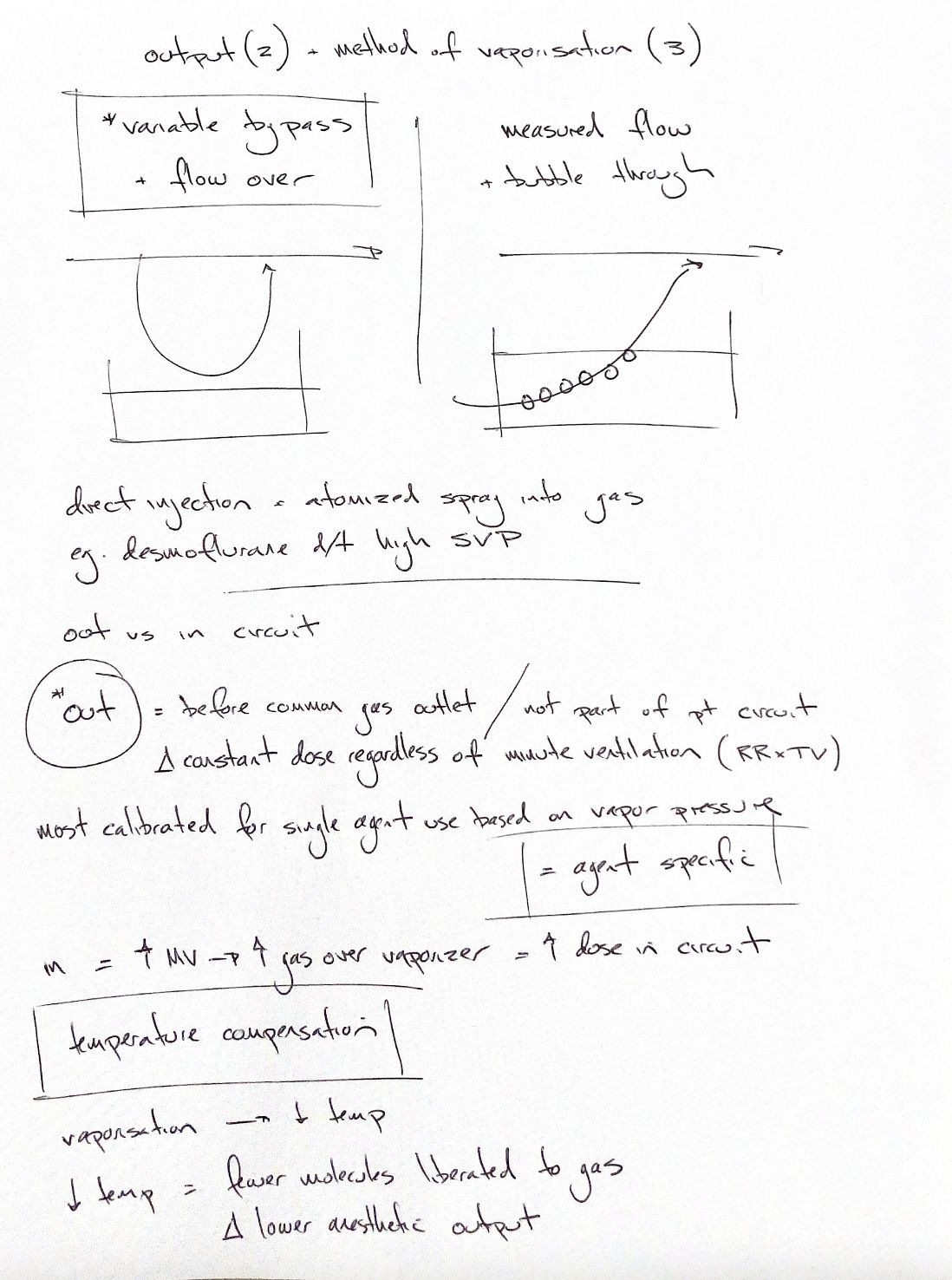
Output control and vaporisation method describe different things. Variable bypass splits fresh gas between a bypass and a vaporising chamber, then recombines the flows. Flow-over describes gas passing over liquid agent. A measured-flow system instead sets the vaporising and diluent flows separately. Bubble-through describes gas bubbling through the liquid.
Direct liquid injection adds a spray that then vaporises. Desflurane needs a separate qualification. Its high saturated vapour pressure needs a suitable delivery system. The Tec 6 heats desflurane and blends its vapour with fresh gas; it does not spray liquid into that gas stream.
An out-of-circuit vaporiser sits before the common gas outlet. Its fresh-gas output does not depend directly on the patient's minute ventilation. That means steady output under the stated conditions, not a fixed absorbed patient dose. With an in-circuit vaporiser, increased minute ventilation can carry more gas over the agent and increase the amount entering the circuit. Minute ventilation is respiratory rate × tidal volume.
Most precision vaporizers are agent specific because calibration depends on the agent's vapour pressure. Concentration, often shown in vol%, is different from partial pressure. Pressure effects depend on the device. D-Vapor keeps its vol% calibration as ambient pressure changes, while the delivered partial pressure changes.
Vaporisation cools the reservoir. Cooling reduces vapour pressure and can lower output. Temperature compensation counters this within the device's specified range. Carrier gas and flow also matter; calibration is not one universal set of conditions.
References
Johnston & Tobias, 2nd ed., Ch21; Andrews & Johnston 1993; Dräger D-Vapor/D-Vapor 3000 IFU, p111; GE Tec 6 Plus.