
Medical gases and pressure regulation
Read the draft explanation
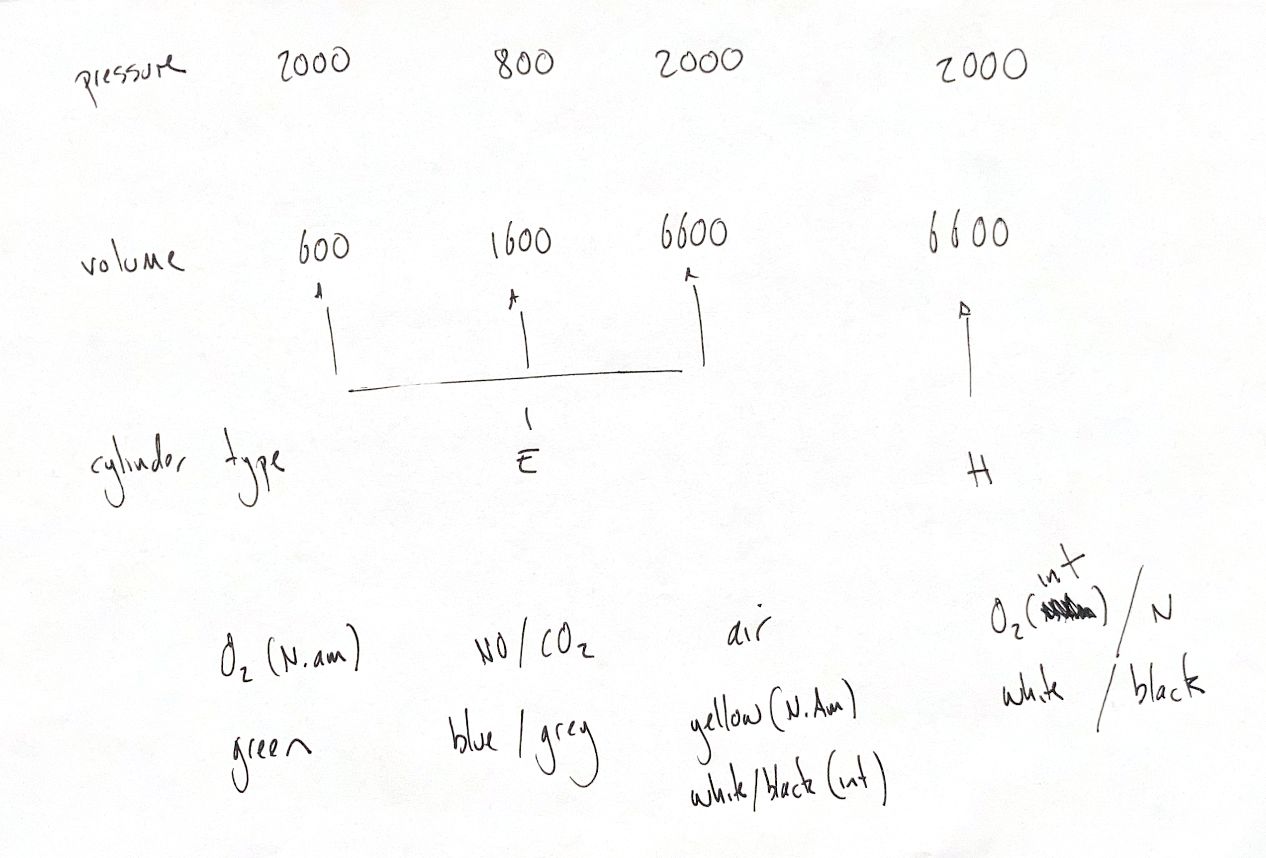
Pressure, gas content and colour answer different questions. The chart uses psi for full-cylinder pressure and litres for the gas available after release. That is not the cylinder's internal water volume. E and H are size cues; the exact fill and contents depend on the gas and product.
My rounded figures differ from Table 21.1. The shared 800 psi and 1600 L cue groups nitrous oxide and carbon dioxide, but the book separates their full pressures as 745 and 838 psi. Both book entries have 1590 L. Nitrous oxide is N₂O; NO means nitric oxide.
The air entry needs particular care. My drawing puts 6600 L under E, and the book also labels its 6550 L air entry E. Airgas's 2025 supplier example lists E medical air as 651 L, with a nominal pressure of 2015 psig at 70°F. The original size-and-volume pairing is uncertain, so it must not be used as a reliable E-cylinder capacity.
The colour cues are regional. The North American chart uses green for oxygen, yellow for air, blue for nitrous oxide, grey for carbon dioxide and black for nitrogen. The book's international oxygen cue is white, and air is white/black. European guidance applies gas colours to the shoulder of a white medical cylinder. Read the gas label; colour is a secondary check.
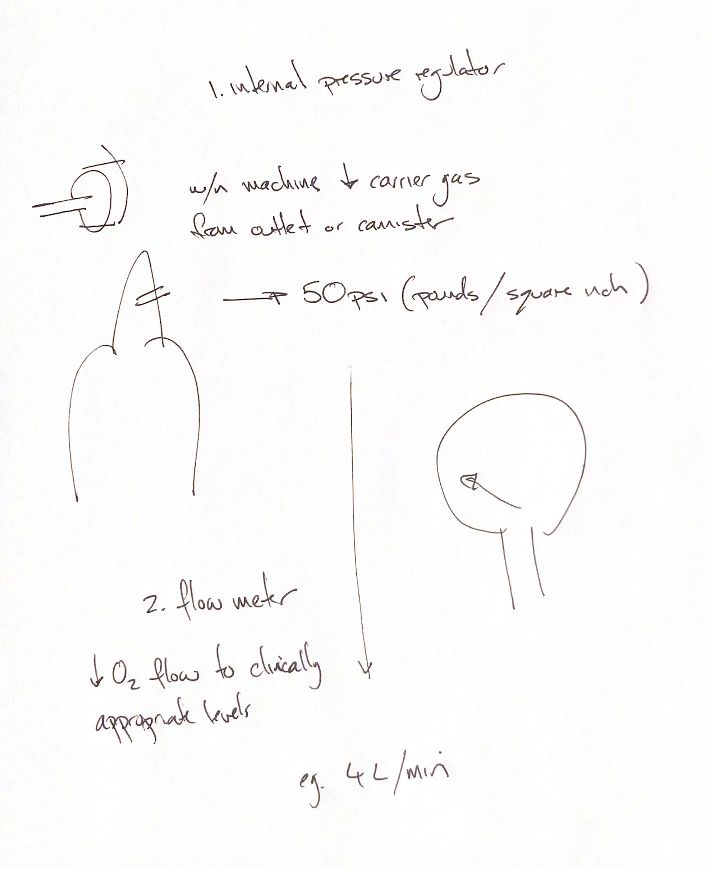
A regulator reduces high cylinder pressure to a working supply pressure. The note and book use about 50 psi, or pounds per square inch. The regulator's location and supply path depend on the machine; a wall supply may already be regulated.
The flowmeter then controls oxygen flow in L/min before gas reaches the vaporiser. The original 4 L/min is an example, not a patient setting or the upper limit of every flowmeter. Pressure and flow are separate controls.
References
Johnston & Tobias, 2nd ed., Table 21.1 and Ch21; Airgas Healthcare 2025; EIGA 177/20; Midmark equipment catalogue.