
Hypercalcaemia: HARDIONS G
Read the draft explanation
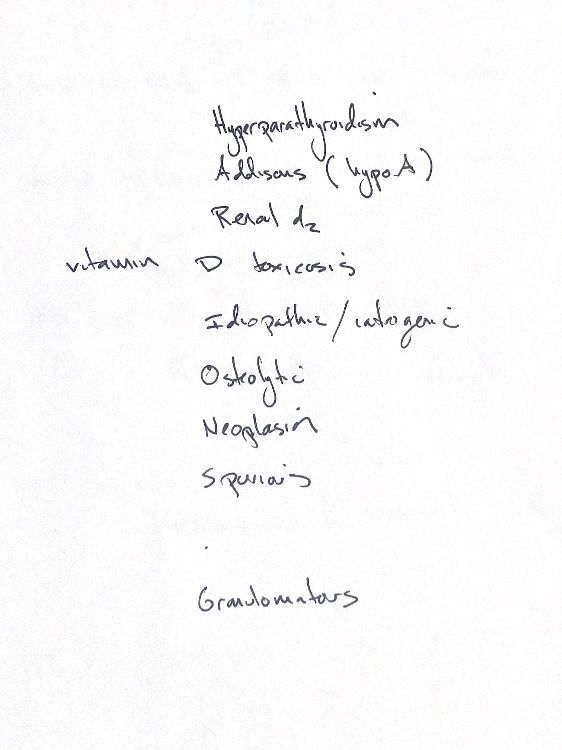
HARDIONS G is my recall list for causes of high calcium: Hyperparathyroidism, Addison’s disease, Renal disease, vitamin D toxicosis, Idiopathic or iatrogenic causes, Osteolytic disease, Neoplasia, Spurious results and Granulomatous disease. The order is a memory cue, not a ranking of how often each cause occurs.
For H, the main hypercalcaemic disorder is primary hyperparathyroidism. Secondary hyperparathyroidism does not automatically mean calcium is high. Addison’s disease means hypoadrenocorticism. Some affected dogs have high calcium, but the mechanism is not settled.
The two I words have different meanings. Idiopathic means no cause has been identified after considering other causes. Iatrogenic means related to treatment, such as excess calcium or vitamin D exposure.
Osteolytic disease involves bone destruction. It can overlap with neoplasia, and bone lysis does not always cause hypercalcaemia. Tumours may also raise calcium through circulating mediators rather than bone invasion. Some granulomatous diseases can increase active vitamin D production. These groups can overlap too.
Finally, total calcium and ionised calcium answer different questions. Total calcium includes protein-bound and anion-bound calcium. Ionised calcium is the biologically active part. A high total result does not reliably predict a high ionised result, especially with renal disease. Ionised calcium may be high, normal or low in renal patients, so renal disease should not automatically explain the finding.
Spurious results keep sample and analytical effects in the list. Haemoconcentration or increased protein binding may raise total calcium without raising ionised calcium. This mnemonic helps recall possible causes; it does not establish a diagnosis.
References
Johnston & Tobias, 2nd ed., Ch5 and Ch121; Cornell eClinpath, Calcium and Free ionized calcium; Hall et al. 2023; Coady et al. 2019.