
Factors affecting GI healing
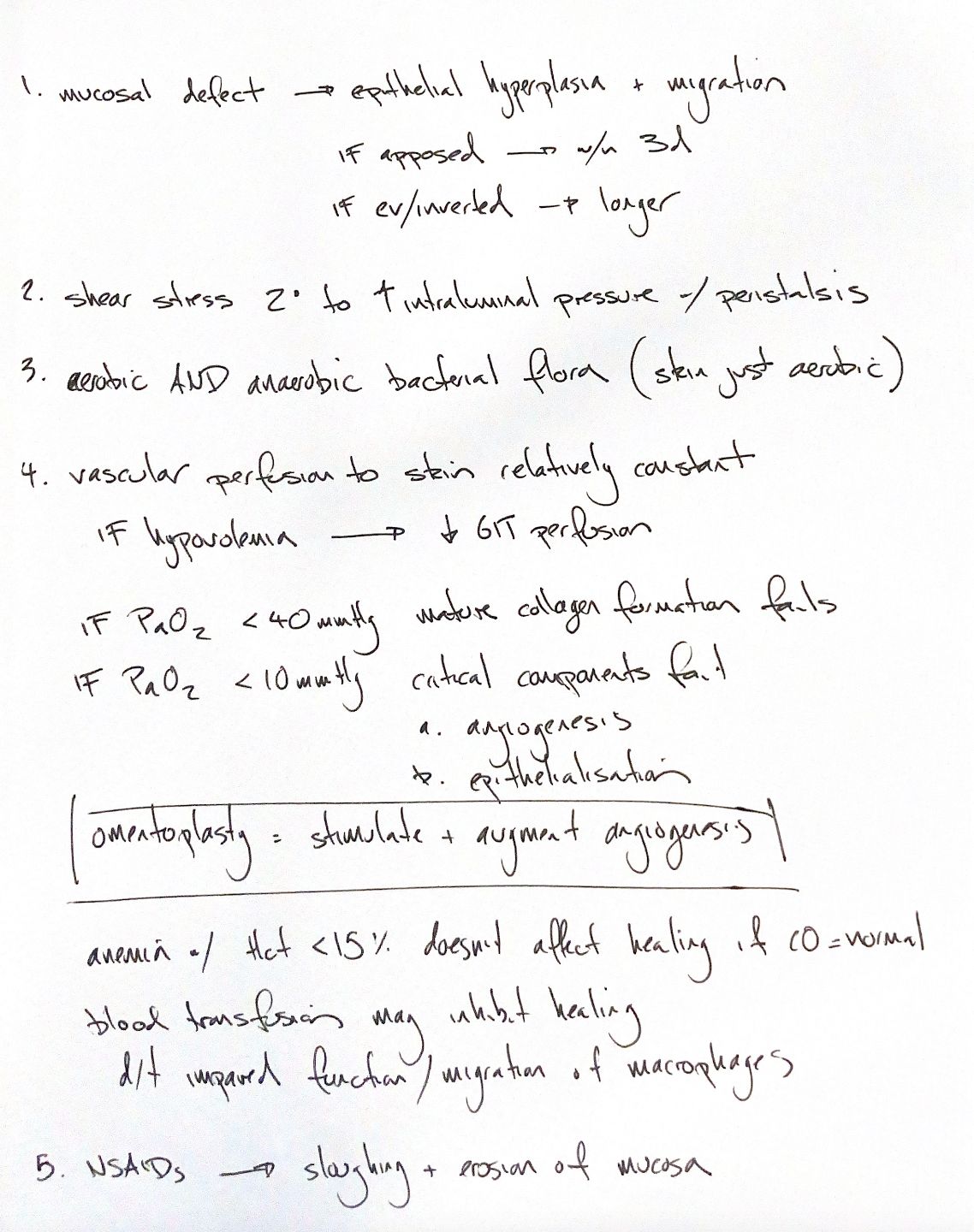
Read the draft explanation
A mucosal defect heals through enterocyte migration and proliferation. With direct apposition, its barrier can seal within 3 days. Inversion or eversion takes longer. This is mucosal closure, not full-wall strength. Peristalsis raises intraluminal pressure and shear stress.
Gut flora includes aerobic and anaerobic organisms; skin flora is largely aerobic. The book compares relatively steady skin perfusion with gut blood flow that can fall in hypovolaemic shock. Skin can also become underperfused.
My note/book links PaO₂ <40 mmHg with failed mature collagen formation, and <10 mmHg with failed angiogenesis and epithelialisation. These are historical recall cues, not validated clinical cutoffs. PaO₂ is arterial oxygen tension; local wound PO₂ is a different measurement. The exact primary basis for these labels and cutoffs was not verified.
Omentoplasty aims to stimulate angiogenesis. That rationale does not guarantee protection from leakage.
My Hct <15%/normal cardiac output cue is too broad. Book wording differs, and normovolaemic experiments do not set a safe haematocrit for every patient. Acute anaemia impaired intestinal repair in a rabbit study.
Transfusion may impair repair in experimental studies. Altered macrophage function or migration is a proposed mechanism. This is not a reason to withhold needed blood.
The NSAID cue needs its study context: carprofen at 400 µg/mL caused sloughing and erosion in isolated colonic tissue from 13 dogs in Ussing chambers. That is an ex vivo barrier study, not proof of failure with every NSAID at clinical doses.
References
Johnston & Tobias, 2nd ed., Ch9/93; Briere 2008; Buchmiller-Crair 2001; Tadros 1992.