
Fibrinolysis, inhibitors and greyhound postoperative bleeding
Read the draft explanation
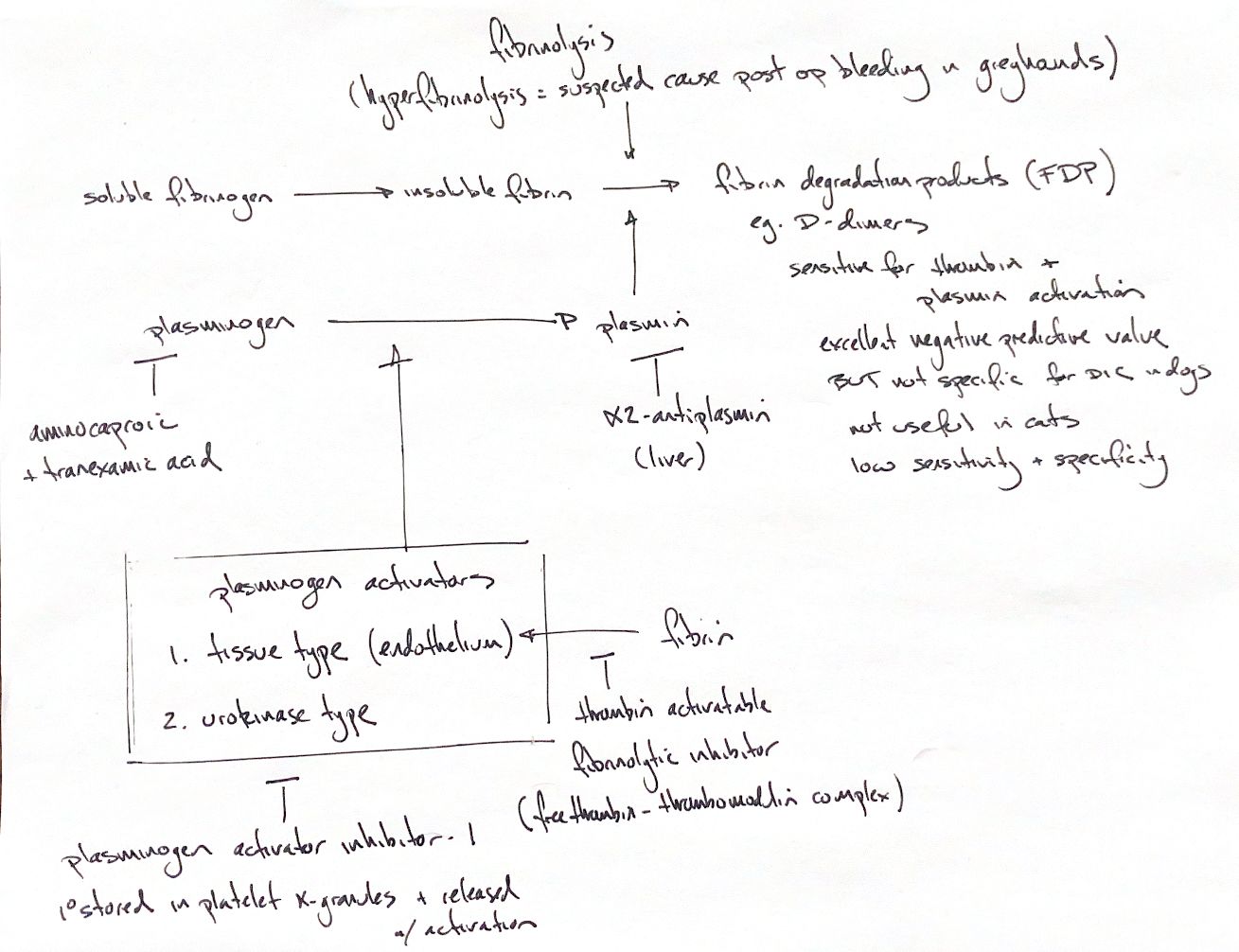
A clot must form, then be cleared. Thrombin turns soluble fibrinogen into fibrin. Plasminogen activators turn plasminogen into plasmin. Plasmin then cuts fibrin into fibrin degradation products, or FDPs.
The two activators are tissue-type plasminogen activator (tPA), released by endothelium, and urokinase-type plasminogen activator (uPA). Fibrin helps tPA activate plasminogen on the clot.
Three brakes limit this process. Plasminogen activator inhibitor-1 (PAI-1) inhibits both activators. It is stored in platelet alpha-granules and released with activation. Liver-made alpha2-antiplasmin inhibits plasmin. The thrombin–thrombomodulin complex activates thrombin-activatable fibrinolysis inhibitor (TAFI). Activated TAFI reduces fibrin's cofactor effect. It is activated by that complex, rather than made from it.
Excess clot breakdown is a suspected cause of delayed postoperative bleeding in some Greyhounds. Epsilon-aminocaproic acid (EACA) and tranexamic acid are lysine analogues. They block plasminogen binding and efficient activation on fibrin. A randomized trial supports EACA for reducing delayed bleeding after gonadectomy in retired racing Greyhounds. That does not prove the mechanism in every dog or give the same clinical evidence for tranexamic acid.
D-dimer comes from cross-linked fibrin. It reflects clot formation and breakdown, linking the thrombin and plasmin sides of the map. The original “excellent negative predictive value” cue is conditional on the canine assay and clinical setting. A low result is not a universal rule-out, and a high result does not diagnose disseminated intravascular coagulation (DIC).
My original “not useful in cats” is too broad. Feline DIC accuracy was limited in a particular assay study. This does not make every D-dimer test useless in every cat.
References
Johnston/Tobias, 2nd ed., Ch. 7; Lara-García 2008; Marín 2012; Tholen 2009.