
Canine hepatocellular carcinoma:forms,resection and prognosis
Read the draft explanation
In dogs, hepatocellular carcinoma, or HCC, is the most common primary liver tumour. The usual 50–70% figure concerns primary nonhematopoietic hepatic tumours in selected series, not all liver masses. In cats, bile duct tumours are the most common primary hepatic neoplasms.
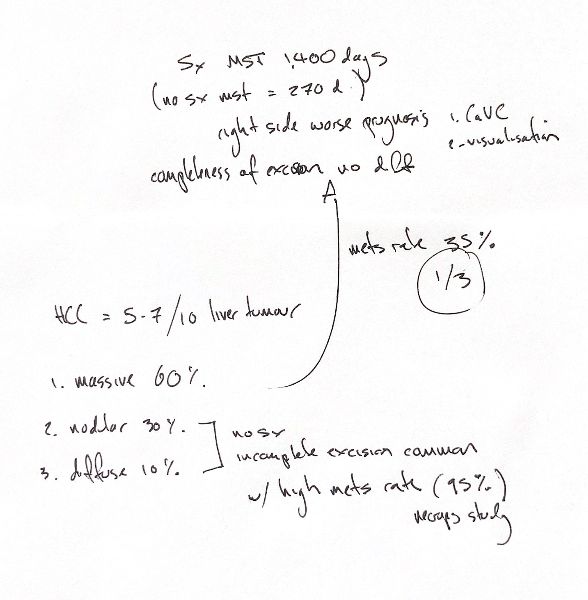
The three gross forms are massive, nodular and diffuse. The original 60/30/10 memory cue rounds the reported 61/29/10 distribution. Massive HCC forms a large mass in one lobe and may be resectable. Nodular and diffuse disease often spans several lobes, so complete excision is difficult.
The circled one-third cue belongs to the necropsy findings. The original 35% and 95% shorthand differs from the book's 36% for massive HCC and 93% for nodular or diffuse HCC. These are necropsy findings, not postoperative spread rates. The original “no surgery” cue means surgery is often unsuitable for nodular or diffuse disease, rather than a rule against every operation.
For massive HCC, a retrospective study compared 42 dogs treated with liver lobectomy with six managed conservatively. Median survival was not reached in the surgical group and exceeded 1,460 days, rather than the original 1,400-day shorthand. It was 270 days in the conservative group. Deaths from other causes were censored. Treatment was not randomly assigned.
Completeness of resection had no significant survival association in that cohort. Only four resections were incomplete, and follow-up varied, so this does not prove that margins never matter.
The right-side cues are CaVC and visualisation. The caudal vena cava lies close to the right liver and caudate lobe. Defining the mass–vessel relationship matters during dissection. Two dogs died after caval trauma. Right-sided tumours had poorer survival overall, but that difference disappeared when those intraoperative deaths were excluded. This points to operative risk rather than proving more aggressive right-lobe tumour biology.
References
Johnston/Tobias, Veterinary Surgery: Small Animal, 2nd ed., Ch. 95; Liptak et al., JAVMA 2004;225:1225–1230; Patnaik et al., Vet Pathol 1981;18:427–438.