
Biliary pathway and major/minor duodenal papillae
Read the draft explanation
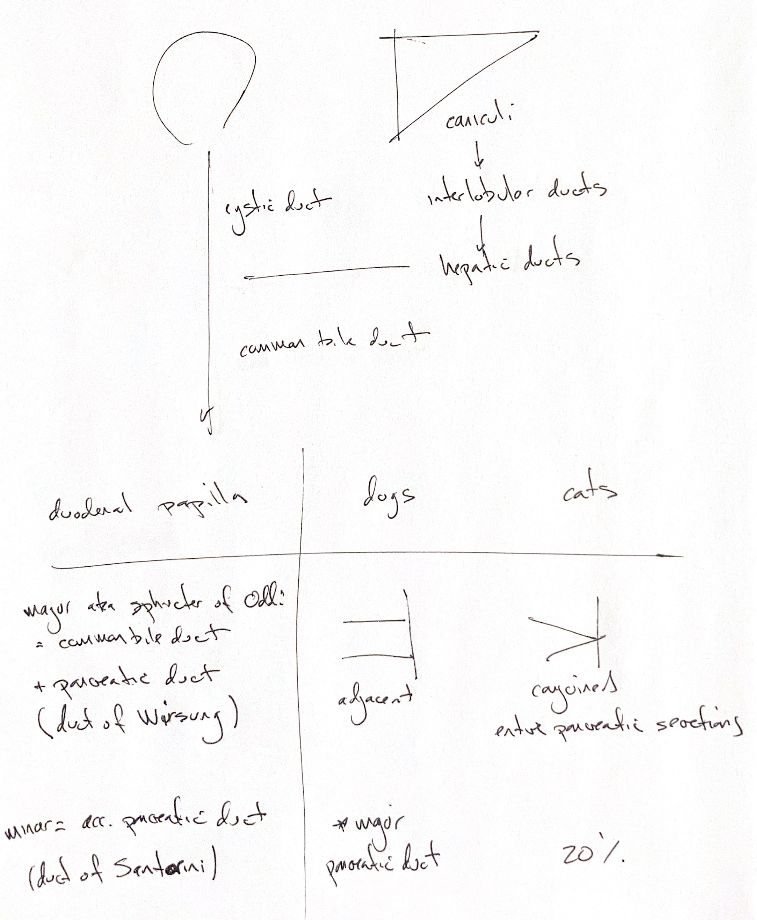
Bile starts in the liver. Tiny canaliculi between liver cells drain into interlobular ducts, then lobar and hepatic ducts. The gallbladder stores and concentrates bile. Bile travels to and from it through the cystic duct. Where the first hepatic duct joins the cystic duct, the common bile duct begins. It carries bile into the duodenum at the major duodenal papilla. A papilla is a small raised area around a duct opening.
The major papilla also receives the pancreatic duct, or duct of Wirsung. In dogs, its opening sits next to the bile duct opening. The two ducts are adjacent, rather than conjoined. In cats, they join before entering the duodenum. The sphincter of Oddi is the smooth-muscle apparatus controlling flow in this outlet region.
The minor papilla receives the accessory pancreatic duct, or duct of Santorini. In dogs this is normally the larger duct and the main route for pancreatic secretions. Here, “major” pancreatic drainage means the main flow route. It still opens at the minor papilla.
In cats, the textbook estimates that about 20% have an accessory pancreatic duct. That percentage refers to cats with the duct, not the fraction of pancreatic juice. When there is no accessory outlet, all exocrine pancreatic secretion uses the major-papilla route. Disease or surgery there can therefore affect the whole pancreatic outflow. Duct anatomy varies, and the drawings show a typical arrangement. The 20% is the textbook's anatomy estimate.
References
Johnston and Tobias, Veterinary Surgery: Small Animal, 2nd ed., chapters 95 and 97; Boyden 1957; Thune et al. 1990.