
Liver production,functional reserve,resection and coagulation cues
Read the draft explanation
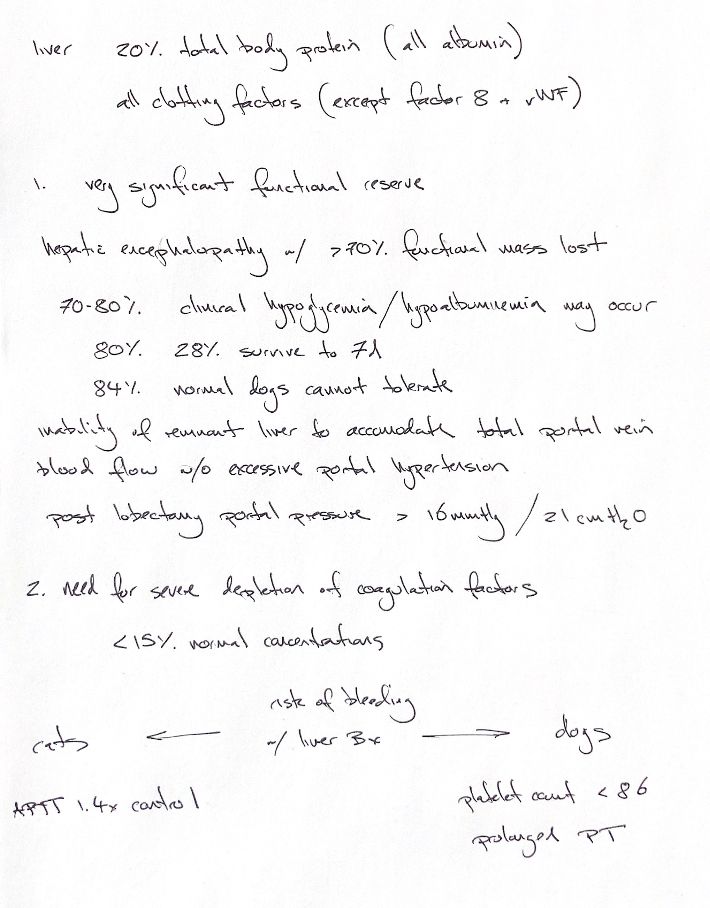
The liver accounts for about 20% of total body protein production, including all albumin. The main liver cells, called hepatocytes, make most clotting factors. The factor VIII/vWF exception concerns cell type: these proteins have endothelial sources, and factor VIII also comes from liver sinusoidal endothelium. vWF means von Willebrand factor.
There is a large functional reserve. The textbook associates hepatic encephalopathy with >70% function lost, and hypoglycemia or hypoalbuminemia with about 70–80% lost. These are approximate reserve cues. Portosystemic shunting can impair clearance without removing tissue. Functional loss is different from surgical volume removed.
In historical experiments in normal dogs, about 28% survived at least 7 days after 80% hepatectomy without portal decompression; the primary result was 28.6%. The supplied book reports 84% resection was not tolerated in its cited experiments. A small remnant may not accommodate total portal inflow without marked portal hypertension. Drawings are not to scale.
The book links poorer outcomes with portal pressure >16 mmHg, approximated as 21 cmH2O. The primary study split was 220 mm saline, about 22 cmH2O. Neither pressure value is a general clinical cutoff.
The original <15% of normal factor concentration for clinically detectable coagulopathy means >85% depletion. Another textbook chapter gives 65–80% factor loss before PT/aPTT prolongation. These differing summaries are not one universal bleeding threshold. A normal screen does not rule out hepatic disease.
The historical biopsy cues are cats with aPTT >1.4×control, and dogs with platelets <86,000/µL AND any PT prolongation. Exact cutoffs are the textbook summary; the primary abstract supports associations in abdominal-organ biopsy patients. Such tests do not reliably predict every bleeding event.
References
Johnston and Tobias, Veterinary Surgery: Small Animal, 2nd ed., chapters 7, 95 and 96; Mitsumoto et al. 1999; Bigge et al. 2001; Shahani et al. 2014.