
Splenic flow, reserve, RBC filtering and functional pools
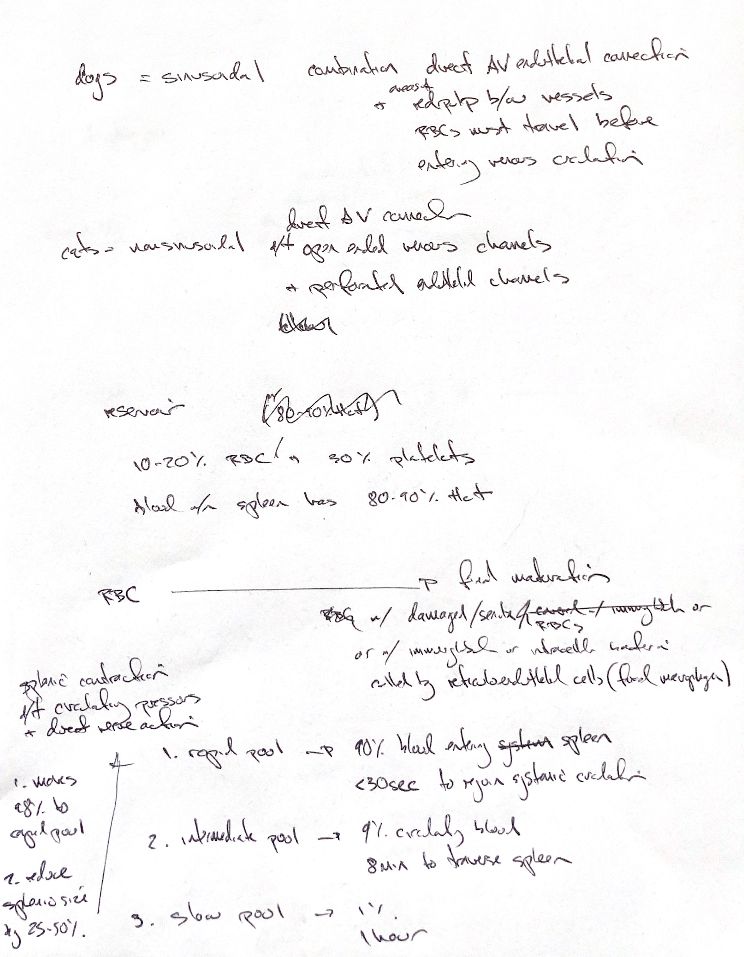
Read the draft explanation
The dog’s sinusoidal spleen has two routes. Blood can pass through a direct arteriovenous endothelial connection, or red cells can cross red pulp before entering a venous sinus.
The cat is nonsinusoidal. Its venules have open ends and wall openings. Here the source says few direct AV connections, and the book says direct connection. Primary cat microscopy instead found anatomically open circulation, with no direct AV connections observed. Fast functional flow does not prove a closed endothelial tube.
The textbook says a dog’s spleen can store 10–20% of its RBC mass and 30% of platelet mass. Blood sampled from splenic sinuses has an Hct of 80–90%. That is local blood, not peripheral Hct.
The spleen also helps finish RBC maturation after marrow production. It removes intracellular material, shapes the membrane into a disc and reduces cell size. Fixed macrophages, also called reticuloendothelial cells, cull damaged, senescent or inelastic RBCs. They also remove Ig-coated cells and cells with intracellular bacteria.
The classic pool description gives rapid flow as about 90% of blood entering the spleen, returning to systemic circulation in under 30 seconds. Intermediate flow is listed as 9% “of circulating blood” and 8 minutes; slow flow as 1% and 1 hour. The wording changes denominator. These are source recall figures, not proven body-blood fractions or three separate vascular sacs. Cat washout work also shows that a slow RBC component need not be a separate vascular space.
During physiologic demand, circulating pressors and direct nerve action contract splenic smooth muscle. The book says up to 98% of stored erythrocytes move into the rapid pool, and spleen size falls to 25–50% of normal. The original says by 25–50%, which means something different. These exact reservoir, pool and contraction figures remain textbook summaries; their primary quantitative basis was not traced.
References
Johnston/Tobias 2e, ch83; Blue & Weiss1981; Schmidt et al.1982/1983; Levesque & Groom1976.